
Water, air and residuesFood and drink
Acrolein: the irritating gas from overheated cooking oil and smoke
CAS 107-02-8.Also known as 2-propenal, acrylaldehyde, acrylic aldehyde, and allyl aldehyde.
Editorial draft Last reviewed 21 November 2026 About 567 words
CC INDEX
How it works58/100 Moderate
Acrolein is a potent airway irritant with frequent exposure from smoke and high-heat cooking. IARC classes it as a probable carcinogen. Indoor kitchen air is largely unregulated.
An editorial summary of this article’s cited evidence. It isn’t medical advice or a personal risk estimate.
Age index
What is the age index?Which age groups are more affected by this chemical’s possible health issues, based on this article’s sources.
- Pregnancy Unborn babies Not well studied
- Infants 0 to 1 Moderate
- Young children 1 to 5 Moderate
- Children 6 to 12 Moderate
- Teens 13 to 19 Moderate
- Adults 20 to 64 Moderate
- Older adults 65 and over Moderate
- Infants (moderate): Smoke exposure; airway irritant
- Young children (moderate): Smoke exposure; airway irritant
- Children (moderate): Airway irritant in smoke and cooking fumes
- Teens (moderate): Airway irritant; tobacco smoke source
- Adults (moderate): Airway irritant; probable carcinogen (IARC)
- Older adults (moderate): Airway irritant; probable carcinogen (IARC)
- Human data on reproductive and developmental effects are not available in the sources used here.

Illustration of oil heating on a stove. Overheated oil releases acrolein.
Credit: Chemical Century; AI-generated illustration
License: CC0 1.0
Illustration, not a photograph of a specific product. Resized and cropped for the web.
Acrolein is a sharp-smelling gas given off when cooking oil is heated to high temperatures, and also found in tobacco smoke, vehicle exhaust and smoke from burning wood or fuel. It strongly irritates the eyes, nose and throat, and over time damages the airways. In 2020 the World Health Organization's cancer agency classified it as probably carcinogenic to humans, based on animal and mechanistic evidence. Kitchen ventilation and avoiding smoking oil are the easiest ways to cut exposure at home.
Everyday exposure: where you meet it and how much
Acrolein forms when organic matter burns, including tobacco and fuels such as gasoline or oil, and from the breakdown of some outdoor air pollutants. People breathe it from tobacco smoke, vehicle exhaust and nearby power plants. Small amounts occur in fried foods, cooking oils and roasted coffee. [1] IARC notes it is present in some cooking oils heated to high temperatures. [2] In a kitchen laboratory study, heating oils released acrolein at 235 to 499 µg/m³, about 100 times higher than California's health guideline. [3] US outdoor air averaged from non-detect to 2.05 µg/m³ in 2006–2009. [1]
Known and suspected harms
Evidence labels are editorial summaries, not individual risk predictions: established means recognized under the stated conditions; probable means a likely contribution with uncertainty; possible means limited evidence; disputed means assessors disagree.
- Established — irritation and airway damage: volunteers reported eye irritation at 0.09 ppm and nose and throat irritation with slower breathing at about 0.3 ppm. Long-term inhalation causes respiratory congestion and eye, nose and throat irritation, and the respiratory system is the main target in animals. [1]
- Disputed — cancer: in 2020 IARC classified acrolein as probably carcinogenic to humans (Group 2A), based on sufficient evidence in animals and strong mechanistic evidence. [2] EPA's hazard summary, based on its earlier assessment, says no human cancer data are available and the animal data were inadequate to determine whether it causes cancer in humans. [1]
Reducing avoidable exposure
Avoid heating oil until it smokes, use a range hood that vents outdoors or open a window while frying, and keep homes and cars smoke-free. [1,3]
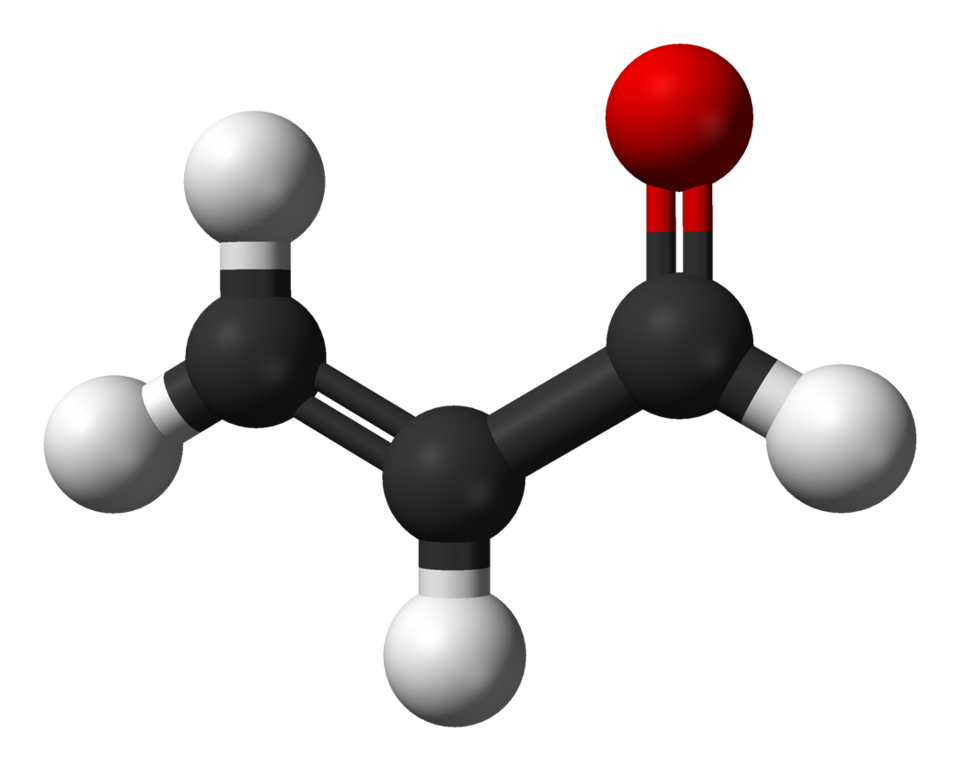
Ball-and-stick model of acrolein.
Credit: Ben Mills / Wikimedia Commons

License: Public domain
Wikimedia-provided scaled PNG/JPEG rendering; no content edits
What it is
Acrolein (CAS 107-02-8) is a small, reactive aldehyde. [1]
What it does and why it is used
Industrially, it is mainly used to make acrylic acid and as a biocide. [1]
Regulatory status and health context
Canada
The sources used here do not cover Canadian rules for acrolein.
United States
EPA's reference concentration for long-term inhalation is 0.00002 mg/m³, based on nasal damage in rats. [1]
International
IARC Group 2A (probably carcinogenic to humans), 2020. [2]
Environmental notes
Acrolein has not been detected in drinking water and is not commonly found in surface water. [1]
Quick facts
- CAS: 107-02-8. [1]
- IARC: Group 2A (2020). [2]
- Main sources: smoke, exhaust, overheated cooking oil. [1,2,3]
- Kitchen study: about 100 times a health guideline while heating oil. [3]
Sources
Sources were accessed on 2026-11-21. Source publication dates differ from this draft's review date. Image licences are listed with each image.
- US EPA: Acrolein hazard summary (PDF).
- IARC: IARC Monographs evaluation of the carcinogenicity of acrolein, crotonaldehyde, and arecoline, 2020.
- Zhang W et al. Investigating aldehyde and ketone compounds produced from indoor cooking emissions and assessing their health risk to human beings. J Environ Sci (China), 2023 (PubMed).