
Household materialsSkin and personal careWater, air and residues
Aluminum: is cooking with foil and aluminum pans safe?
CAS 7429-90-5.Also known as aluminium, aluminum foil, aluminium foil, Al, and aluminum compounds.
Editorial draft Last reviewed 21 November 2026 About 931 words
CC INDEX
How it works50/100 Moderate
Aluminum harm is established mainly for people with kidney disease, who can accumulate it. For healthy people, little is absorbed from cookware, and the sources do not support a causal link with Alzheimer's disease or breast cancer. Exposure is everyday, but regulatory concern is modest.
An editorial summary of this article’s cited evidence. It isn’t medical advice or a personal risk estimate.
Age index
What is the age index?Which age groups are more affected by this chemical’s possible health issues, based on this article’s sources.
- Pregnancy Unborn babies Not well studied
- Infants 0 to 1 Not well studied
- Young children 1 to 5 Not well studied
- Children 6 to 12 Lower concern
- Teens 13 to 19 Not well studied
- Adults 20 to 64 Lower concern
- Older adults 65 and over Moderate
- Older adults (moderate): Kidney disease is more common with age (general principle)
- Risk depends mainly on kidney function rather than age: people with kidney disease can store aluminum and are the group of real concern.

Illustration of foil and an aluminum pan in a kitchen. Acidic or salty foods pick up more aluminum from foil.
Credit: Chemical Century; AI-generated illustration
License: CC0 1.0
Illustration, not a photograph of a specific product. Resized and cropped for the web.
Aluminum is part of everyday cooking, from foil-wrapped leftovers to baking trays, and it also turns up in some antacids, antiperspirants, food additives and drinking water treatment. For healthy people, the amount absorbed from food and cookware is small, and the body clears most of it through the kidneys. The people who need to pay attention are those with kidney disease, who can build up aluminum over time, and parents of children with kidney problems. Worries about Alzheimer's disease and breast cancer come up often, but the sources reviewed here do not show that aluminum causes either.
Everyday exposure: where you meet it and how much
ATSDR says everyone is exposed to low levels of aluminum from food, air, water and soil. Aluminum compounds are also used in antacids, buffered aspirin, food additives, cosmetics and antiperspirants. It adds that "very little enters your body from aluminum cooking utensils." [1] An Italian study found that cooking in aluminum containers added relatively little aluminum to food, with the highest release into acidic and salty foods; even if all food were prepared and stored in aluminum, it estimated intake at about 6 mg a day, well below the international tolerable intake. [5]
Aluminum also occurs in drinking water, partly because aluminum salts are used as coagulants in water treatment. Health Canada sets a maximum acceptable concentration of 2.9 mg/L and an operational guidance value of 0.1 mg/L. [3] EFSA set a tolerable weekly intake for aluminum from the diet and noted that some people may exceed it. [4]
Known and suspected harms
Evidence labels are editorial summaries, not individual risk predictions: established means recognized under the stated conditions; probable means a likely contribution with uncertainty; possible means limited evidence; disputed means assessors disagree.
- Established — build-up in people with kidney disease: ATSDR reports that some people with kidney disease store a lot of aluminum in their bodies and sometimes develop bone or brain disease that may be caused by it. Children with kidney problems who were given aluminum in medical treatments developed bone disease. [1]
- Established — workplace lung and nerve effects: some workers who breathe large amounts of aluminum dust or fumes have lung problems or lower scores on nervous-system tests. This applies to industrial exposure, not kitchens. [1]
- Possible — extra intake from foil and pans: acidic and salty foods cooked in aluminum pick up the most aluminum, although the measured increase was relatively low. [5]
- Disputed — Alzheimer's disease: ATSDR states that some studies link high aluminum exposure to Alzheimer's disease while others do not, and "we do not know for certain whether aluminum causes Alzheimer's disease." A 2025 systematic review found the evidence split: of 54 studies, 26 reported a positive association with Alzheimer's disease or dementia and 24 found none or a negative one. [1,6]
- Not supported — breast cancer from antiperspirants: the National Cancer Institute states that no scientific evidence links antiperspirant or deodorant use to breast cancer. [2]
ATSDR notes that aluminum has not been shown to cause cancer in animals and that children do not appear to be more sensitive than adults. [1]
Reducing avoidable exposure
Avoid cooking or storing very acidic or salty foods, such as tomato sauce, citrus or marinades, in aluminum foil or uncoated aluminum pans; use glass, ceramic or stainless steel instead. Take antacids as directed, and avoid taking aluminum-containing antacids with citrus drinks, which ATSDR notes can increase absorption. People with kidney disease should ask their care team about aluminum sources. [1,5]
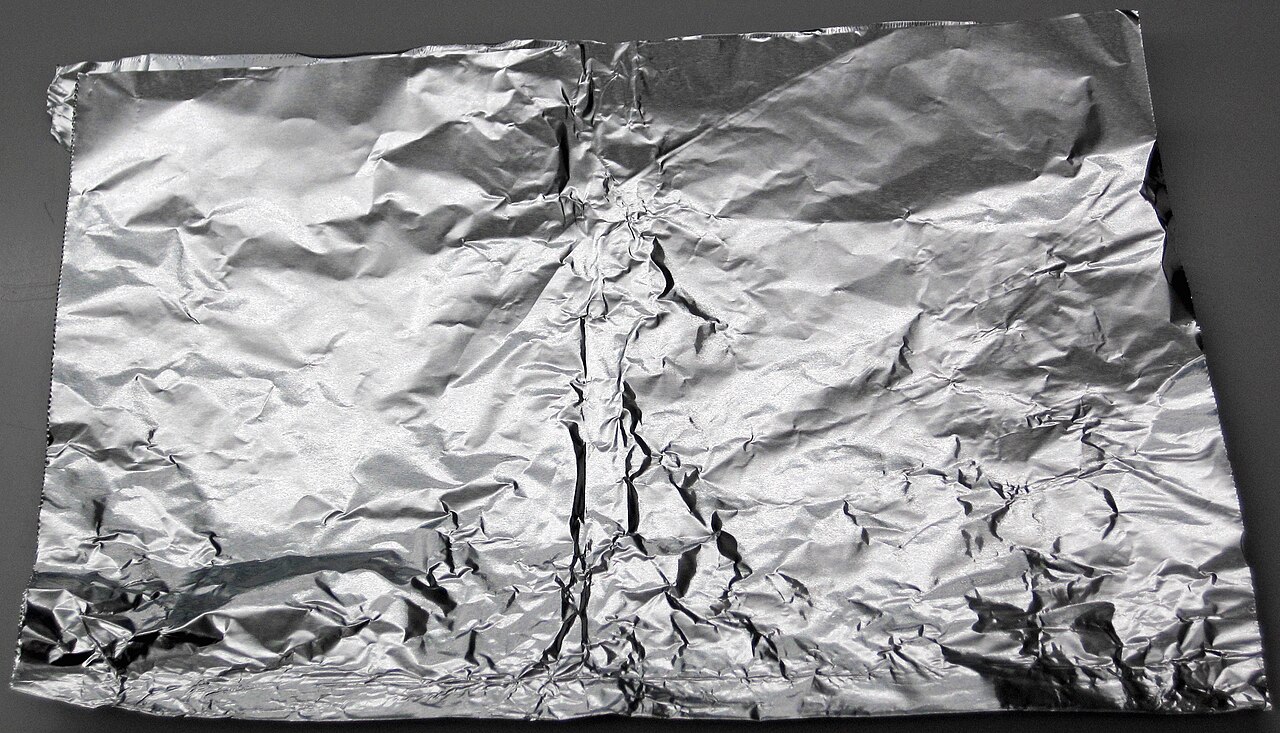
Aluminum foil, close up.
Credit: James St. John / Wikimedia Commons

License: CC BY 2.0
Wikimedia-provided scaled JPEG; no content edits
What it is
Aluminum (aluminium, CAS 7429-90-5) is a light metal and the most abundant metal in the earth's crust. In nature it is always found combined with other elements such as oxygen, silicon and fluorine. [1]
What it does and why it is used
Aluminum metal is used for foil, cans, cookware and building materials. Aluminum compounds are used in water treatment, antacids, food additives, cosmetics and antiperspirants, where they form a temporary plug in sweat ducts. [1,2]
Regulatory status and health context
Canada
Health Canada's drinking water guideline for aluminum is a maximum acceptable concentration of 2.9 mg/L, based on nerve-muscle and other effects in animal studies, with an operational guidance value of 0.1 mg/L. [3]
United States
ATSDR summarizes health effects and notes that the US Department of Health and Human Services and EPA have not evaluated aluminum's cancer potential in humans. [1]
European Union
EFSA set a tolerable weekly intake for dietary aluminum in 2008 and concluded that intake could exceed it in a significant part of the European population. [4]
Environmental notes
ATSDR notes that aluminum cannot be destroyed in the environment; it can only change its form. [1]
Quick facts
- CAS: 7429-90-5. [1]
- Main exposure: food, water, antacids, cosmetics; very little from cookware. [1]
- Clear risk group: people with kidney disease (established). [1]
- Alzheimer's link: not proven (disputed). [1,6]
- Antiperspirants and breast cancer: no scientific evidence of a link. [2]
Sources
Sources were accessed on 2026-11-21. Source publication dates differ from this draft's review date. Image licences are listed with each image.
- ATSDR (CDC): ToxFAQs for aluminum.
- National Cancer Institute: Antiperspirants/deodorants and breast cancer.
- Health Canada: Guidelines for Canadian Drinking Water Quality, summary table.
- EFSA: Safety of aluminium from dietary intake, scientific opinion, 2008.
- Gramiccioni L et al. Aluminium levels in Italian diets and in selected foods from aluminium utensils. Food Addit Contam, 1996 (PubMed).
- Soleimani H et al. Environmental aluminum exposure and Alzheimer's disease risk: systematic review and meta-analysis. Ecotoxicol Environ Saf, 2025 (PubMed).