
Household materialsWater, air and residues
Asbestos: the old building material that is safest left undisturbed
CAS 1332-21-4.Also known as chrysotile, amphibole asbestos, and asbestos fibres.
Editorial draft Last reviewed 15 November 2026 About 840 words
CC INDEX
How it works78/100 High
Asbestos is a proven cause of mesothelioma, lung cancer and asbestosis, and NCI says the evidence suggests no safe level of exposure. Most people now meet only low levels unless materials are disturbed. Canada prohibits most import, sale and use, so the score sits in the high band.
An editorial summary of this article’s cited evidence. It isn’t medical advice or a personal risk estimate.
Age index
What is the age index?Which age groups are more affected by this chemical’s possible health issues, based on this article’s sources.
- Pregnancy Unborn babies Not well studied
- Infants 0 to 1 Moderate
- Young children 1 to 5 Moderate
- Children 6 to 12 Moderate
- Teens 13 to 19 Moderate
- Adults 20 to 64 Higher concern
- Older adults 65 and over Higher concern
- Adults (higher concern): Regular or job exposure can cause mesothelioma, lung cancer and asbestosis
- Older adults (higher concern): Diseases can appear many years after past exposure
- ATSDR says it is not known whether children's different lungs and breathing cause more fibres to stay in their lungs; children may also swallow contaminated soil and dust. Illness is most common in people exposed regularly, often at work, and can appear many years later.

Illustration of an older basement with pipe insulation and floor tiles. Some older building materials contain asbestos; testing before renovation is the safe approach.
Credit: Chemical Century; AI-generated illustration
License: CC0 1.0
Illustration, not a photograph of a specific product. Resized and cropped for the web.
Many older homes still have asbestos hidden in pipe wrap, floor tiles, roofing or textured ceilings. It was popular because its tough fibres resist heat and fire, but breathing those fibres can cause serious lung disease and cancer years later. The good news is that asbestos materials that are intact and left alone usually release few fibres. The risk comes mainly from damaging or disturbing them during repairs, so it pays to check before you renovate.
Everyday exposure: where you meet it and how much
Asbestos is the name for six naturally occurring minerals made of bundles of fibres that resist heat, fire and chemicals. [1] It has been used in insulation, roofing, fireproofing, cement and plastics, ceiling and floor tiles, paints and coatings, and vehicle brakes and clutches. [1,3]
In homes it may be found in vermiculite attic insulation, vinyl floor tiles and sheet-flooring backing, roofing and siding shingles, textured paints and patching compounds, and coatings on hot water and steam pipes. [3] Fibres are released into the air mainly when such materials are disturbed or damaged during maintenance, repair, remodelling or demolition. [3] Everyone is exposed to low levels in air, water and soil, and most people do not become ill. [1]
Known and suspected harms
Evidence labels are editorial summaries, not individual risk predictions: established means recognized under the stated conditions; probable means a likely contribution with uncertainty; possible means limited evidence; disputed means assessors disagree. These labels do not describe how common an effect is.
- Established — cancer: according to IARC, as summarized by NCI, there is sufficient evidence that asbestos causes mesothelioma and cancers of the lung, larynx and ovary; most mesotheliomas are thought to be due to asbestos. [1]
- Established — lung disease: asbestos exposure may also cause asbestosis, an inflammatory lung condition that can cause shortness of breath, coughing and permanent lung damage, and other lung and pleural disorders. [1] Symptoms may take many years to develop. [3]
- Established — combined effect with smoking: smokers exposed to asbestos have a lung cancer risk greater than the risks of asbestos and smoking added together. [1]
- Possible — other cancers: there is limited evidence linking asbestos to cancers of the stomach, pharynx and colorectum. [1]
Reducing avoidable exposure and harm
The most important step is to know where asbestos may be in your home and avoid disturbing damaged or deteriorating insulation and ceiling or floor tiles. [2] If you suspect asbestos, contact local health or environmental authorities about testing and trained removal companies. [2] People who have been exposed should not smoke. [1] Workers should use the protective equipment and safety procedures their employer provides. [1]
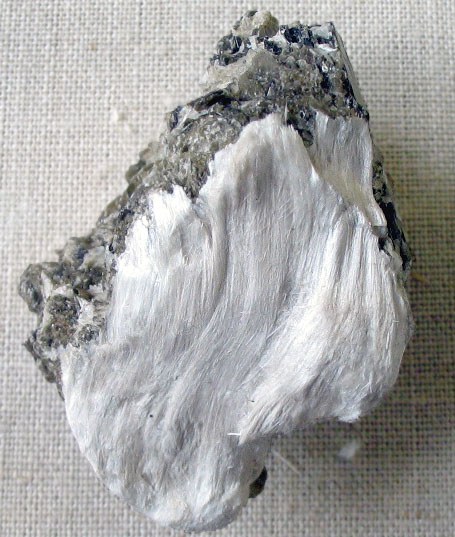
Asbestos fibres in a mineral sample with muscovite.
Credit: Aram Dulyan / Wikimedia Commons

License: Public domain
Resized for the web; no content edits
What it is
Asbestos (CAS 1332-21-4) is a group of silicate minerals. [1,2] Chrysotile, a serpentine form with long, curly fibres, has been the most widely used; amphibole forms such as crocidolite and amosite have straight, needle-like fibres. [1]
What it does and why it is used
Its fibres are strong, resist heat, fire and chemicals and do not conduct electricity, which made it useful for insulation, fireproofing, friction products and building materials. [1,3]
Regulatory status and health context
Canada
Canada's asbestos regulations prohibit the import, sale and use of processed asbestos fibres, of most products containing them, and of consumer products containing asbestos in more than trace amounts, with limited exclusions. [4] Health Canada says a drinking water guideline is not needed because there is no evidence of harm from asbestos in drinking water. [5]
United States
NCI notes that EPA banned all new uses of asbestos in 1989, while uses developed before then remained allowed; this review did not check more recent US rules. [1] EPA's drinking water limit is 7 million fibres per litre for fibres longer than 10 micrometres. [6]
European Union
The EU law website was not fully available when this article was reviewed, so EU legal status was not checked and is not summarized here.
Environmental notes
Asbestos occurs naturally in rock and soil and can enter water through erosion of natural deposits or the decay of asbestos-cement water mains. [3,6]
Quick facts
- CAS: 1332-21-4. [2]
- Where: older insulation, tiles, roofing, textured coatings and pipe wrap. [3]
- Main danger: mesothelioma, lung cancer and asbestosis. [1]
- Most at risk: workers and people who disturb asbestos materials, especially smokers. [1]
Sources
All URLs were fetched on 2026-11-15; Health Canada pages were read with a separate web-reading tool because they did not respond to this review's direct requests. The EU law website was not fully available that day, so EU legislation could not be checked for this review. Source publication dates differ from this draft's review date.
- National Cancer Institute: Asbestos exposure and cancer risk.
- ATSDR: Public Health Statement for asbestos.
- US EPA: Learn about asbestos.
- Justice Laws Website: Prohibition of Asbestos and Products Containing Asbestos Regulations (SOR/2018-196).
- Health Canada: Guidelines for Canadian Drinking Water Quality, summary tables.
- US EPA: National Primary Drinking Water Regulations.