
Aspartame: sweetness, safety and the label
CAS 22839-47-0.Also known as E951 and L-aspartyl-L-phenylalanine methyl ester.
Editorial draft Last reviewed 8 November 2026 About 924 words
CC INDEX
How it works38/100 Mild
The only established harm is the phenylalanine hazard for people with PKU, which labels already address. IARC's 2023 Group 2B cancer classification is a possible hazard that FDA and JECFA dispute at permitted intakes.
An editorial summary of this article’s cited evidence. It isn’t medical advice or a personal risk estimate.
Age index
What is the age index?Which age groups are more affected by this chemical’s possible health issues, based on this article’s sources.
- Pregnancy Unborn babies Not well studied
- Infants 0 to 1 Not well studied
- Young children 1 to 5 Lower concern
- Children 6 to 12 Lower concern
- Teens 13 to 19 Lower concern
- Adults 20 to 64 Lower concern
- Older adults 65 and over Lower concern
- The established hazard is for people of any age with PKU, who should follow the label warning.

A real sample of recrystallized aspartame; not a finished sweetener product.
Credit: LHcheM / Wikimedia Commons

License: CC BY-SA 3.0
Wikimedia-provided thumbnail; scaled from original, no content edits
A can of diet soda with lunch, a stick of sugar-free gum, a packet stirred into afternoon coffee: aspartame is a quiet part of many people's day, especially for those cutting back on sugar. For people born with the inherited condition PKU, it is a real and well-understood problem, which is why labels carry a warning. For everyone else, the headlines about cancer have caused more worry than the evidence supports so far: one international agency calls it a possible hazard, while food-safety regulators say permitted intakes are not a concern. Understanding that difference can help people make a calm choice instead of an anxious one.
Everyday exposure: where you meet it and how much
Diet soft drinks, chewing gum, desserts and tabletop sweeteners can contain aspartame. Exposure depends on the formulation, amount consumed and body weight—not simply whether an ingredient name appears. WHO illustrates a can containing 200–300 mg of aspartame; that is an example, not a measurement of every can. A 70 kg adult's 40 mg/kg/day ADI corresponds to 2,800 mg/day, calculated across all sources. An ADI is a lifetime exposure benchmark, not a consumption goal or a sharp boundary between harmless and poisonous. [1–3,5]
Known and suspected harms
Evidence labels are editorial summaries, not a formal grading system or a replacement for IARC categories: established means a recognized effect under specified conditions; probable means a likely contribution with meaningful uncertainty; possible means suggestive or limited evidence; disputed means relevant assessors disagree. None is an estimate of an individual's risk.
- Established — phenylalanine hazard for people with PKU: aspartame supplies phenylalanine, which people with phenylketonuria cannot process normally. Their medically supervised dietary restrictions take precedence over general-population ADIs. Required label warnings address this susceptible group. [1–3]
- Possible — cancer hazard: IARC classified aspartame as Group 2B, possibly carcinogenic to humans, in 2023. The human evidence was limited, specifically for hepatocellular carcinoma, a liver cancer. Animal and mechanistic evidence were also limited. This is a hazard classification, not proof that normal dietary intake causes cancer or a calculation of cancer risk per can. [5]
- Disputed — interpretation of cancer evidence at dietary exposures: the FDA disagrees with the evidence supporting IARC's conclusion; JECFA retained its 0–40 mg/kg/day ADI. The remaining uncertainty should be documented, but it does not justify calling cancer an established effect at permitted intake. [1,5]
Reducing exposure without creating a different problem
If you want less aspartame, choose water or unsweetened drinks and check the ingredient list for aspartame/E951. Do not assume replacing a diet drink with a sugar-sweetened drink improves health: a separate assessment of sugar intake is needed. For PKU, follow your specialist's plan and the phenylalanine warning rather than this general advice. These are ingredient-avoidance choices, not evidence that avoidance itself prevents cancer. [1–3]
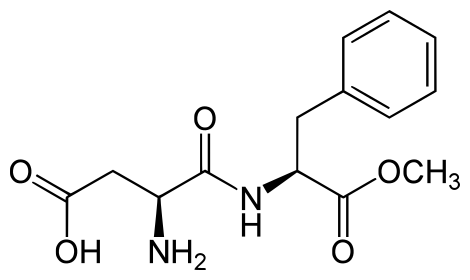
Aspartame structural formula.
Credit: Yikrazuul / Wikimedia Commons

License: Public domain (simple structural formula)
Original SVG unmodified
What it is
Aspartame is a low-calorie sweetener made from the amino acids aspartic acid and phenylalanine. Its structural name is L-aspartyl-L-phenylalanine methyl ester; PubChem records CAS 22839-47-0. The chemistry identifies the ingredient, not the risk from a particular serving. In the EU, it may be identified as E951. [1–4]
What it does and why it is used
The FDA describes aspartame as about 200 times sweeter than table sugar. Pure aspartame contains calories, but much less is needed for sweetness, allowing manufacturers to reduce sugar in some products. This does not make every resulting product nutritionally equivalent. It loses sweetness when heated and is not typically used in baking. [1]
Regulatory status and health context
Canada
Health Canada has permitted aspartame since 1981 under the Food and Drug Regulations. Its ADI is 40 mg/kg body weight/day. After considering the 2023 international assessment summaries, it reported no further action at that time and continued monitoring. A phenylalanine statement is required for people with PKU; the established susceptible-group hazard described above remains relevant regardless of general-population limits. [2]
United States
The FDA permits approved uses and maintains a 50 mg/kg/day ADI, higher than the Canadian and European figures. It requires a phenylalanine warning and supports safety for the general population under approved conditions. Its disagreement with IARC should be understood as disagreement about evidence interpretation, not an assertion that the underlying studies never existed. [1]
European Union
EFSA's topic page, reviewed in September 2026, describes authorised use and a 40 mg/kg/day ADI, with estimated consumer exposure below it. That general-population assessment does not apply to people with PKU. EFSA advises on science; European and national authorities decide permitted uses. [3]
Why the two international conclusions can coexist
IARC asks whether an agent could cause cancer under some circumstances. JECFA evaluates risk with exposure in mind. WHO explicitly describes the assessments as complementary. IARC's limited evidence—possible hazard—does not supply a reliable cancer-risk estimate for a typical consumer. JECFA's unchanged ADI does not erase the need to investigate unresolved signals. Report both rather than treating either as the entire story. [5]
Environmental notes
The cited sources concern food safety and do not establish a comparative environmental footprint for aspartame-containing products. No environmental ranking is assigned.
Quick facts
- Identity: CAS 22839-47-0; E951. [3,4]
- Purpose: high-intensity sweetener. [1]
- Canada/EU ADI: 40 mg/kg/day; US: 50 mg/kg/day. [1–3]
- Established susceptible-group concern: phenylalanine in PKU. [1–3]
- Possible hazard, not a measured dietary cancer risk: IARC Group 2B. [5]
Sources
All URLs were fetched for this draft on 2026-11-08.