
Water, air and residuesFood and drink
Atrazine: the farm weed killer that can reach well water
CAS 1912-24-9.Also known as atrazin and triazine herbicide.
Editorial draft Last reviewed 15 November 2026 About 645 words
CC INDEX
How it works40/100 Mild
Atrazine may affect reproduction and pregnancy, but the human evidence is limited and IARC says it is not classifiable as a carcinogen. Most people are not regularly exposed. Drinking water limits exist in Canada and the US, so the score sits in the mild band.
An editorial summary of this article’s cited evidence. It isn’t medical advice or a personal risk estimate.
Age index
What is the age index?Which age groups are more affected by this chemical’s possible health issues, based on this article’s sources.
- Pregnancy Unborn babies Moderate
- Infants 0 to 1 Not well studied
- Young children 1 to 5 Moderate
- Children 6 to 12 Moderate
- Teens 13 to 19 Moderate
- Adults 20 to 64 Moderate
- Older adults 65 and over Moderate
- ATSDR says little is known about effects in children. Maternal exposure through drinking water has been associated with low fetal weight and some birth defects, but it is unclear whether or at what level this occurs in people.

Illustration of a cornfield near a farmhouse well. Atrazine is used on crops such as corn and can reach groundwater.
Credit: Chemical Century; AI-generated illustration
License: CC0 1.0
Illustration, not a photograph of a specific product. Resized and cropped for the web.
Atrazine is one of the weed killers farmers use on cornfields, sugarcane and other crops, and it can wash off into streams or seep down into groundwater. Most people are not exposed to it regularly, but families who drink from wells in farming areas may have more contact. Research suggests it may affect reproduction, though it is not clear whether this happens at the levels people usually meet. Staying away from freshly treated fields and soil is a simple way to limit contact.
Everyday exposure: where you meet it and how much
Atrazine is a herbicide used before weeds emerge, with the highest use on field corn, sweet corn, sorghum and sugarcane, and other uses on crops, nurseries and turf. [2] It is also used near highways and railroads. [1]
Most people are not exposed regularly. [1] People living near treated fields may be exposed through contaminated drinking water, and it is commonly found in water from drinking wells in some farming regions because it breaks down slowly in groundwater. [1]
Known and suspected harms
Evidence labels are editorial summaries, not individual risk predictions: established means recognized under the stated conditions; probable means a likely contribution with uncertainty; possible means limited evidence; disputed means assessors disagree. These labels do not describe how common an effect is.
- Possible — reproduction and pregnancy: studies of couples on farms using atrazine found a higher risk of preterm delivery, though the farmers were exposed to other pesticides; maternal exposure in drinking water has been associated with low fetal weight and heart, urinary and limb defects. [1]
- Possible — organ effects: atrazine caused liver, kidney and heart damage in animals, but this has not been examined in people. [1]
- Possible — cancer: human studies suggest a possible link with some cancers but are not specific enough; IARC has found it not classifiable as to carcinogenicity in humans. [1]
Reducing avoidable exposure and harm
Because it is a restricted-use pesticide, most people cannot buy it. [1] Avoid areas where it is being applied, and avoid digging or working in soil where it has been applied. [1]
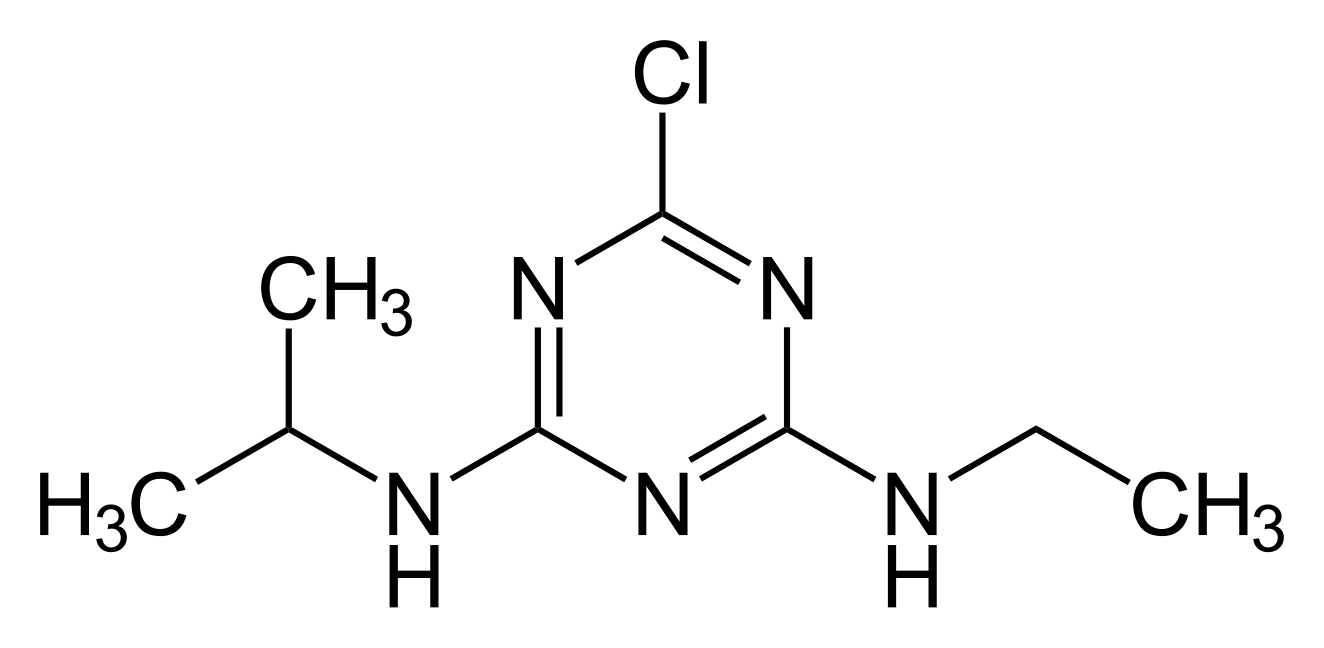
Skeletal structure of atrazine.
Credit: NEUROtiker / Wikimedia Commons

License: Public domain
Rendered from SVG to PNG, whitespace trimmed and placed on white
What it is
Atrazine (CAS 1912-24-9) is a chlorinated triazine herbicide. [2,5]
What it does and why it is used
It is absorbed by plants and kills grasses and broadleaf weeds. [1,2]
Regulatory status and health context
Canada
Canada's drinking water guideline sets a maximum acceptable concentration of 0.005 mg/L for atrazine and its breakdown products, based on reduced body weight in offspring. [3]
United States
The US drinking water limit for atrazine is 0.003 mg/L. [4] EPA reviews registered pesticides, including atrazine, at least every 15 years. [2]
European Union
The EU law website was not fully available when this article was reviewed, so EU legal status was not checked and is not summarized here.
Environmental notes
Atrazine can wash into streams and lakes or move into groundwater, and it persists for a long time in rivers, lakes and groundwater. [1] In soil it is usually broken down within one growing season. [1]
Quick facts
- CAS: 1912-24-9. [5]
- Where: cornfields and other crops; well water in some farm areas. [1,2]
- Main danger: possible reproductive effects. [1]
- Most at risk: people drinking well water near treated fields. [1]
Sources
All URLs were fetched on 2026-11-15; Health Canada pages were read with a separate web-reading tool because they did not respond to this review's direct requests. The EU law website was not fully available that day, so EU legislation could not be checked for this review. Source publication dates differ from this draft's review date.