
Cleaning and laundryWater, air and residues
Butoxyethanol (2-butoxyethanol): are cleaning-product fumes harmful to breathe?
CAS 111-76-2.Also known as 2-butoxyethanol, ethylene glycol monobutyl ether, EGBE, butyl glycol, and butyl cellosolve.
Editorial draft Last reviewed 21 November 2026 About 771 words
CC INDEX
How it works58/100 Moderate
ATSDR documents irritation, headache and vomiting after hours of high exposure and serious effects after swallowing cleaners. Red blood cell damage is seen mainly in animals. Canada limits the amount allowed in indoor products.
An editorial summary of this article’s cited evidence. It isn’t medical advice or a personal risk estimate.
Age index
What is the age index?Which age groups are more affected by this chemical’s possible health issues, based on this article’s sources.
- Pregnancy Unborn babies Not well studied
- Infants 0 to 1 Moderate
- Young children 1 to 5 Moderate
- Children 6 to 12 Lower concern
- Teens 13 to 19 Not well studied
- Adults 20 to 64 Moderate
- Older adults 65 and over Not well studied
- Infants (moderate): Swallowing products left within reach (general principle)
- Young children (moderate): Accidental swallowing of household cleaners
- Adults (moderate): Long cleaning sessions in closed rooms; workplace exposure

Illustration of glass cleaning with a window open. Ventilation lowers the solvent vapour you breathe.
Credit: Chemical Century; AI-generated illustration
License: CC0 1.0
Illustration, not a photograph of a specific product. Resized and cropped for the web.
The sharp, sweet smell of many glass cleaners, degreasers and all-purpose sprays often comes partly from butoxyethanol, a solvent that helps lift grease and dries quickly. Breathing high levels for hours, such as when cleaning a small, closed room, has given people sore eyes and noses, headaches and nausea. Swallowing large amounts of a concentrated product can cause serious poisoning, although small sips of ordinary glass cleaner by children usually caused no symptoms in one poison-centre review. For ordinary cleaning with an open window, the risk is low, and Canada now caps how much can go into indoor products.
Everyday exposure: where you meet it and how much
ATSDR says many people are exposed to small amounts of 2-butoxyethanol every day by breathing air or touching household cleaners that contain it. It is also used in liquid soaps, cosmetics, paints, varnishes, paint thinners and strippers. Workers in printing, furniture finishing, spray painting and car repair can have higher exposure. [1] Its breakdown products leave the body within 24 to 48 hours. [1]
Known and suspected harms
Evidence labels are editorial summaries, not individual risk predictions: established means recognized under the stated conditions; probable means a likely contribution with uncertainty; possible means limited evidence; disputed means assessors disagree.
- Established — irritation and headache from high vapour levels: ATSDR reports that people exposed to high levels for several hours had irritated noses and eyes, headache, a metallic taste and vomiting; no harmful effects were seen on their lungs or hearts. [1]
- Established — serious poisoning if swallowed: people who swallowed large amounts of cleaners containing it developed breathing problems, low blood pressure, low haemoglobin, acidic blood and blood in the urine. [1] In one published case, an 18-year-old who drank a large amount of a glass-cleaner concentrate containing 22% 2-butoxyethanol developed severe drowsiness, acidic blood and blood in the urine, and recovered with hospital treatment including dialysis. [3] By contrast, a poison-centre review of 24 children aged 7 months to 9 years who swallowed ordinary glass cleaner (0.5% to 9.9% 2-butoxyethanol) found none developed symptoms. [4]
- Possible — red blood cell damage and reproductive effects: in animals, 2-butoxyethanol destroys red blood cells (haemolysis), and high doses caused reproductive problems and minor birth defects. It is not known whether it affects reproduction in people. [1]
Reducing avoidable exposure
Open windows or run a fan while cleaning, especially in small rooms like bathrooms, and avoid long sessions with spray cleaners in closed spaces. Spray onto a cloth rather than into the air. Store cleaners in their original containers, locked or out of children's reach. CDC advises following label directions and never mixing cleaning products. If a child swallows a cleaner, call a poison centre right away. [1,5]
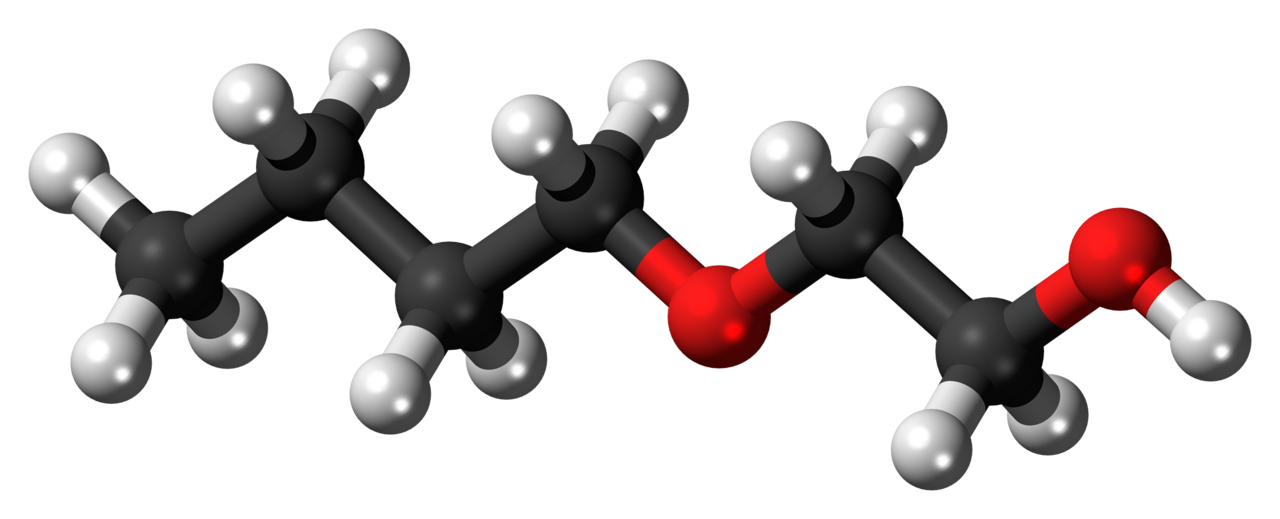
Ball-and-stick model of 2-butoxyethanol.
Credit: Jynto (talk) / Wikimedia Commons

License: CC0
Wikimedia-provided scaled PNG/JPEG rendering; no content edits
What it is
2-Butoxyethanol (CAS 111-76-2) is a colourless liquid with a sweet, ether-like smell. It is one of the glycol ethers, a family of solvents. [1]
What it does and why it is used
It dissolves both grease and water, which makes it useful in glass and surface cleaners, degreasers, paints and coatings. [1]
Regulatory status and health context
Canada
Canada's Certain Products Containing Toxic Substances Regulations (SOR/2025-36), which replaced the earlier 2-Butoxyethanol Regulations, set maximum concentrations for 2-butoxyethanol in indoor products, for example 6.0% in non-aerosol cleaners, 10% in carpet cleaners and 22% in laundry stain removers. [2]
United States
ATSDR notes the US Occupational Safety and Health Administration has a workplace exposure limit of 50 parts per million. [1]
European Union
The sources used here do not cover EU limits for consumer products.
Environmental notes
ATSDR notes it may break down in air within a few days and does not build up in plants and animals. [1]
Quick facts
- CAS: 111-76-2. [1]
- Found in: glass and surface cleaners, degreasers, paints, liquid soaps. [1]
- Main harms: irritation and headache from high vapour (established); serious poisoning if swallowed (established). [1]
- Canada: concentration limits in indoor products. [2]
- Best protection: ventilation and safe storage. [1,5]
Sources
Sources were accessed on 2026-11-21. Source publication dates differ from this draft's review date. Image licences are listed with each image.
- ATSDR (CDC): ToxFAQs for 2-butoxyethanol and 2-butoxyethanol acetate.
- Government of Canada: Certain Products Containing Toxic Substances Regulations, SOR/2025-36 (Justice Laws).
- Gualtieri JF et al. Repeated ingestion of 2-butoxyethanol: case report and literature review. J Toxicol Clin Toxicol, 2003 (PubMed).
- Dean BS, Krenzelok EP. Clinical evaluation of pediatric ethylene glycol monobutyl ether poisonings. J Toxicol Clin Toxicol, 1992 (PubMed).
- CDC MMWR: Cleaning and disinfectant chemical exposures and temporal associations with COVID-19, National Poison Data System, 2020.