
Carrageenan: the seaweed thickener in chocolate milk and ice cream
Also known as seaweed extract and E 407.
Editorial draft Last reviewed 15 November 2026 About 658 words
CC INDEX
How it works38/100 Mild
The sources used for this review do not document harm at permitted levels, but EFSA has identified safety data gaps, especially for very young infants. Carrageenan is common in dairy and processed foods. Canada and the US set conditions of use, so the score sits in the mild band.
An editorial summary of this article’s cited evidence. It isn’t medical advice or a personal risk estimate.
Age index
What is the age index?Which age groups are more affected by this chemical’s possible health issues, based on this article’s sources.
- Pregnancy Unborn babies Lower concern
- Infants 0 to 1 Not well studied
- Young children 1 to 5 Lower concern
- Children 6 to 12 Lower concern
- Teens 13 to 19 Lower concern
- Adults 20 to 64 Lower concern
- Older adults 65 and over Lower concern
- EFSA's 2018 opinion did not cover infants below 12 weeks of age, and a separate assessment for babies under 16 weeks was requested. Canada permits carrageenan in infant formula at set limits.

Illustration of red seaweed and dairy foods. Carrageenan is a seaweed extract used to thicken foods such as chocolate milk and ice cream.
Credit: Chemical Century; AI-generated illustration
License: CC0 1.0
Illustration, not a photograph of a specific product. Resized and cropped for the web.
Carrageenan is a thickener made from red seaweed that gives body to chocolate milk, ice cream and cream cheese. It is permitted in Canada and the United States. European food safety scientists have said some safety data are still missing, especially for formula fed to very young babies. For most people it is one of many minor ingredients, and the ingredient list is the easiest way to spot it.
Everyday exposure: where you meet it and how much
Carrageenan is used as an emulsifier, stabilizer or thickener in foods. [1] Health Canada permits it in foods including flavoured milk, cream, cream cheese, ice cream mix, sherbet, salad dressing, beer and infant formula, with limits for some foods such as 5,000 ppm in ice cream mix and 300 ppm in infant formula as consumed. [2]
Known and suspected harms
Evidence labels are editorial summaries, not individual risk predictions: established means recognized under the stated conditions; probable means a likely contribution with uncertainty; possible means limited evidence; disputed means assessors disagree. These labels do not describe how common an effect is.
- Possible — data gaps: EFSA re-evaluated carrageenan in 2018 and identified gaps in the risk assessment relevant to all population groups, and has asked for technical and toxicological data. [3] Under EU rules, an additive may be removed from the EU list if requested data are not provided. [3]
- Possible — very young babies: EFSA's opinion excluded uses in foods for infants below 12 weeks of age, and a separate assessment for babies under 16 weeks, including special formulas, was requested. [3]
- Established — permitted uses: US rules allow carrageenan in the amount needed for its purpose and require the additive to be labelled by name. [1]
Reducing avoidable exposure and harm
Check ingredient lists for carrageenan on dairy desserts, flavoured milks and processed meats if you prefer to limit it. [1,2]
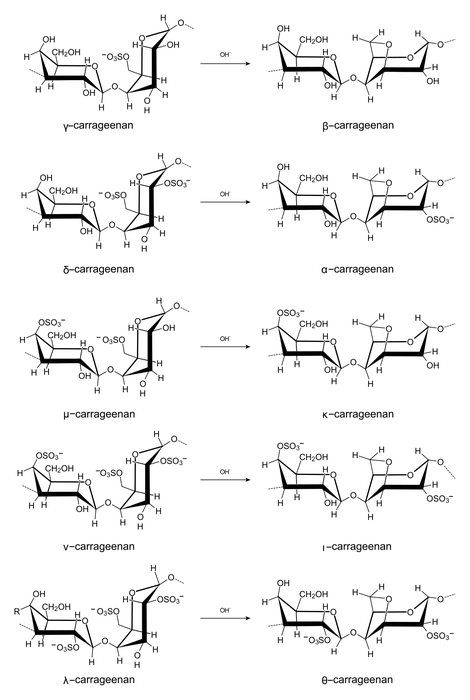
Molecular structures of different carrageenan types.
Credit: Roland Mattern / Wikimedia Commons

License: Public domain
Rendered from SVG to PNG, whitespace trimmed and placed on white
What it is
Carrageenan is a refined extract of certain red seaweeds; chemically it is a sulfated polysaccharide built mainly from galactose and anhydrogalactose units, with 20% to 40% sulfate. [1]
What it does and why it is used
It forms gels and thickens liquids, keeping ingredients evenly mixed. [1,2]
Regulatory status and health context
Canada
Carrageenan and its ammonium, calcium, potassium and sodium forms are on Health Canada's List of Permitted Emulsifying, Gelling, Stabilizing or Thickening Agents, with limits in some foods such as 150 ppm in evaporated milk. [2]
United States
US rules allow carrageenan from specified red seaweeds as an emulsifier, stabilizer or thickener, except in standardized foods that do not provide for it. [1]
European Union
EFSA re-evaluated carrageenan (E 407) as a food additive in 2018 and has since called for more data, including on its use in formula for infants under 16 weeks. [3] The EU law website was not fully available when this article was reviewed, so the current EU legal text was not checked.
Environmental notes
The sources used for this review do not assess carrageenan's environmental effects, so we do not summarize them here.
Quick facts
- CAS: no single CAS number verified. [1]
- Where: chocolate milk, ice cream, cream cheese, dressings. [2]
- Main concern: data gaps identified by EFSA. [3]
- Most at risk: very young infants, pending EFSA's assessment. [3]
Sources
All URLs were fetched on 2026-11-15; Health Canada pages were read with a separate web-reading tool because they did not respond to this review's direct requests. The EU law website was not fully available that day, so EU legislation could not be checked. Source publication dates differ from this draft's review date.