
Dextromethorphan: the cough suppressant that is safe as directed but dangerous in large doses
CAS 125-71-3.Also known as DXM and dextromethorphan hydrobromide.
Editorial draft Last reviewed 14 November 2026 About 795 words
CC INDEX
How it works58/100 Moderate
Large doses of dextromethorphan can cause breathing problems, seizures and death, and misuse by teens and accidental doubling with combination products are well documented. Cough and cold medicines are common in homes, but harm needs doses above the label. Labels warn against use in young children, so the score sits in the moderate band.
An editorial summary of this article’s cited evidence. It isn’t medical advice or a personal risk estimate.
Age index
What is the age index?Which age groups are more affected by this chemical’s possible health issues, based on this article’s sources.
- Pregnancy Unborn babies Not well studied
- Infants 0 to 1 Not well studied
- Young children 1 to 5 Higher concern
- Children 6 to 12 Moderate
- Teens 13 to 19 Higher concern
- Adults 20 to 64 Lower concern
- Older adults 65 and over Not well studied
- Young children (higher concern): Combination cough and cold products can cause serious harm under age 4
- Teens (higher concern): Some teens take very high doses to get high
- Overdose breathing problems are described as especially likely in young children; MedlinePlus advises telling a doctor about a pregnancy before using it.

Illustration of cough syrup and a dosing cup. Dextromethorphan is a common cough suppressant in cold medicines.
Credit: Chemical Century; AI-generated illustration
License: CC0 1.0
Illustration, not a photograph of a specific product. Resized and cropped for the web.
Dextromethorphan is the cough-quieting ingredient in many cold syrups, capsules and lozenges, often combined with other medicines in the same bottle. Taken as the label directs, it eases a cough for a while, sometimes with mild side effects such as dizziness or drowsiness. Problems come from too much: doubling up on products that share the ingredient, giving combination cold medicines to young children, or teens taking very high amounts to get high, which can cause hallucinations, seizures and breathing trouble. Reading every label and keeping these medicines put away helps prevent most of that harm.
Everyday exposure: where you meet it and how much
Dextromethorphan is used to temporarily relieve cough caused by the common cold, the flu or other conditions; it relieves the cough but does not treat its cause or speed recovery. [1] It comes as liquid-filled capsules, chewable tablets, dissolving strips, liquids, extended-release suspensions and lozenges, alone and in combination with antihistamines, decongestants and other ingredients. [1] It is found in many over-the-counter cough and cold medicines. [2]
Because several nonprescription products may contain the same active ingredient, using two or more at the same time can cause an accidental overdose. [1]
Known and suspected harms
Evidence labels are editorial summaries, not individual risk predictions: established means recognized under the stated conditions; probable means a likely contribution with uncertainty; possible means limited evidence; disputed means assessors disagree. These labels do not describe how common an effect is.
- Established — overdose: taking dextromethorphan in large amounts can cause serious side effects or death. [1] Overdose symptoms include slow, shallow or stopped breathing (especially in young children), bluish lips and fingernails, blurred vision, drowsiness, dizziness, hallucinations, seizures, coma, high or low blood pressure, rapid heartbeat and raised body temperature. [2]
- Established — harm in young children: nonprescription cough and cold combination products, including those containing dextromethorphan, can cause serious side effects or death in young children. [1]
- Established — misuse by teens: many teenagers take very high amounts to "feel good" and to have hallucinations, which can be dangerous; products that contain it often contain other medicines that are also dangerous in overdose. [2]
- Established — medicine interactions: overdose symptoms may be more frequent or severe in people who also take certain medicines that affect serotonin, and MedlinePlus advises telling a doctor about use of an MAO inhibitor now or within the past two weeks. [1,2]
- Established — common side effects at usual doses: dizziness, lightheadedness, drowsiness, nervousness, restlessness, nausea, vomiting and stomach pain. [1]
Reducing avoidable exposure and harm
Use dextromethorphan only as the label directs and do not take more than the recommended amount in 24 hours. [1] Check the labels of all cough and cold products before using two at once, do not give these products to children younger than 4, and use caution and follow directions for children aged 4 to 11. [1] Store medicines where teens and children cannot easily get them, and get medical help right away for a possible overdose; most people recover, and survival depends on how quickly a person gets hospital help. [2]
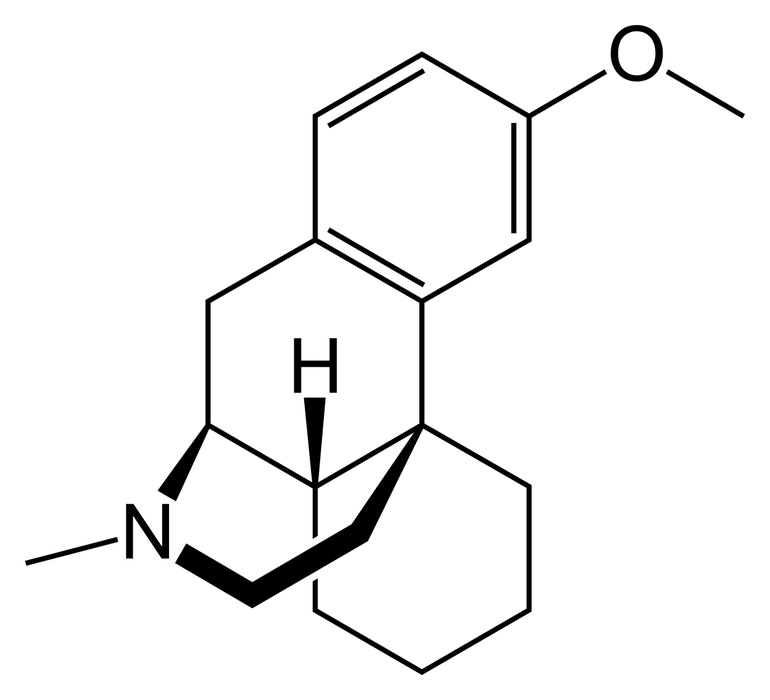
Skeletal structure of dextromethorphan.
Credit: Fvasconcellos / Wikimedia Commons

License: Public domain
Rendered from SVG to PNG, whitespace trimmed and placed on white
What it is
Dextromethorphan (CAS 125-71-3) is an antitussive, or cough suppressant. [1,4]
What it does and why it is used
It works by decreasing activity in the part of the brain that causes coughing. [1]
Regulatory status and health context
Canada
The sources used for this review do not cover dextromethorphan's status in Canada, so we do not summarize it here.
United States
Dextromethorphan is sold without a prescription in the US; MedlinePlus advises against giving nonprescription cough and cold combination products to children younger than 4. [1]
European Union
The EU cosmetics regulation lists dextromethorphan and its salts among substances prohibited in cosmetic products. [3] The sources used for this review do not cover its regulation as a medicine in the EU.
Environmental notes
The sources used for this review do not assess dextromethorphan's environmental effects, so we do not summarize them here.
Quick facts
- CAS: 125-71-3. [4]
- Where: over-the-counter cough and cold syrups, capsules, tablets, strips and lozenges. [1,2]
- Main danger: overdose from large amounts or doubled-up products. [1,2]
- Most at risk: young children; teens who misuse it. [1,2]
Sources
All URLs were fetched on 2026-11-14, except the EU cosmetics regulation, which did not respond to this review's requests; it was read from a copy fetched for earlier Chemical Century articles in November 2026. The EU text is the regulation as originally published, and later amendments were not checked. Source publication dates differ from this draft's review date.