
Food and drinkMakeup and colour
Erythrosine (Red No. 3): the cherry-red dye the US is removing from food
CAS 16423-68-0.Also known as FD&C Red No. 3 and Red 3.
Editorial draft Last reviewed 15 November 2026 About 690 words
CC INDEX
How it works46/100 Moderate
High doses caused cancer in male rats through a mechanism FDA says does not occur in humans, yet US law requires removing it from food. It is used in some candies, frostings and desserts. US revocation and Canadian limits put regulation in focus, so the score sits in the moderate band.
An editorial summary of this article’s cited evidence. It isn’t medical advice or a personal risk estimate.
Age index
What is the age index?Which age groups are more affected by this chemical’s possible health issues, based on this article’s sources.
- Pregnancy Unborn babies Lower concern
- Infants 0 to 1 Lower concern
- Young children 1 to 5 Lower concern
- Children 6 to 12 Lower concern
- Teens 13 to 19 Lower concern
- Adults 20 to 64 Lower concern
- Older adults 65 and over Lower concern
- The sources used for this review do not single out an age group for erythrosine.

Illustration of brightly frosted cupcakes. Erythrosine is a synthetic cherry-red food dye.
Credit: Chemical Century; AI-generated illustration
License: CC0 1.0
Illustration, not a photograph of a specific product. Resized and cropped for the web.
Erythrosine is a bright cherry-red food dye found in some candies, cake frostings, cookies and frozen desserts. In the United States, where it is called Red No. 3, regulators are ending its use in food and swallowed medicines. That decision rests on a law that bans additives shown to cause cancer in animals, after studies found tumours in male rats given high doses. US regulators say the effect is specific to male rats and that people are usually exposed to much lower amounts, while Canada still permits the dye.
Everyday exposure: where you meet it and how much
Erythrosine is a synthetic dye that gives foods and drinks a bright, cherry-red colour and is found in some candy, cakes and cupcakes, cookies, frozen desserts, frostings and icings, and swallowed medicines. [1] US labels list it as FD&C Red No. 3, FD&C Red 3 or Red 3. [1]
Known and suspected harms
Evidence labels are editorial summaries, not individual risk predictions: established means recognized under the stated conditions; probable means a likely contribution with uncertainty; possible means limited evidence; disputed means assessors disagree. These labels do not describe how common an effect is.
- Established — cancer in male rats: FDA found that the dye caused cancer in male laboratory rats exposed to high levels because of a hormonal mechanism that occurs in male rats. [1] Studies in other animals and in humans did not show the same effect, and FDA says there is no evidence it causes cancer in humans. [1]
- Established — exposure is far lower in people: FDA says typical human exposure is much lower than the levels that caused effects in male rats. [2]
- Established — legal finding, not a new safety signal: FDA is revoking authorization as a matter of law under the Delaney Clause, which bars additives found to cause cancer in humans or animals. [1,2]
Reducing avoidable exposure and harm
If you want to avoid it, look for Red No. 3, Red 3 or erythrosine on ingredient lists of candy, frostings and desserts. [1,3] In the US, products made before the deadlines may still be on shelves afterwards. [1]
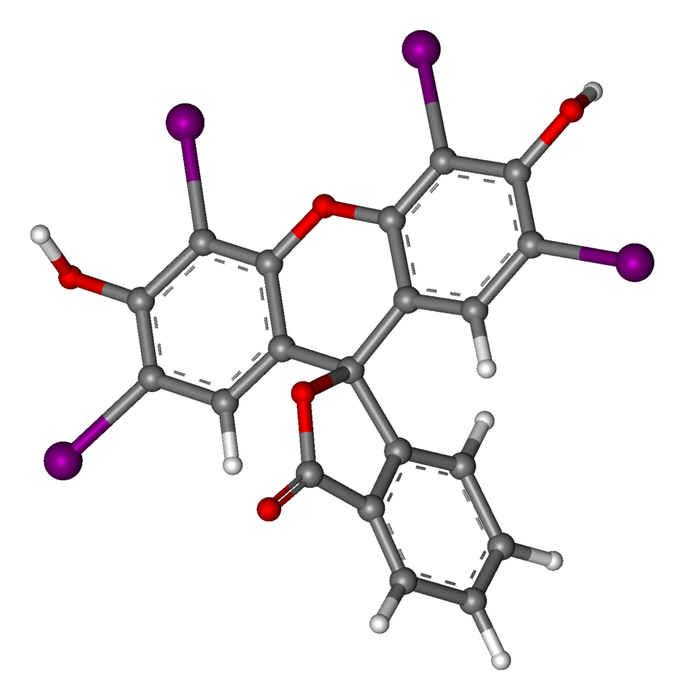
Ball-and-stick model of erythrosine.
Credit: MarinaVladivostok / Wikimedia Commons

License: CC0 1.0
Whitespace trimmed and placed on white
What it is
Erythrosine (CAS 16423-68-0) is a synthetic colour; Canada and Europe use the name erythrosine, while the US calls it FD&C Red No. 3. [1,4]
What it does and why it is used
It colours foods and swallowed medicines bright pink to cherry red. [1]
Regulatory status and health context
Canada
Erythrosine is on Health Canada's List of Permitted Food Colours as a synthetic colour, generally limited to 300 ppm in foods such as unstandardized foods, alone or combined with certain other synthetic colours. [3]
United States
FDA issued orders on January 16, 2025, and August 5, 2026, revoking the dye's authorization in food and swallowed drugs. [1] Manufacturers have until January 15, 2027, for food and January 18, 2028, for swallowed drugs to reformulate. [1] FDA denied its use in cosmetics and externally applied drugs in 1990. [1]
European Union
FDA notes that Europe allows certain uses under the name erythrosine. [1] The EU law website was not fully available when this article was reviewed, so EU legal conditions were not checked.
Environmental notes
The sources used for this review do not assess erythrosine's environmental effects, so we do not summarize them here.
Quick facts
- CAS: 16423-68-0. [4]
- Where: some candy, frostings, cookies, frozen desserts. [1]
- Main concern: cancer in male rats at high doses; US removal. [1]
- Most at risk: no human risk group identified by FDA. [1]
Sources
All URLs were fetched on 2026-11-15; Health Canada pages were read with a separate web-reading tool because they did not respond to this review's direct requests. The EU law website was not fully available that day, so EU legislation could not be checked. Source publication dates differ from this draft's review date.