
Fructose: when fruit sugar in drinks becomes a problem
CAS 57-48-7.Also known as fruit sugar, levulose, D-fructose, crystalline fructose, and fructose syrup.
Editorial draft Last reviewed 21 November 2026 About 758 words
CC INDEX
How it works62/100 High
Controlled studies show high fructose intake from drinks worsens fat and insulin markers, and large cohort studies link it to gout. Exposure from sweetened drinks is common. WHO advises limiting free sugars, but fructose itself is not specially regulated.
An editorial summary of this article’s cited evidence. It isn’t medical advice or a personal risk estimate.
Age index
What is the age index?Which age groups are more affected by this chemical’s possible health issues, based on this article’s sources.
- Pregnancy Unborn babies Not well studied
- Infants 0 to 1 Higher concern
- Young children 1 to 5 Moderate
- Children 6 to 12 Moderate
- Teens 13 to 19 Moderate
- Adults 20 to 64 Moderate
- Older adults 65 and over Moderate
- Infants (higher concern): Hereditary fructose intolerance appears when fruit and juice are introduced
- Young children (moderate): Sugary drinks; WHO limits free sugars for children too
- Teens (moderate): Sweetened drinks are a major source
- Adults (moderate): Belly fat, insulin sensitivity, gout risk (men)

Illustration contrasting sweetened drinks and whole fruit. Added fructose in drinks, not whole fruit, is the main concern.
Credit: Chemical Century; AI-generated illustration
License: CC0 1.0
Illustration, not a photograph of a specific product. Resized and cropped for the web.
Fructose is the natural sugar in fruit and honey, and it makes up about half of table sugar and high-fructose syrups. Eating whole fruit is not the concern: the problems show up when large amounts of added fructose come from sweetened drinks and processed foods. In studies, drinking a lot of fructose-sweetened beverages increased deep belly fat and lowered insulin sensitivity, and men who drank more sugary soft drinks were more likely to develop painful gout. For a small number of people born with hereditary fructose intolerance, even small amounts can be dangerous.
Everyday exposure: where you meet it and how much
Fructose is a simple sugar found mainly in fruit. [3] Table sugar (sucrose) is made of one glucose and one fructose unit, so sweetened foods and drinks are major sources. [5] Sugar-sweetened soft drinks, fruit juice and fructose-rich fruits such as apples and oranges all contribute to intake. [2]
Known and suspected harms
Evidence labels are editorial summaries, not individual risk predictions: established means recognized under the stated conditions; probable means a likely contribution with uncertainty; possible means limited evidence; disputed means assessors disagree.
- Probable — belly fat, blood fats and insulin sensitivity: overweight and obese adults who drank fructose-sweetened beverages providing 25% of their energy for 10 weeks gained visceral (deep abdominal) fat, made more fat in the liver, had worse blood lipid markers and became less sensitive to insulin. A matched group drinking glucose-sweetened beverages gained similar weight without these changes. The amounts were high. [1]
- Probable — gout in men: in a 12-year study of 46,393 men, two or more sugary soft drinks a day carried 1.85 times the risk of gout compared with less than one a month, and men in the highest fifth of fructose intake had 2.02 times the risk of those in the lowest. Diet soft drinks were not linked to gout. Fruit juice and fructose-rich fruits were also associated with higher risk. [2]
- Established — hereditary fructose intolerance: in this inherited condition, estimated at 1 in 20,000 to 30,000 people, eating fructose causes nausea, bloating, abdominal pain, diarrhoea, vomiting and low blood sugar; repeated intake can damage the liver and kidneys. Symptoms usually start in infancy when fruit and juice are introduced. [3]
- Established — malabsorption: fructose taken on its own at doses above about 25 g can be poorly absorbed, which can cause gut symptoms; this does not happen in the same way when it is eaten with glucose, as in table sugar. [5]
Reducing avoidable exposure
WHO recommends keeping free sugars below 10% of daily energy for adults and children. Swapping sugary drinks and juice for water and eating whole fruit instead of juice lowers fructose intake. Anyone with suspected hereditary fructose intolerance needs medical diagnosis and a strict diet. [3,4]
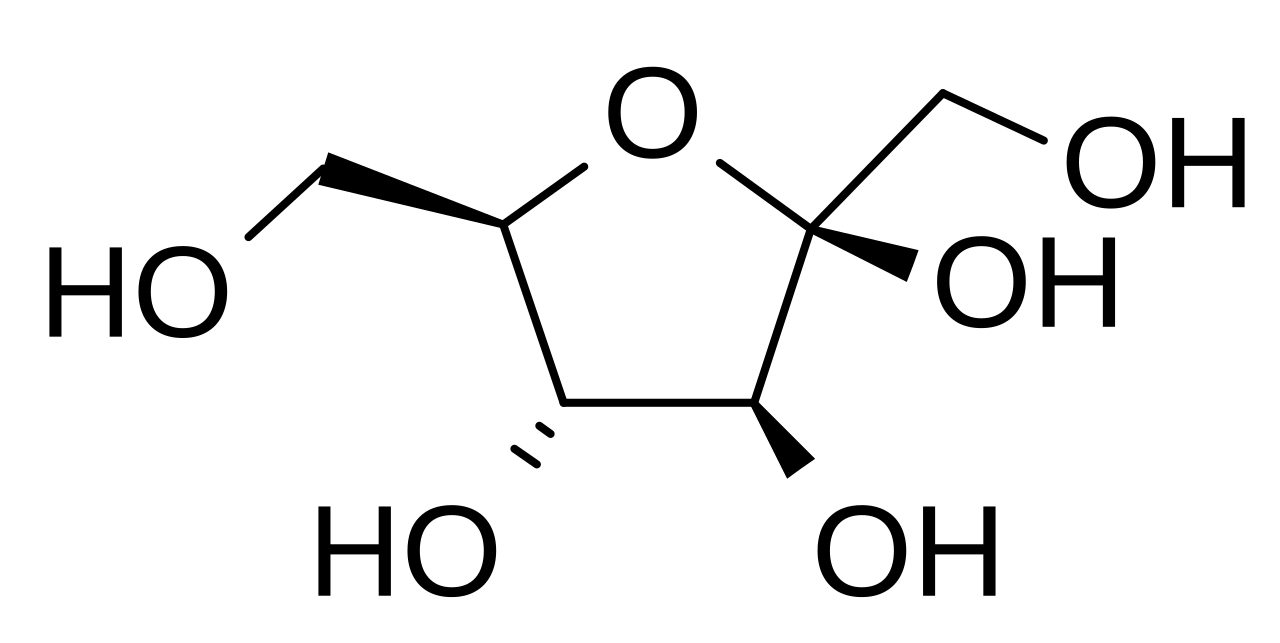
Structural formula of fructose.
Credit: Michael D. Turnbull / Wikimedia Commons

License: CC0
Wikimedia-provided scaled PNG/JPEG rendering; no content edits
What it is
Fructose (CAS 57-48-7) is a monosaccharide, a single-unit sugar, with the same formula as glucose but a different structure. [5]
What it does and why it is used
It sweetens foods and drinks and is sweeter than table sugar (relative sweetness 115 to 180, versus 100 for sucrose). Its glycemic index is low (19, versus 100 for glucose), because it is only partly converted to glucose in the body. [5]
Regulatory status and health context
Canada
The sources used here do not cover Canadian rules specific to fructose.
United States
The sources used here do not cover US rules specific to fructose.
International
WHO's 2015 guideline advises limiting free sugars to less than 10% of total energy intake. [4]
Environmental notes
The sources used here do not provide enough environmental data for a rating.
Quick facts
- CAS: 57-48-7. [5]
- Sources: fruit, honey, table sugar, sweetened drinks. [2,3,5]
- Glycemic index: 19 (glucose = 100). [5]
- Gout risk (men): 1.85 times with two or more sugary drinks a day. [2]
- WHO: free sugars under 10% of energy. [4]
Sources
Sources were accessed on 2026-11-21. Source publication dates differ from this draft's review date. Image licences are listed with each image.
- Stanhope KL et al. Consuming fructose-sweetened, not glucose-sweetened, beverages increases visceral adiposity and lipids and decreases insulin sensitivity in overweight/obese humans. J Clin Invest, 2009 (PubMed).
- Choi HK, Curhan G. Soft drinks, fructose consumption, and the risk of gout in men: prospective cohort study. BMJ, 2008 (PubMed).
- MedlinePlus Genetics: Hereditary fructose intolerance.
- World Health Organization: Guideline: sugars intake for adults and children, 2015.
- Brouns F. Saccharide characteristics and their potential health effects in perspective. Front Nutr, 2020.