
Haloacetic acids (HAA5) in tap water: what the limit means and how to lower them
Also known as HAA5, HAAs, dichloroacetic acid, trichloroacetic acid, monochloroacetic acid, and HAA disinfection by-products.
Editorial draft Last reviewed 21 November 2026 About 667 words
CC INDEX
How it works58/100 Moderate
Haloacetic acids occur in most chlorinated water and are regulated in the US, EU and by WHO guidance. Cancer evidence is suggestive rather than established, and limits are designed to keep levels low.
An editorial summary of this article’s cited evidence. It isn’t medical advice or a personal risk estimate.
Age index
What is the age index?Which age groups are more affected by this chemical’s possible health issues, based on this article’s sources.
- Pregnancy Unborn babies Not well studied
- Infants 0 to 1 Not well studied
- Young children 1 to 5 Not well studied
- Children 6 to 12 Not well studied
- Teens 13 to 19 Not well studied
- Adults 20 to 64 Moderate
- Older adults 65 and over Not well studied
- Adults (moderate): Long-term intake linked to possible bladder cancer risk
- Cancer concerns relate to many years of exposure; the sources used here do not rate children separately.

Illustration of tap water. Haloacetic acids form during chlorine disinfection.
Credit: Chemical Century; AI-generated illustration
License: CC0 1.0
Illustration, not a photograph of a specific product. Resized and cropped for the web.
Haloacetic acids are a family of chemicals that form when chlorine used to disinfect drinking water reacts with natural organic matter such as decaying leaves. They are one of the two main groups of disinfection by-products, along with trihalomethanes, and regulators in the US and EU set limits for the sum of five of them. Long-term exposure above those limits is linked to a possible increase in cancer risk, mainly bladder cancer. Disinfection prevents serious waterborne disease, so the goal is to keep by-products low, not to stop treating water.
Everyday exposure: where you meet it and how much
Chlorinated acetic acids form from organic material during water chlorination. WHO notes mean levels in US distribution systems of 5.3 µg/L in groundwater and 16 µg/L in surface water for trichloroacetic acid, with maximums up to 174 µg/L. [4] Drinking the water is the main route. [6]
Known and suspected harms
Evidence labels are editorial summaries, not individual risk predictions: established means recognized under the stated conditions; probable means a likely contribution with uncertainty; possible means limited evidence; disputed means assessors disagree.
- Possible — bladder cancer: a 40-year review notes that more than 600 disinfection by-products have been identified and many are genotoxic or carcinogenic in rodents. It concludes that the data support a hypothesis that oral exposure to haloacetic acids, combined with a specific genotype, may increase bladder cancer risk for a small but significant group, and that improved treatment and stricter rules have likely reduced such risks. [6]
- Established — limits set for long-term health: WHO sets a provisional guideline value of 0.05 mg/L for dichloroacetate and 0.2 mg/L for trichloroacetic acid. IARC classifies trichloroacetic acid in Group 3, not classifiable as to carcinogenicity in humans, and WHO considers it not a genotoxic carcinogen. [3,4]
Reducing avoidable exposure
If you are on a public supply, your water provider's annual report lists by-product levels. If you use a home filter, check that it is independently certified for the by-products you want to reduce. Never stop disinfecting water; WHO stresses that difficulty meeting by-product guidelines must never compromise disinfection. [3,6]
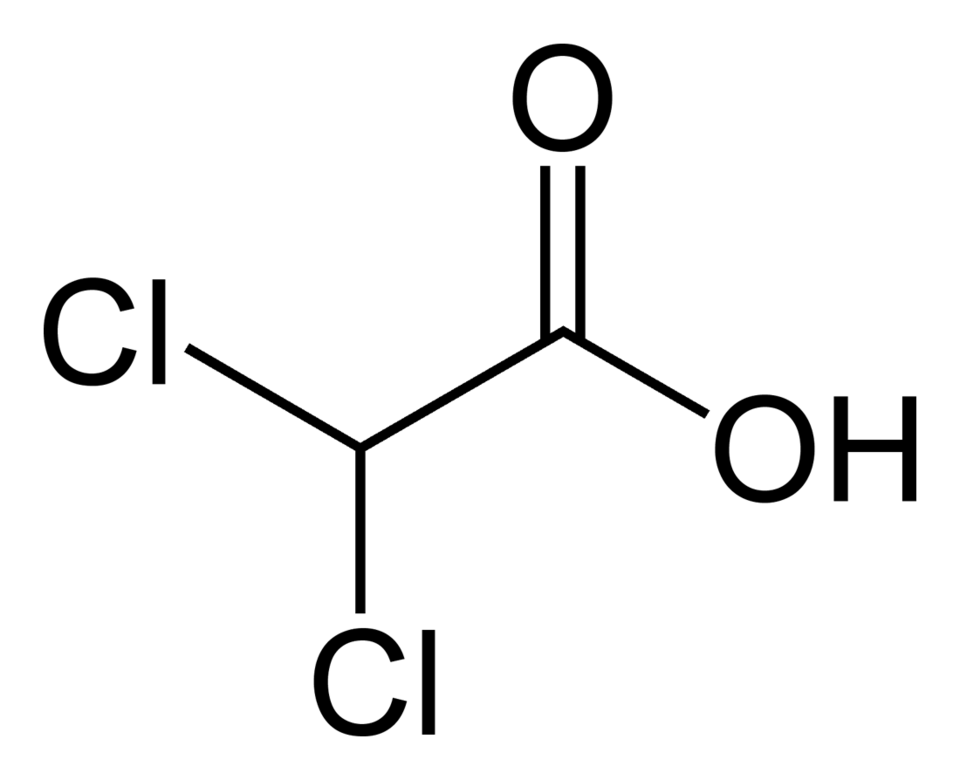
Structural formula of dichloroacetic acid, one of the five regulated haloacetic acids.
Credit: Unknown / Wikimedia Commons

License: Public domain
Wikimedia-provided scaled PNG/JPEG rendering; no content edits
What it is
Haloacetic acids are acetic acid molecules in which one or more hydrogen atoms are replaced by chlorine or bromine. The five regulated together are monochloro-, dichloro- and trichloroacetic acid and mono- and dibromoacetic acid. [5]
What it does and why it is used
They have no intended use in water; they are unwanted by-products of chlorine disinfection. [4,6]
Regulatory status and health context
International
WHO: dichloroacetate 0.05 mg/L (provisional) and trichloroacetic acid 0.2 mg/L. [3,4]
United States
EPA's maximum contaminant level is 0.060 mg/L for HAA5 (and 0.080 mg/L for total trihalomethanes), under the Stage 1 and Stage 2 disinfection by-product rules. [1,2]
European Union
The Drinking Water Directive sets 60 µg/L for the sum of five haloacetic acids, measured where disinfection methods that can generate them are used; monitoring obligations apply from 12 January 2026. [5]
Environmental notes
The sources used here do not provide enough environmental data for a rating.
Quick facts
- CAS: group; dichloroacetic acid 79-43-6, trichloroacetic acid 76-03-9.
- US limit: 0.060 mg/L (HAA5). [1]
- EU limit: 60 µg/L (sum of five). [5]
- Main concern: possible bladder cancer with long-term exposure. [6]
Sources
Sources were accessed on 2026-11-21. Source publication dates differ from this draft's review date. Image licences are listed with each image.
- eCFR: 40 CFR 141.64, maximum contaminant levels for disinfection byproducts.
- US EPA: Stage 1 and Stage 2 disinfectants and disinfection byproducts rules.
- WHO: Guidelines for drinking-water quality, 4th edition with addenda, Annex 3 chemical summary tables (PDF).
- WHO: Trichloroacetic acid in drinking-water, chemical fact sheet, 2022 (PDF).
- European Union: Directive (EU) 2020/2184 on the quality of water intended for human consumption (EUR-Lex).
- DeMarini DM. A review on the 40th anniversary of the first regulation of drinking water disinfection by-products. Environ Mol Mutagen, 2020 (PubMed).