
Cleaning and laundryMedicines and health
Hydrogen peroxide: the first-aid bottle that is mild at 3% and dangerous when concentrated
CAS 7722-84-1.Also known as hydrogen dioxide, H2O2, and peroxide.
Editorial draft Last reviewed 14 November 2026 About 1052 words
CC INDEX
How it works52/100 Moderate
Concentrated hydrogen peroxide can cause serious burns and, rarely, life-threatening gas bubbles in the blood, and these harms are well documented in poisoning references. Household 3% solution is common but usually causes only mild irritation, so ordinary exposure scores low. Rules mostly set concentration limits and labels, so the score sits in the moderate band.
An editorial summary of this article’s cited evidence. It isn’t medical advice or a personal risk estimate.
Age index
What is the age index?Which age groups are more affected by this chemical’s possible health issues, based on this article’s sources.
- Pregnancy Unborn babies Not well studied
- Infants 0 to 1 Not well studied
- Young children 1 to 5 Higher concern
- Children 6 to 12 Moderate
- Teens 13 to 19 Moderate
- Adults 20 to 64 Moderate
- Older adults 65 and over Moderate
- Young children (higher concern): A clear, tasteless liquid can be swallowed by mistake
- Risk depends mostly on concentration: household-strength solution usually causes mild irritation, while concentrated solutions can cause burns at any age.

Illustration of household hydrogen peroxide. Household hydrogen peroxide is a 3% solution sold in opaque bottles.
Credit: Chemical Century; AI-generated illustration
License: CC0 1.0
Illustration, not a photograph of a specific product. Resized and cropped for the web.
The brown bottle under the bathroom sink, the cleaner wiped over a cutting board and the bleach in a hair-lightening kit are all hydrogen peroxide. At household strength, a splash or an accidental sip usually causes nothing worse than mild irritation. The stronger solutions sold for hair bleaching, industry or so-called food-grade use are a different matter: they can burn the mouth, throat and eyes, and swallowing them has caused serious injuries and deaths. Keeping only the weaker strength at home, in its original bottle and away from children, avoids most of the danger.
Everyday exposure: where you meet it and how much
Household hydrogen peroxide, sold in opaque bottles in drugstores and supermarkets, contains 3% hydrogen peroxide; some contact lens disinfecting solutions contain the same strength. [1] Hair bleach is stronger, usually more than 6% and often 6 to 10%, and some industrial solutions contain far more. [1,2] Products marketed as "food-grade" hydrogen peroxide are typically 35%, despite a name that makes them sound edible. [1]
People use hydrogen peroxide to clean counters and cutting boards, remove odours and some fabric stains, and disinfect contact lenses. [1] Most exposures are small splashes or sips of the household product. The serious cases involve swallowing concentrated solutions, getting them in the eyes or breathing them in. [1,2]
Known and suspected harms
Evidence labels are editorial summaries, not individual risk predictions: established means recognized under the stated conditions; probable means a likely contribution with uncertainty; possible means limited evidence; disputed means assessors disagree. These labels do not describe how common an effect is.
- Established — mild irritation from household-strength solution: exposures to small amounts of 3% hydrogen peroxide usually cause only mild irritation. [1] In one reported case, a 2-year-old girl drank some 3% solution her mother had poured into a cup to treat a cut; she was given water to drink and was fine a few hours later. [1]
- Established — burns from concentrated solutions: higher concentrations can cause burns. [1] MedlinePlus lists burns in the mouth and throat, eye burns, abdominal pain, vomiting (sometimes with blood), breathing difficulty and, rarely, seizures among the symptoms of poisoning, with airway irritation that may be severe from solutions stronger than 10%. [2]
- Established — rare gas embolism after swallowing: rarely, life-threatening effects occur when oxygen bubbles released from hydrogen peroxide travel into the circulation and block blood flow to tissue. [1] Poison Control describes an 82-year-old woman who was given about two tablespoons of 32% hydrogen peroxide; she had bleeding in her digestive tract and breathing problems, and died after 15 days in hospital. [1]
- Established — harm to healing wounds: hydrogen peroxide is no longer recommended for cleaning skin wounds, because research has shown it can irritate or damage the cells needed for healing. [1]
Reducing avoidable exposure and harm
For household use, buy only 3% solution, keep it in its original opaque bottle and store it out of children's sight and reach. [1] Do not use hydrogen peroxide to make a person vomit, at any age. [1] Concentrated "food-grade" solution is promoted as an alternative therapy for many conditions without scientific evidence; diluted doses kept in the refrigerator can be mistaken for something safe to drink, and children and adults who swallowed concentrated solution have been severely injured or died. [1] If hydrogen peroxide gets on the skin or in the eyes, flush with plenty of water for at least 15 minutes, and seek medical help right away after swallowing a large amount; do not make the person throw up unless told to. [2]
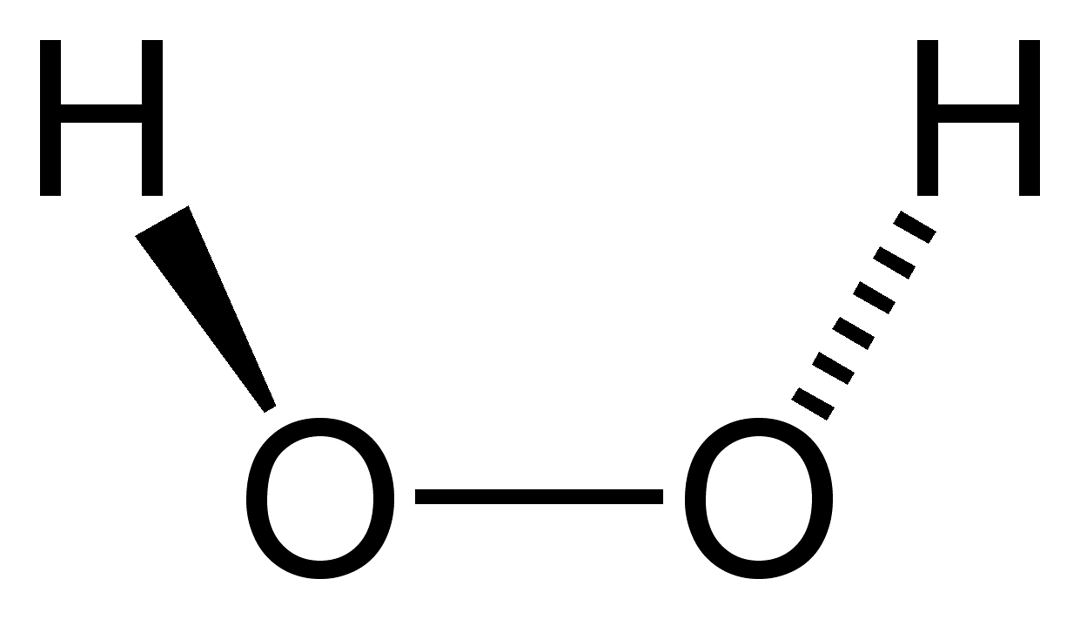
Structural formula of hydrogen peroxide.
Credit: Benjah-bmm27 / Wikimedia Commons

License: Public domain
Whitespace trimmed and placed on white
What it is
Hydrogen peroxide (CAS 7722-84-1), also called hydrogen dioxide, is a highly reactive chemical usually sold diluted in water. [1,3,6] Its solutions look like water and are tasteless, odourless and colourless; it is less stable than water and breaks down into water and oxygen. [1]
What it does and why it is used
It is used as a household cleaner and disinfectant, in contact lens care, in hair bleach and, at very high strength, in industry for jobs such as bleaching paper. [1,2] In US food production it is allowed as an antimicrobial, bleaching or oxidizing agent in a listed set of foods, such as milk used to make cheese, starch, dried eggs and some whey. [3]
Regulatory status and health context
Canada
Health Canada's Cosmetic Ingredient Hotlist restricts peroxides and peroxide-generating compounds, including hydrogen peroxide: they are not permitted in products intended for the genital area, and oral products containing them carry extra conditions. [4]
United States
FDA lists hydrogen peroxide as generally recognized as safe for treating specific foods within stated limits, for example a maximum of 0.05% in milk used for cheesemaking and 0.15% in starch. [3] This food-processing rule does not make concentrated solutions safe to drink. [1]
European Union
The EU cosmetics regulation, as originally published in 2009, set maximum hydrogen peroxide levels of 12% in hair products, 4% in skin products, 2% in nail hardeners and 0.1% in oral products, with warnings such as "Contains hydrogen peroxide" and "Avoid contact with eyes". [5] Later amendments were not checked for this review.
Environmental notes
The sources used for this review do not assess hydrogen peroxide's environmental effects. Poison Control notes that it is unstable and breaks down into water and oxygen. [1]
Quick facts
- CAS: 7722-84-1. [6]
- Where: household 3% solution, contact lens solutions, hair bleach, concentrated "food-grade" products. [1,2]
- Main danger: burns and, rarely, gas embolism from concentrated solutions. [1,2]
- Most at risk: anyone who swallows concentrated solution; young children who find it within reach. [1]
Sources
All URLs were fetched on 2026-11-14, except the Health Canada Hotlist and the EU cosmetics regulation, which did not respond to this review's requests; those were read from copies fetched for earlier Chemical Century articles in November 2026. The EU text is the regulation as originally published, and later amendments were not checked. Source publication dates differ from this draft's review date.
- Poison Control (National Capital Poison Center): Is hydrogen peroxide safe?.
- MedlinePlus: Hydrogen peroxide poisoning.
- eCFR: 21 CFR 184.1366, hydrogen peroxide.
- Health Canada: Cosmetic Ingredient Hotlist, prohibited and restricted ingredients.
- EUR-Lex: Regulation (EC) No 1223/2009 on cosmetic products, as originally published.
- PubChem PUG REST: hydrogen peroxide synonyms.