
Household materialsWater, air and residues
Malathion: the insecticide used on crops, for mosquitoes and in some lice treatments
CAS 121-75-5.Also known as organophosphate insecticide.
Editorial draft Last reviewed 15 November 2026 About 647 words
CC INDEX
How it works44/100 Moderate
Malathion poisoning can affect breathing, the heart and nervous system and may need intensive care, and it can be absorbed through skin. It is used on crops, in gardens, for mosquito control and in some lice products, so the score sits in the moderate band.
An editorial summary of this article’s cited evidence. It isn’t medical advice or a personal risk estimate.
Age index
What is the age index?Which age groups are more affected by this chemical’s possible health issues, based on this article’s sources.
- Pregnancy Unborn babies Lower concern
- Infants 0 to 1 Moderate
- Young children 1 to 5 Moderate
- Children 6 to 12 Lower concern
- Teens 13 to 19 Lower concern
- Adults 20 to 64 Lower concern
- Older adults 65 and over Lower concern
- The sources used for this review do not give age-specific advice; MedlinePlus advises keeping chemicals out of children's reach.

Illustration of a garden sprayer. Malathion is used to control insects on crops and in gardens.
Credit: Chemical Century; AI-generated illustration
License: CC0 1.0
Illustration, not a photograph of a specific product. Resized and cropped for the web.
Malathion is an insecticide used on crops and in gardens, in large outdoor mosquito spraying, and in certain head lice treatments. Poisoning may happen if it is swallowed, handled without gloves or not washed off the hands, and large amounts can be absorbed through the skin. Symptoms can affect breathing, the heart, the gut and the nervous system. Most people who keep improving in the first hours after treatment recover, though some effects may last for weeks or longer.
Everyday exposure: where you meet it and how much
Malathion is an insecticide used in agriculture to kill and control insects on crops and in gardens. [1] Government agencies use it to kill mosquitoes in large outdoor areas, and it may be found in certain head lice products. [1] Poisoning may occur if you swallow it, handle it without gloves or do not wash your hands soon after touching it, and large amounts can be absorbed through the skin. [1]
Known and suspected harms
Evidence labels are editorial summaries, not individual risk predictions: established means recognized under the stated conditions; probable means a likely contribution with uncertainty; possible means limited evidence; disputed means assessors disagree. These labels do not describe how common an effect is.
- Established — poisoning symptoms: chest tightness, difficulty breathing or no breathing, increased urination or incontinence, increased saliva and tears, small (or sometimes dilated) pupils, low or high blood pressure, slow (or sometimes rapid) heart rate, weakness, agitation, anxiety, coma, confusion, convulsions, dizziness, headache, muscle twitching, blue lips and fingernails, sweating, abdominal cramps, diarrhea, loss of appetite, nausea and vomiting; wheezing and increased airway mucus can also occur. [1]
- Established — recovery: people who continue to improve in the first 4 to 6 hours after medical treatment usually recover, but prolonged treatment, including intensive care, is often needed, and some effects may last for weeks, months or longer. [1]
- Established — hazard classification: 98.3% of reports classify it as possibly causing an allergic skin reaction and 97.4% as harmful if swallowed. [2] Percentages are shares of company reports to the European Chemicals Agency's classification inventory, as compiled by PubChem.
Reducing avoidable exposure and harm
Call poison control for treatment information. [1] If malathion is on the skin, wash the area thoroughly for at least 15 minutes, throw away contaminated clothing and wear protective gloves when touching it. [1] Keep chemicals in their original containers, marked as poison and out of children's reach. [1]
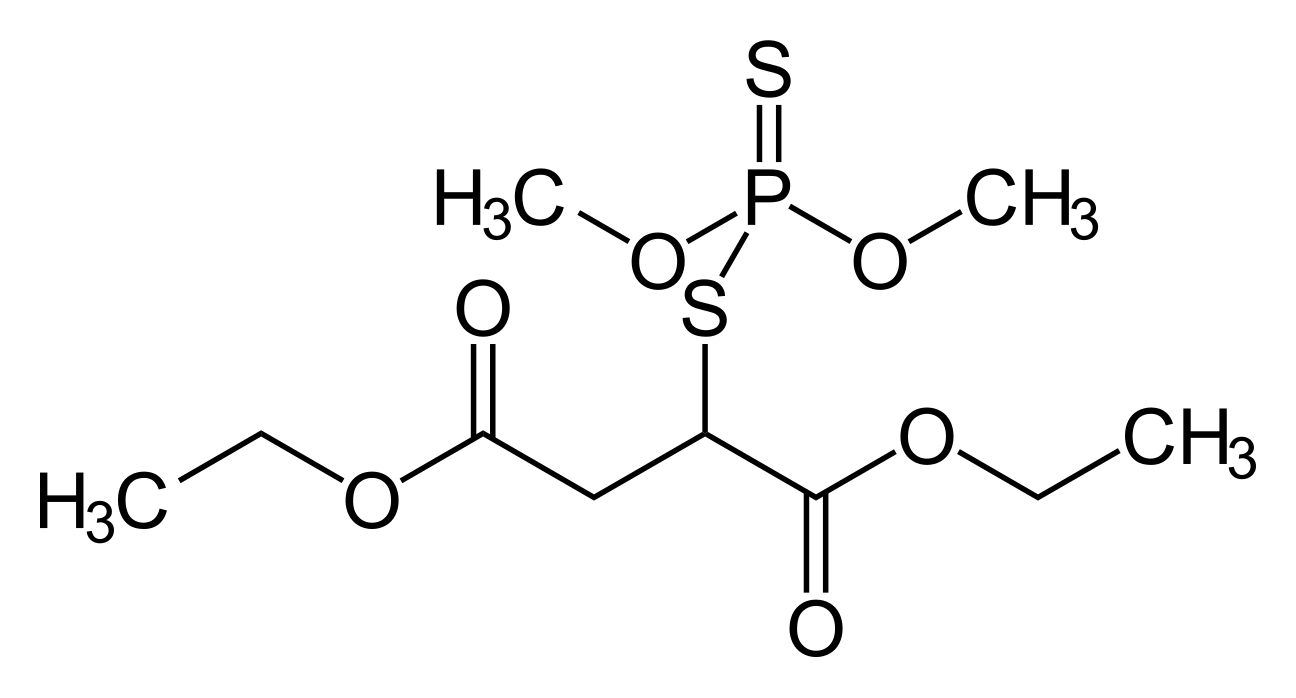
Structure of malathion.
Credit: NEUROtiker / Wikimedia Commons

License: Public domain
Rendered from SVG to PNG, whitespace trimmed and placed on white
What it is
Malathion (CAS 121-75-5) is an insecticide. [1,3]
What it does and why it is used
It is used to kill or control insects. [1]
Regulatory status and health context
Canada
The sources used for this review do not summarize Canadian rules for malathion, so we do not describe them here.
United States
The sources used for this review do not summarize US rules for malathion, so we do not describe them here.
European Union
The EU law website was not fully available when this article was reviewed, so EU legal status was not checked and is not summarized here.
Environmental notes
All reports to the European classification inventory compiled by PubChem classify malathion as very toxic to aquatic life, with long-lasting effects. [2] The sources used for this review do not assess other environmental effects.
Quick facts
- CAS: 121-75-5. [3]
- Where: crops, gardens, mosquito spraying, some lice products. [1]
- Main concern: poisoning by swallowing or skin absorption. [1]
- Environment: very toxic to aquatic life. [2]
Sources
All URLs were fetched on 2026-11-15. The EU law website was not fully available that day, so EU legislation could not be checked for this review. Source publication dates differ from this draft's review date.