
Medicines and healthWater, air and residues
Nicotine: the addictive ingredient in tobacco and vapes, and a poison for small children
CAS 54-11-5.Also known as 3-(1-methyl-2-pyrrolidinyl)pyridine, liquid nicotine, and nicotine replacement therapy.
Editorial draft Last reviewed 15 November 2026 About 816 words
CC INDEX
How it works78/100 High
Nicotine is highly addictive, can poison small children in tiny amounts, and drives tobacco use, which WHO says kills more than 7 million people a year. Exposure is common through smoking, vaping and second-hand aerosol. Canada caps nicotine in vaping liquids at 20 mg per mL, so the score sits in the high band.
An editorial summary of this article’s cited evidence. It isn’t medical advice or a personal risk estimate.
Age index
What is the age index?Which age groups are more affected by this chemical’s possible health issues, based on this article’s sources.
- Pregnancy Unborn babies Higher concern
- Infants 0 to 1 Higher concern
- Young children 1 to 5 Higher concern
- Children 6 to 12 Higher concern
- Teens 13 to 19 Higher concern
- Adults 20 to 64 Moderate
- Older adults 65 and over Moderate
- Pregnancy (higher concern): Health Canada says vaping exposes the fetus to nicotine with health risks
- Infants (higher concern): Small amounts of swallowed nicotine can poison young children
- Young children (higher concern): Small amounts of swallowed nicotine can poison young children
- Children (higher concern): Developing brains are more sensitive to nicotine
- Teens (higher concern): Developing brains are more sensitive to nicotine
- Children and teens are especially susceptible because the brain develops into early adulthood; in young children, swallowing 1 to 2 mg of nicotine has been linked to poisoning.

Illustration of nicotine products stored up high. Nicotine is found in tobacco, vaping products and quit-smoking aids.
Credit: Chemical Century; AI-generated illustration
License: CC0 1.0
Illustration, not a photograph of a specific product. Resized and cropped for the web.
Nicotine is the reason cigarettes and many vapes are so hard to put down: it is a highly addictive substance that reaches the brain within moments. It is also used in patches and gum that help people quit, because nicotine itself is not what causes most smoking-related cancers. The bigger worries are addiction, especially for young people whose brains are still developing, and accidental poisoning of small children by gum, patches or liquid refills. Keeping these products locked away and asking for help to quit can both make a real difference.
Everyday exposure: where you meet it and how much
Nicotine is found in cigarettes, chewing and pipe tobacco, e-cigarettes, liquid nicotine, nicotine gum, inhalers and patches, some insecticides and tobacco leaves. [1] It is rapidly absorbed when swallowed or inhaled. [1] When vaped, it moves quickly from the lungs through the bloodstream to the brain and other organs. [3]
Bystanders can also be exposed: nicotine has been detected in the blood and urine of non-users exposed to second-hand vaping aerosol. [3]
Known and suspected harms
Evidence labels are editorial summaries, not individual risk predictions: established means recognized under the stated conditions; probable means a likely contribution with uncertainty; possible means limited evidence; disputed means assessors disagree. These labels do not describe how common an effect is.
- Established — addiction: nicotine is an addictive substance, and withdrawal symptoms such as intense craving, anxiety, depression and trouble sleeping can begin within 2 to 3 hours of the last use and peak 2 to 3 days after quitting. [2] WHO describes nicotine as highly addictive and harmful, particularly for children, adolescents and young adults. [4]
- Established — harm to developing brains: Health Canada says children and teens are especially susceptible because brain development continues into early adulthood, and nicotine can make it harder for youth to concentrate, learn and manage emotions. [3]
- Established — poisoning of young children: acute nicotine poisoning usually occurs in young children who chew nicotine gum or patches, and swallowing 1 to 2 mg has been associated with toxicity. [1] Symptoms include vomiting, drooling, agitation, palpitations, muscle twitching, seizures and breathing that may stop; an overdose may cause seizures or death. [1]
- Established — heart rate and blood pressure: nicotine can raise heart rate by about 10 to 20 beats per minute and blood pressure by 5 to 10 mm Hg. [2]
- Established — nicotine itself not known to cause cancer: Health Canada notes that nicotine itself is not known to cause cancer, respiratory or vascular disease; the main harms of smoking come from tobacco smoke. [3,4]
Reducing avoidable exposure and harm
Store gum, patches, vapes and liquid refills out of children's reach, and get medical help right away if a child swallows any. [1] If you smoke or vape and want to stop, nicotine replacement therapies are approved to ease withdrawal while you wean off nicotine. [3] Health Canada recommends vaping outdoors only and being cautious around others; vaping is not intended for young people. [3]
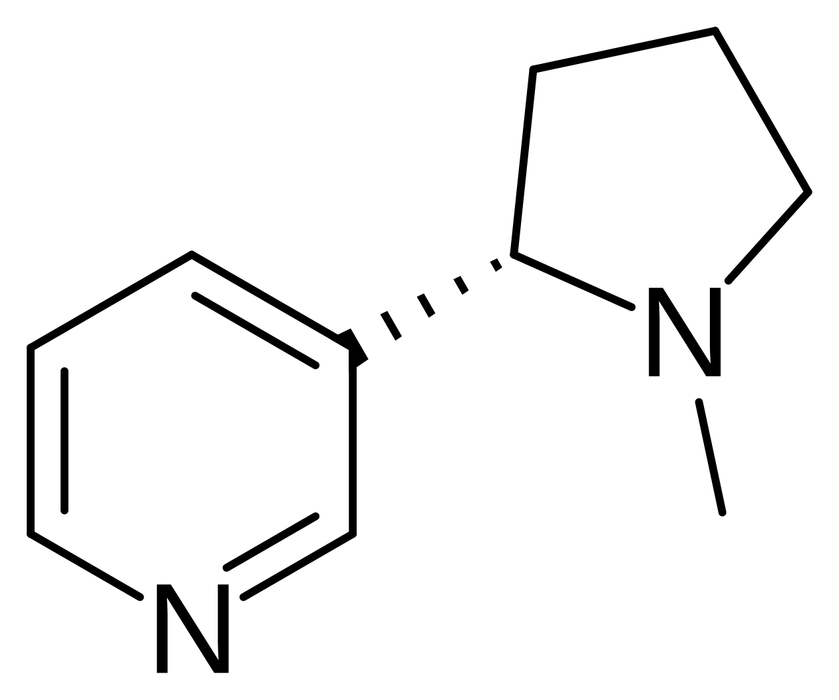
Skeletal structure of nicotine.
Credit: Innerstream / Wikimedia Commons

License: Public domain
Rendered from SVG to PNG, whitespace trimmed and placed on white
What it is
Nicotine (CAS 54-11-5) is a bitter-tasting compound that occurs naturally in large amounts in tobacco leaves. [1,6]
What it does and why it is used
It acts on the brain, where it can boost mood, increase alertness and create dependence, which is why it keeps people using tobacco and vaping products. [2] In medicine it is used in patches, gum, inhalers and pouches to help people quit smoking. [3]
Regulatory status and health context
Canada
Canada's Nicotine Concentration in Vaping Products Regulations prohibit vaping products with nicotine above 20 mg per mL. [5] Health Canada advises that vaping is not intended for young people. [3]
United States
The sources used for this review do not summarize US nicotine regulations, so we do not summarize them here.
European Union
The EU law website was not fully available when this article was reviewed, so EU legal status was not checked and is not summarized here.
Environmental notes
MedlinePlus notes that nicotine is used in some insecticides. [1] The sources used for this review do not assess its environmental effects further.
Quick facts
- CAS: 54-11-5. [6]
- Where: tobacco, vaping products, nicotine gum and patches. [1]
- Main danger: addiction; poisoning of young children. [1,2]
- Most at risk: young children, teens and pregnant people. [1,3]
Sources
All URLs were fetched on 2026-11-15; Health Canada pages were read with a separate web-reading tool because they did not respond to this review's direct requests. The EU law website was not fully available that day, so EU legislation could not be checked. Source publication dates differ from this draft's review date.