
Omeprazole: the heartburn pill that turns down stomach acid, and why courses are short
CAS 73590-58-6.Also known as proton pump inhibitor and PPI.
Editorial draft Last reviewed 15 November 2026 About 619 words
CC INDEX
How it works48/100 Moderate
Omeprazole is usually well tolerated, but long or high-dose use of this class is linked to fractures and stomach polyps, and rare serious skin and allergic reactions occur. It is a common heartburn medicine sold without a prescription. Package limits on course length guide use, so the score sits in the moderate band.
An editorial summary of this article’s cited evidence. It isn’t medical advice or a personal risk estimate.
Age index
What is the age index?Which age groups are more affected by this chemical’s possible health issues, based on this article’s sources.
- Pregnancy Unborn babies Not well studied
- Infants 0 to 1 Not well studied
- Young children 1 to 5 Not well studied
- Children 6 to 12 Not well studied
- Teens 13 to 19 Not well studied
- Adults 20 to 64 Lower concern
- Older adults 65 and over Moderate
- Non-prescription omeprazole is meant for adults with frequent heartburn; children take it only on prescription. MedlinePlus asks people with osteoporosis, low magnesium, calcium or potassium, low vitamin B12, lupus or liver disease to tell their doctor first.

Illustration of a morning routine. Non-prescription omeprazole is usually taken in the morning before eating.
Credit: Chemical Century; AI-generated illustration
License: CC0 1.0
Illustration, not a photograph of a specific product. Resized and cropped for the web.
Omeprazole is a heartburn medicine, sold with and without a prescription, for people whose heartburn keeps coming back. It works by turning down the amount of acid the stomach makes, so it can take a few days to reach its full effect. Non-prescription packs are designed for short courses, and longer use is usually best discussed with a doctor. Heartburn that comes with chest pain, trouble swallowing or weight loss may need a check-up rather than another box.
Everyday exposure: where you meet it and how much
Non-prescription omeprazole is used to treat frequent heartburn, meaning heartburn on 2 or more days a week, in adults. [1] Prescription omeprazole treats reflux disease, ulcers and other conditions with too much stomach acid in adults and some children. [1] The non-prescription delayed-release tablets are usually taken once a day in the morning, at least 1 hour before eating, for 14 days in a row. [1]
Known and suspected harms
Evidence labels are editorial summaries, not individual risk predictions: established means recognized under the stated conditions; probable means a likely contribution with uncertainty; possible means limited evidence; disputed means assessors disagree. These labels do not describe how common an effect is.
- Established — common side effects: constipation, gas, nausea, diarrhea, vomiting and headache. [1]
- Probable — bone fractures: people who take proton pump inhibitors such as omeprazole may be more likely to fracture their wrists, hips or spine, with the highest risk at high doses or with use for one year or longer. [1]
- Probable — stomach polyps: people who take proton pump inhibitors may develop fundic gland polyps, a type of growth on the stomach lining. [1]
- Established — rare serious reactions: blistering or peeling skin, allergic swelling, irregular heartbeat, seizures, severe watery diarrhea with fever, or new joint pain with a sun-sensitive rash need urgent medical attention. [1]
Reducing avoidable exposure and harm
Do not take non-prescription omeprazole for longer than 14 days, or more often than once every 4 months, without talking to your doctor. [1] It is not for immediate relief; it may take 1 to 4 days to feel the full benefit. [1] Tell your doctor first if heartburn comes with chest pain, shortness of breath, trouble swallowing, unexplained weight loss, or bloody vomit or stools. [1]
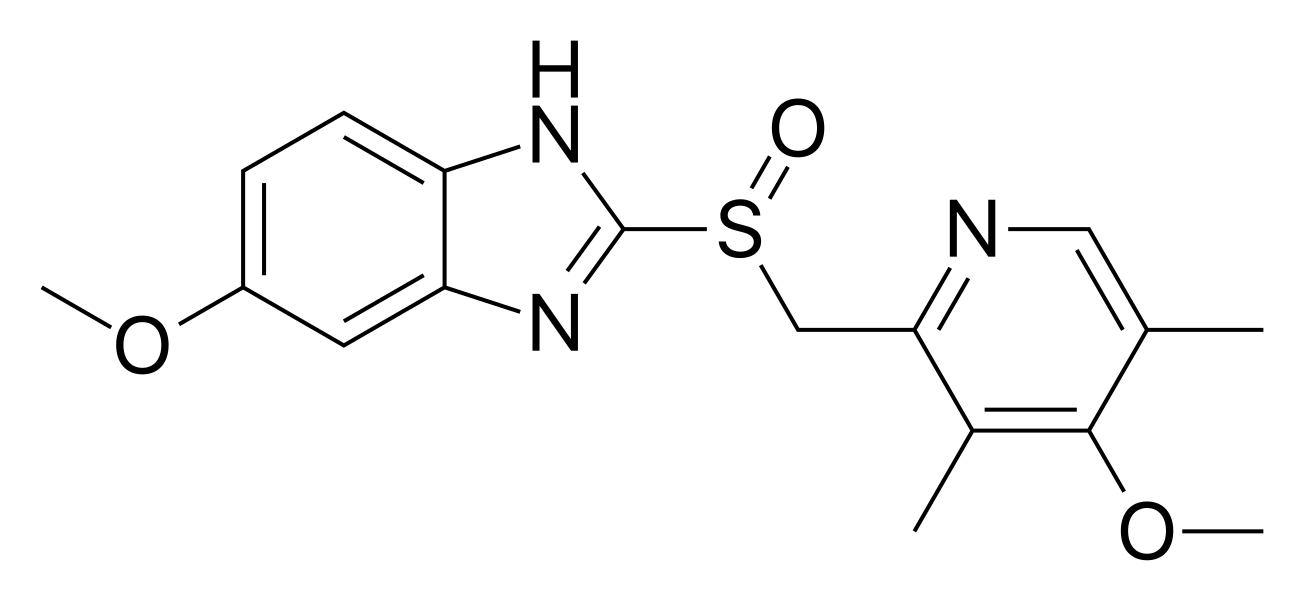
Structural formula of omeprazole.
Credit: Ayacop / Wikimedia Commons

License: Public domain
Rendered from SVG to PNG, whitespace trimmed and placed on white
What it is
Omeprazole (CAS 73590-58-6) is a proton-pump inhibitor. [1,2]
What it does and why it is used
It decreases the amount of acid made in the stomach. [1]
Regulatory status and health context
Canada
The sources used for this review do not summarize Canadian rules for omeprazole, so we do not describe them here.
United States
Omeprazole is sold both on prescription and without one; the non-prescription form is a delayed-release tablet for frequent heartburn in adults. [1]
European Union
The EU law website was not fully available when this article was reviewed, so EU legal status was not checked and is not summarized here.
Environmental notes
The sources used for this review do not assess omeprazole's environmental effects, so we do not summarize them here. MedlinePlus advises using a medicine take-back program rather than flushing unneeded medicine. [1]
Quick facts
- CAS: 73590-58-6. [2]
- Where: heartburn tablets and prescription capsules. [1]
- Main concern: fractures and polyps with long or high-dose use. [1]
- Most at risk: people with osteoporosis or low magnesium, calcium or B12. [1]
Sources
All URLs were fetched on 2026-11-15. The EU law website was not fully available that day, so EU legislation could not be checked for this review. Source publication dates differ from this draft's review date.