
Household materialsWater, air and residues
Organophosphate flame retardants: are they in your couch, nursing pillow and house dust?
Also known as OPFRs, TDCIPP, TDCPP, chlorinated tris, TCEP, TCIPP, TPHP, triphenyl phosphate, and TPP.
Editorial draft Last reviewed 21 November 2026 About 858 words
CC INDEX
How it works56/100 Moderate
These chemicals are common in household dust and foam furniture. Human studies suggest links to hormone changes but are limited; TDCIPP is listed as a carcinogen under California Proposition 65 and Canada bans TCEP in foam products for children under three.
An editorial summary of this article’s cited evidence. It isn’t medical advice or a personal risk estimate.
Age index
What is the age index?Which age groups are more affected by this chemical’s possible health issues, based on this article’s sources.
- Pregnancy Unborn babies Moderate
- Infants 0 to 1 Higher concern
- Young children 1 to 5 Higher concern
- Children 6 to 12 Moderate
- Teens 13 to 19 Not well studied
- Adults 20 to 64 Moderate
- Older adults 65 and over Not well studied
- Pregnancy (moderate): Hormone-related concerns; human data limited
- Infants (higher concern): Foam baby products and floor dust (general principle)
- Young children (higher concern): Hand-to-mouth contact with house dust (general principle)

Illustration of foam furnishings. Flame retardants in foam can migrate into household dust.
Credit: Chemical Century; AI-generated illustration
License: CC0 1.0
Illustration, not a photograph of a specific product. Resized and cropped for the web.
When older flame retardants called PBDEs were phased out, many sofa and foam makers switched to a different family: organophosphate flame retardants. These chemicals slowly escape from foam cushions, baby products and electronics and settle in household dust, where crawling babies and toddlers pick them up on their hands. Studies in adults have linked higher dust levels with changes in thyroid and reproductive hormones, and one common chemical is listed in California as a cause of cancer. The science in people is still young, but simple habits like wet dusting and handwashing lower exposure.
Everyday exposure: where you meet it and how much
A study of foam from 102 US couches bought between 1985 and 2010 found flame retardants in 85%. In couches bought in 2005 or later, after the older PentaBDE mixture was phased out, TDCIPP was the most common, found in 52%. A flammability-standard label predicted that a flame retardant was present, but the lack of a label did not mean it was absent. [2]
These chemicals are not bound tightly to foam, so they move into household dust. In one study, TDCIPP and triphenyl phosphate were found in 96% and 98% of house dust samples. [1] A North Carolina study found that a flame retardant's presence in sofa foam was generally linked to higher levels of that chemical in house dust, and concluded that sofas are likely major sources of exposure at home. For TDCIPP the link was weaker, suggesting other sources too. [3]
Known and suspected harms
Evidence labels are editorial summaries, not individual risk predictions: established means recognized under the stated conditions; probable means a likely contribution with uncertainty; possible means limited evidence; disputed means assessors disagree.
- Possible — hormone changes and semen quality: in men attending a fertility clinic, higher TDCIPP in house dust was linked to a small drop in free thyroxine and a rise in prolactin, and higher triphenyl phosphate was linked to a 19% lower sperm concentration. The authors concluded these flame retardants "may be associated" with altered hormones and lower semen quality and that more research is needed. [1]
- Established listing — TDCIPP and cancer: California lists TDCIPP under Proposition 65 as a chemical known to the state to cause cancer. This listing is based mainly on animal evidence. [4]
- Established regulatory concern — TCEP in children's foam products: Canada prohibits products made wholly or partly of polyurethane foam containing TCEP that are intended for children under three; Health Canada says TCEP is harmful to young children's health through oral exposure. [5,6]
Reducing avoidable exposure
Dust with a damp cloth and vacuum with a HEPA filter, wash hands (and children's hands) before eating, and replace torn foam cushions or cover exposed foam. When buying furniture or children's foam products, look for labels stating no added flame retardants. These steps lower exposure; they have not been shown to prevent a specific disease. [1,3,6]
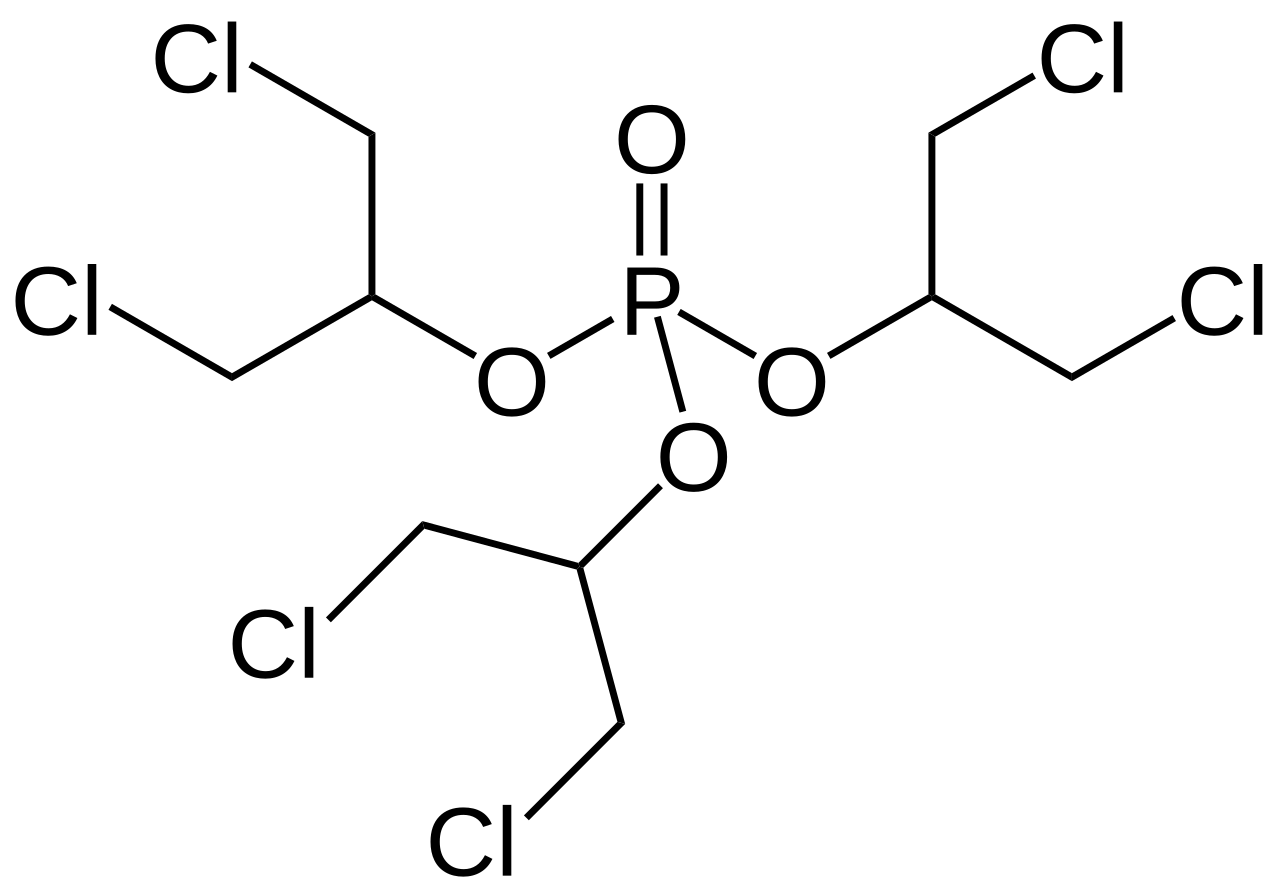
Structural formula of tris(1,3-dichloro-2-propyl) phosphate (TDCIPP), a common organophosphate flame retardant.
Credit: Ed (Edgar181) / Wikimedia Commons

License: Public domain
Wikimedia-provided scaled PNG/JPEG rendering; no content edits
What it is
Organophosphate flame retardants are esters of phosphoric acid. Some contain chlorine, such as TDCIPP (CAS 13674-87-8) and TCEP (CAS 115-96-8); others, such as triphenyl phosphate, do not. [1,4,5]
What it does and why it is used
They are added to polyurethane foam, plastics, textiles and electronics to slow the spread of fire, partly to meet flammability standards for upholstered furniture. [2]
Regulatory status and health context
Canada
Since 2014, TCEP has been banned in polyurethane foam products intended for children under three. Health Canada also encourages manufacturers to meet flammability requirements without flame-retardant chemicals. [5,6]
United States
California lists TDCIPP under Proposition 65 as known to cause cancer, which triggers warning requirements. A US couch study found that the absence of a flammability label did not mean a couch was free of flame retardants. [2,4]
European Union
The sources used here do not cover EU rules for these chemicals.
Environmental notes
The sources used here focus on indoor exposure and do not provide enough environmental data for a rating.
Quick facts
- Examples: TDCIPP, TCEP, TCIPP, triphenyl phosphate. [1,3,5]
- Where: foam furniture, baby products, electronics, house dust. [1,2,3]
- Human evidence: links with hormone changes and semen quality (possible). [1]
- California: TDCIPP listed as causing cancer. [4]
- Canada: TCEP banned in foam products for children under three. [5]
Sources
Sources were accessed on 2026-11-21. Source publication dates differ from this draft's review date. Image licences are listed with each image.
- Meeker JD, Stapleton HM. House dust concentrations of organophosphate flame retardants in relation to hormone levels and semen quality parameters. Environ Health Perspect, 2010 (PubMed).
- Stapleton HM et al. Novel and high volume use flame retardants in US couches reflective of the 2005 PentaBDE phase out. Environ Sci Technol, 2012 (PubMed).
- Hammel SC et al. Associations between flame retardant applications in furniture foam, house dust levels, and residents' serum levels. Environ Int, 2017 (PubMed).
- California OEHHA: Tris(1,3-dichloro-2-propyl) phosphate (TDCPP), Proposition 65.
- Canada Gazette: Regulations Amending Schedule 2 to the Canada Consumer Product Safety Act (TCEP), SOR/2014-79.
- Health Canada: Notice to stakeholders on the use of flame-retardant chemicals in certain consumer products.