
Phenylephrine: the cold-tablet decongestant regulators say does not work when swallowed
CAS 59-42-7.Also known as phenylephrine hydrochloride and oral phenylephrine.
Editorial draft Last reviewed 15 November 2026 About 769 words
CC INDEX
How it works48/100 Moderate
FDA found no safety signal at label doses but proposed removing oral phenylephrine because it does not work as a decongestant. It can cause nervousness and sleeplessness, and it is common in cold and allergy products. Canada's under-6 rule and the pending US proposal keep regulation in view, so the score sits in the moderate band.
An editorial summary of this article’s cited evidence. It isn’t medical advice or a personal risk estimate.
Age index
What is the age index?Which age groups are more affected by this chemical’s possible health issues, based on this article’s sources.
- Pregnancy Unborn babies Not well studied
- Infants 0 to 1 Higher concern
- Young children 1 to 5 Higher concern
- Children 6 to 12 Moderate
- Teens 13 to 19 Lower concern
- Adults 20 to 64 Lower concern
- Older adults 65 and over Moderate
- Infants (higher concern): Cough and cold medicines should not be given under age 6 in Canada
- Young children (higher concern): Cough and cold medicines should not be given under age 6 in Canada
- Health Canada says non-prescription cough and cold medicines with phenylephrine should not be given to children under 6. People with high blood pressure, diabetes, an enlarged prostate, or thyroid or heart disease should ask a doctor first.

Illustration of a pharmacy shelf. Phenylephrine is a decongestant in many cold and allergy tablets.
Credit: Chemical Century; AI-generated illustration
License: CC0 1.0
Illustration, not a photograph of a specific product. Resized and cropped for the web.
Phenylephrine is a decongestant found in many cold and allergy tablets, but its reputation has taken a knock. US regulators have proposed removing it from swallowed decongestant products because their review found it does not relieve a stuffy nose when taken by mouth. Their concern is about whether it works, not about safety at label doses. It can still cause nervousness or sleeplessness, and young children should not be given cough and cold products without advice.
Everyday exposure: where you meet it and how much
Phenylephrine is used to relieve nasal discomfort from colds, allergies and hay fever and to relieve sinus congestion and pressure. [1] It comes as a tablet, a liquid or a dissolving strip, usually taken every 4 hours as needed, alone or in combination products. [1] It is also an ingredient in nasal sprays. [2]
Known and suspected harms
Evidence labels are editorial summaries, not individual risk predictions: established means recognized under the stated conditions; probable means a likely contribution with uncertainty; possible means limited evidence; disputed means assessors disagree. These labels do not describe how common an effect is.
- Established — not effective by mouth: FDA proposed in November 2024 to remove oral phenylephrine as a non-prescription nasal decongestant ingredient after its review found it is not effective for this use. [2] FDA said the proposal is based on effectiveness, not safety. [2]
- Established — side effects: nervousness, dizziness and sleeplessness mean you should stop using it and call a doctor. [1]
- Established — risk to young children: non-prescription cough and cold combination products, including those with phenylephrine, can cause serious side effects or death in young children. [1] Health Canada lists phenylephrine among ingredients that should not be used in children under 6. [4]
- Established — interactions and conditions: do not take it with, or within 2 weeks of stopping, an MAO inhibitor antidepressant; people with high blood pressure, diabetes, an enlarged prostate, or thyroid or heart disease should tell their doctor. [1]
Reducing avoidable exposure and harm
Read the Drug Facts label and check every ingredient, because many cold products contain more than one active ingredient. [3] Ask a pharmacist about other options for a stuffy nose. [3] Stop and call a doctor if symptoms do not get better within 7 days or you have a fever. [1] Do not give cough and cold medicines to children under 6. [4]
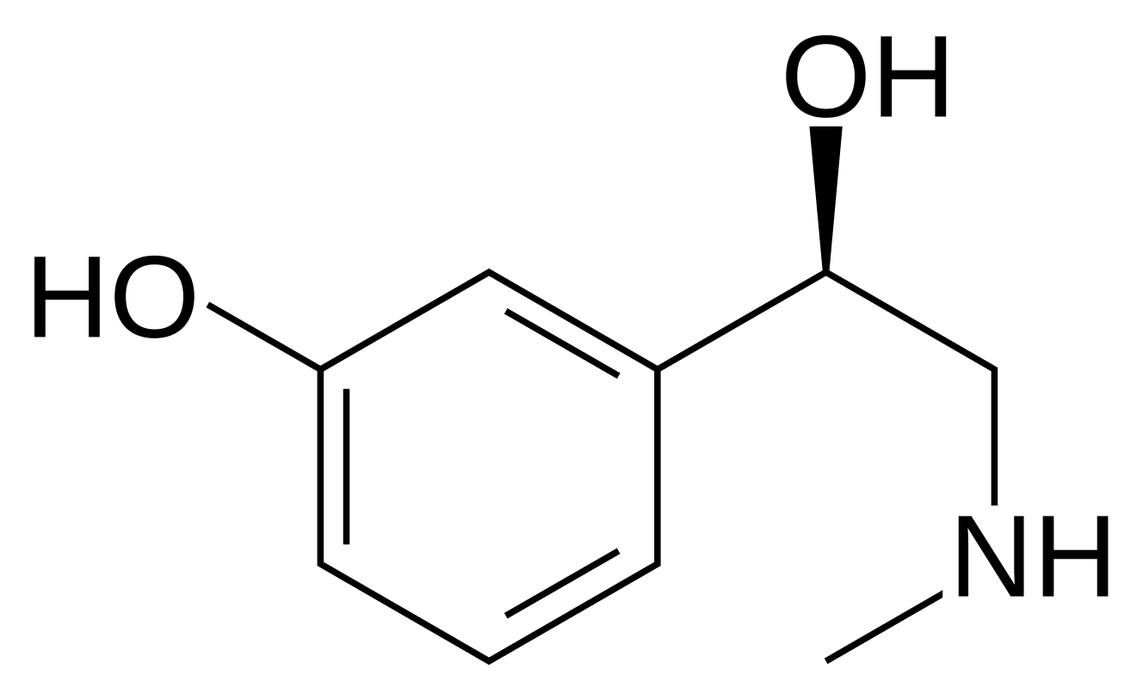
Structural formula of phenylephrine.
Credit: Vyacheslav Nasretdinov / Wikimedia Commons

License: CC BY-SA 3.0
Rendered from SVG to PNG, whitespace trimmed and placed on white
What it is
Phenylephrine (CAS 59-42-7) is a nasal decongestant, sold in medicines mainly as phenylephrine hydrochloride (CAS 61-76-7). [1,5,6]
What it does and why it is used
It reduces swelling of the blood vessels in the nasal passages. [1] FDA's review concluded that, when swallowed at label doses, it is not effective at relieving nasal congestion. [2]
Regulatory status and health context
Canada
In 2009 Health Canada had manufacturers relabel non-prescription cough and cold medicines containing phenylephrine and certain other ingredients as not for use in children under 6. [4] The sources used for this review do not describe any Canadian review of oral phenylephrine's effectiveness.
United States
FDA's November 2024 proposed order would remove oral phenylephrine from the non-prescription decongestant rules; products may still be sold until a final order is issued, and nasal sprays are not affected. [2,3] The FDA pages read for this review do not report a final order. [3]
European Union
The EU law website was not fully available when this article was reviewed, so EU legal status was not checked and is not summarized here.
Environmental notes
The sources used for this review do not assess phenylephrine's environmental effects, so we do not summarize them here. MedlinePlus advises using a medicine take-back program rather than flushing unneeded medicine. [1]
Quick facts
- CAS: 59-42-7. [5]
- Where: cold and allergy tablets, liquids and nasal sprays. [1,2]
- Main concern: does not work when swallowed, per FDA review. [2]
- Most at risk: children under 6; people with heart disease. [1,4]
Sources
All URLs were fetched on 2026-11-15; the Health Canada page was read with a separate web-reading tool because it did not respond to this review's direct requests. The EU law website was not fully available that day, so EU legislation could not be checked. Source publication dates differ from this draft's review date.
- MedlinePlus: Phenylephrine.
- FDA: FDA proposes ending use of oral phenylephrine as OTC monograph nasal decongestant active ingredient (Nov 2024).
- FDA: Key information about nonprescription oral phenylephrine.
- Health Canada: Concerns about children's medication.
- PubChem PUG REST: phenylephrine synonyms.
- PubChem PUG REST: phenylephrine hydrochloride synonyms.