
Potassium bromate: the flour improver allowed in the US but not on Canada's list
CAS 7758-01-2.Also known as bromic acid, potassium salt and bromated flour.
Editorial draft Last reviewed 15 November 2026 About 747 words
CC INDEX
How it works52/100 Moderate
IARC classes potassium bromate as possibly carcinogenic to humans based on animal tumours, and it is highly toxic in acute poisoning, but human data are lacking. Exposure is limited to residues in some US bread and malt products. It is not on Canada's permitted flour treatment list and is banned in EU cosmetics, so the score sits in the moderate band.
An editorial summary of this article’s cited evidence. It isn’t medical advice or a personal risk estimate.
Age index
What is the age index?Which age groups are more affected by this chemical’s possible health issues, based on this article’s sources.
- Pregnancy Unborn babies Not well studied
- Infants 0 to 1 Not well studied
- Young children 1 to 5 Not well studied
- Children 6 to 12 Not well studied
- Teens 13 to 19 Not well studied
- Adults 20 to 64 Not well studied
- Older adults 65 and over Not well studied
- No human cancer data were available to IARC, and the sources reviewed give no age-specific information on dietary bromate residues.

Illustration of a bakery counter. Potassium bromate has been used in some flour to strengthen bread dough.
Credit: Chemical Century; AI-generated illustration
License: CC0 1.0
Illustration, not a photograph of a specific product. Resized and cropped for the web.
Potassium bromate has long been used to strengthen bread dough, and some flour sold in the United States is labelled 'bromated' because of it. When baking goes as intended, most of it should break down, leaving only small residues. The concern is that it caused tumours in laboratory animals, and international cancer experts list it as possibly carcinogenic to people, although human data are lacking. Canada does not include it among permitted flour treatment agents, so for many readers this is mostly a label to watch on imported products.
Everyday exposure: where you meet it and how much
Exposure to potassium bromate may occur through its use as a dough conditioner and food additive, and bromate can also form in some drinking water as a by-product of ozone disinfection. [1] In the US, bromated flour may contain up to 50 parts per million of potassium bromate, added only to flours whose baking qualities it improves. [2] It may also be used in malting barley for beer and spirits under set residue limits. [3]
Known and suspected harms
Evidence labels are editorial summaries, not individual risk predictions: established means recognized under the stated conditions; probable means a likely contribution with uncertainty; possible means limited evidence; disputed means assessors disagree. These labels do not describe how common an effect is.
- Possible — cancer: IARC classed potassium bromate in Group 2B, possibly carcinogenic to humans; no human data were available, but in rats it caused kidney and thyroid tumours, and in mice a low incidence of kidney tumours. [1]
- Established — damage in animal kidneys: it produces lipid peroxidation and oxidative DNA damage in rat kidney, and IARC concluded that it causes kidney tumours through oxidative damage. [1]
- Established — acute poisoning: IARC notes a number of reported cases of acute poisoning and describes potassium bromate as highly toxic. [1]
Reducing avoidable exposure and harm
In the US, check flour and bread labels for 'bromated' flour or potassium bromate if you prefer to avoid it. [2] FDA says it has worked with the baking industry to improve baking technology and testing so that the ingredient is used in a way that minimizes residual bromate. [4]
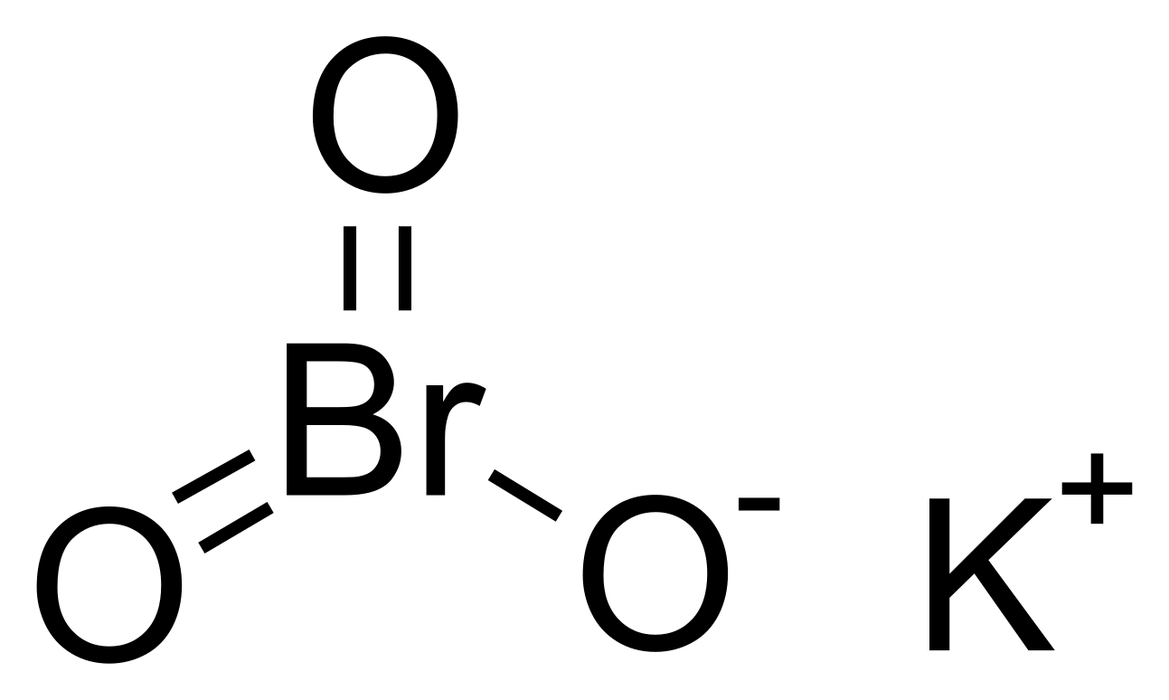
Structural formula of potassium bromate.
Credit: Warraich Sahib / Wikimedia Commons

License: Public domain
Rendered from SVG to PNG, whitespace trimmed and placed on white
What it is
Potassium bromate (CAS 7758-01-2) is the potassium salt of bromic acid, a strong oxidizing agent. [1,7]
What it does and why it is used
It is added to some flours to improve their baking qualities, and is used in malting barley. [2,3]
Regulatory status and health context
Canada
Potassium bromate does not appear on Health Canada's List of Permitted Flour Treatment Agents, which lists the agents that may be used in bread and flour in Canada. [5]
United States
US rules allow potassium bromate in bromated flour at up to 50 ppm and in malting barley under residue limits. [2,3] It appears on FDA's list of select chemicals in the food supply under review, where FDA describes working with industry to minimize residual bromate. [4]
European Union
Potassium bromate is listed in Annex II of the EU cosmetics regulation, the list of substances prohibited in cosmetic products. [6] EU food-additive law could not be checked for this review.
Environmental notes
IARC notes that bromate can form in drinking water as a by-product of ozone disinfection. [1]
Quick facts
- CAS: 7758-01-2. [1,7]
- Where: bromated flour and some bread in the US; malting barley. [2,3]
- Main concern: possible carcinogen based on animal studies. [1]
- Most at risk: no group singled out by the sources reviewed. [1]
Sources
All URLs were fetched on 2026-11-15; Health Canada pages were read with a separate web-reading tool because they did not respond to this review's direct requests. The EU law website was not fully available that day, so the EU cosmetics regulation was read from a copy fetched for earlier Chemical Century articles in November 2026; that copy is the regulation as originally published, later amendments were not checked, and EU food-additive law could not be checked. Source publication dates differ from this draft's review date.
- IARC Summaries and Evaluations: Potassium bromate (Vol. 73, 1999), archived copy.
- eCFR: 21 CFR 137.155, bromated flour.
- eCFR: 21 CFR 172.730, potassium bromate.
- FDA: List of select chemicals in the food supply under FDA review.
- Health Canada: List of Permitted Flour Treatment Agents.
- EUR-Lex: Regulation (EC) No 1223/2009 on cosmetic products, as originally published.
- PubChem PUG REST: potassium bromate synonyms.