
Potassium sorbate: the preservative in bread, cheese and wine
CAS 24634-61-5.Also known as sorbate preservative.
Editorial draft Last reviewed 15 November 2026 About 544 words
CC INDEX
How it works34/100 Mild
Potassium sorbate is generally recognized as safe in food, and its known hazards are eye, skin and airway irritation from the pure chemical. It is common in baked goods, cheese and drinks. Canada sets food-by-food limits, so the score sits in the mild band.
An editorial summary of this article’s cited evidence. It isn’t medical advice or a personal risk estimate.
Age index
What is the age index?Which age groups are more affected by this chemical’s possible health issues, based on this article’s sources.
- Pregnancy Unborn babies Lower concern
- Infants 0 to 1 Lower concern
- Young children 1 to 5 Lower concern
- Children 6 to 12 Lower concern
- Teens 13 to 19 Lower concern
- Adults 20 to 64 Lower concern
- Older adults 65 and over Lower concern
- The sources used for this review do not single out an age group.

Illustration of bread, cheese and wine. Potassium sorbate is a preservative used in many such foods.
Credit: Chemical Century; AI-generated illustration
License: CC0 1.0
Illustration, not a photograph of a specific product. Resized and cropped for the web.
Potassium sorbate is a common preservative that helps slow spoilage in foods like bread, cheese, wine and salad dressing. It is generally recognized as safe in the United States and is permitted in many foods in Canada at set limits. The pure powder can irritate the eyes and skin, which matters mostly to people handling it in bulk. In foods, it is usually used at levels that regulators set food by food.
Everyday exposure: where you meet it and how much
Health Canada permits potassium sorbate as a preservative in foods including bread, cakes and muffins, many cheeses, cider and wine, olives, tortillas, margarine and salad dressings. [2] Limits include 1,000 ppm in bread and 500 ppm in wine, calculated as sorbic acid. [2]
Known and suspected harms
Evidence labels are editorial summaries, not individual risk predictions: established means recognized under the stated conditions; probable means a likely contribution with uncertainty; possible means limited evidence; disputed means assessors disagree. These labels do not describe how common an effect is.
- Established — eye irritation: in notifications to the UN-based hazard classification system compiled by PubChem, the pure chemical is most often classed as causing serious eye irritation. [3]
- Established — skin irritation: many notifications also class it as causing skin irritation. [3]
- Possible — airway irritation: a smaller share of notifications class the dust as possibly causing respiratory irritation. [3]
Reducing avoidable exposure and harm
In the kitchen, normal food amounts are allowed by regulators. [1,2] If you handle the pure powder, avoid getting it in your eyes or on your skin and avoid breathing the dust. [3]
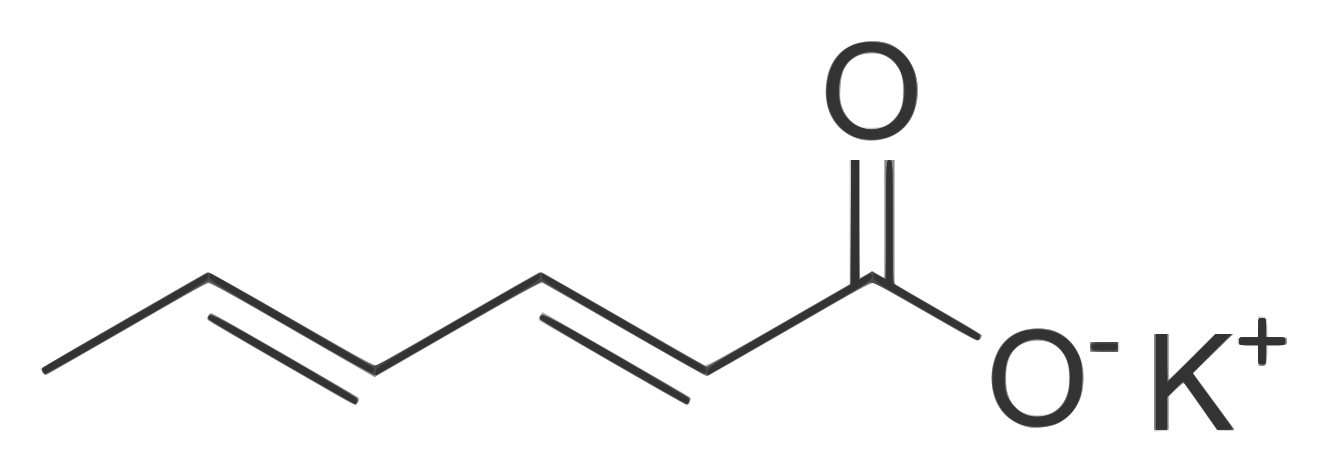
Structural formula of potassium sorbate.
Credit: Mrgreen71 / Wikimedia Commons

License: CC BY-SA 3.0
Rendered from SVG to PNG, whitespace trimmed and placed on white
What it is
Potassium sorbate (CAS 24634-61-5) is the potassium salt of sorbic acid. [4]
What it does and why it is used
It acts as a preservative, slowing spoilage in foods and drinks. [2]
Regulatory status and health context
Canada
Potassium sorbate is on Health Canada's List of Permitted Preservatives, with limits such as 1,000 ppm in bread, 3,500 ppm in cakes and muffins, 500 ppm in wine and 3,350 ppm in salad dressings. [2]
United States
US rules list potassium sorbate as generally recognized as safe when used in accordance with good manufacturing practice. [1]
European Union
The EU law website was not fully available when this article was reviewed, so EU legal status was not checked and is not summarized here.
Environmental notes
The sources used for this review do not assess potassium sorbate's environmental effects, so we do not summarize them here.
Quick facts
- CAS: 24634-61-5. [4]
- Where: bread, cheese, wine, dressings. [2]
- Main concern: eye and skin irritation from the pure chemical. [3]
- Most at risk: people handling the bulk powder. [3]
Planning meals around fewer additives? See also The Low-Additive Family Meal Plan, a printable 7-day plan with recipes and a grocery list ($4 USD).
Sources
All URLs were fetched on 2026-11-15; Health Canada pages were read with a separate web-reading tool because they did not respond to this review's direct requests. The EU law website was not fully available that day, so EU legislation could not be checked. Source publication dates differ from this draft's review date.