
Saccharin: the oldest artificial sweetener and how its cancer warning came off
CAS 81-07-2.Also known as sodium saccharin and calcium saccharin.
Editorial draft Last reviewed 15 November 2026 About 717 words
CC INDEX
How it works40/100 Mild
Early rat studies linked saccharin to bladder cancer, but more than 30 human studies found those results did not apply to people, and FDA considers it safe within its acceptable daily intake. Exposure is common through table-top sweeteners and diet foods. US and Canadian rules set limits, so the score sits in the mild band.
An editorial summary of this article’s cited evidence. It isn’t medical advice or a personal risk estimate.
Age index
What is the age index?Which age groups are more affected by this chemical’s possible health issues, based on this article’s sources.
- Pregnancy Unborn babies Lower concern
- Infants 0 to 1 Lower concern
- Young children 1 to 5 Lower concern
- Children 6 to 12 Lower concern
- Teens 13 to 19 Lower concern
- Adults 20 to 64 Lower concern
- Older adults 65 and over Lower concern
- The sources used for this review set one acceptable daily intake for everyone and do not single out an age group.

Illustration of a diner counter. Saccharin is a long-used zero-calorie sweetener.
Credit: Chemical Century; AI-generated illustration
License: CC0 1.0
Illustration, not a photograph of a specific product. Resized and cropped for the web.
Saccharin is the oldest artificial sweetener still in use, familiar from table-top sweetener packets. It is hundreds of times sweeter than sugar and adds no calories, though some people notice a bitter or metallic aftertaste. For years it carried a cancer warning in the United States after studies in rats, but later research found those results did not apply to people and the label was dropped. Like other sweeteners, it may not help much with long-term weight control.
Everyday exposure: where you meet it and how much
Saccharin is used in drinks, as a table-top sugar substitute, and in processed foods; it also has technical uses in chewable vitamins and chewing gum. [1,2] It is 200 to 700 times sweeter than table sugar, has no calories, and may have a bitter or metallic aftertaste in some liquids. [1,3] It was first discovered and used in 1879. [1]
Known and suspected harms
Evidence labels are editorial summaries, not individual risk predictions: established means recognized under the stated conditions; probable means a likely contribution with uncertainty; possible means limited evidence; disputed means assessors disagree. These labels do not describe how common an effect is.
- Established — rat cancer findings do not apply to people: in the early 1970s saccharin was linked with bladder cancer in laboratory rats, which led to a US warning label. [1] More than 30 human studies later showed the rat results were irrelevant to humans, and in 2000 the US National Toxicology Program concluded saccharin should be removed from its list of potential carcinogens. [1]
- Established — acceptable daily intake: FDA lists an acceptable daily intake of 15 mg per kilogram of body weight, which FDA estimates a 60 kg adult would reach at about 45 sweetener packets a day. [1]
- Probable — little help with long-term weight control: WHO's 2023 guideline names saccharin among the non-sugar sweeteners it recommends against using for weight control, citing no long-term benefit for body fat and possible long-term undesirable effects. [4]
Reducing avoidable exposure and harm
Check labels if you prefer to avoid it: US rules require foods with saccharin to state how much they contain. [2] WHO suggests reducing the sweetness of the diet overall, for example with fruit or unsweetened drinks. [4]
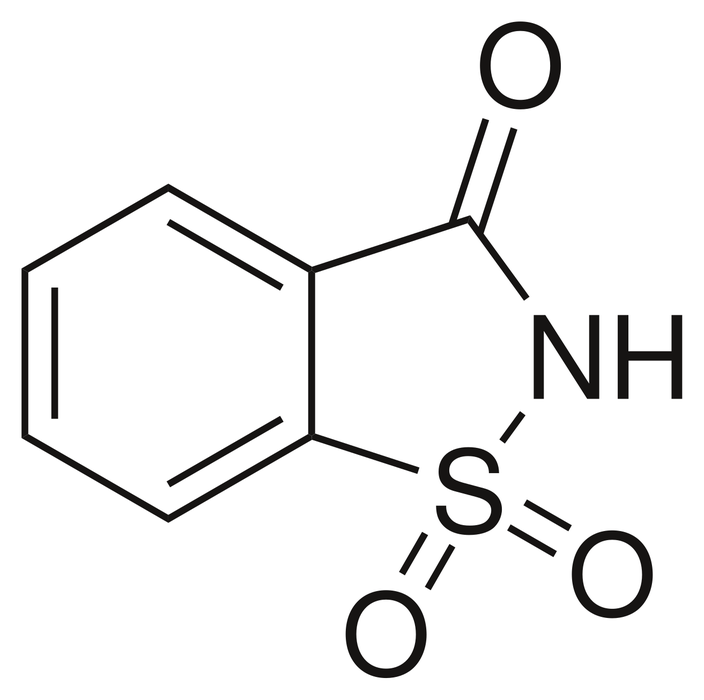
Structural formula of saccharin.
Credit: Harbin / Wikimedia Commons

License: Public domain
Rendered from SVG to PNG, whitespace trimmed and placed on white
What it is
Saccharin (CAS 81-07-2) is the chemical 1,2-benzisothiazolin-3-one 1,1-dioxide; it is also used as ammonium, calcium and sodium salts. [2,6]
What it does and why it is used
It provides intense sweetness without calories, replacing sugar in diet products and table-top sweeteners. [1,3]
Regulatory status and health context
Canada
Saccharin and its calcium, potassium and sodium salts are on Health Canada's List of Permitted Sweeteners, including table-top sweeteners, chewing gum up to 2,500 ppm and carbonated non-alcoholic drinks up to 300 ppm. [5]
United States
FDA has regulated saccharin as a food additive since 1977, and products no longer have to carry the old warning label. [1] An interim US regulation limits it to 12 mg per fluid ounce in drinks, 20 mg per teaspoon of sugar sweetness in table-top use and 30 mg per serving in processed foods. [2]
European Union
The EU law website was not fully available when this article was reviewed, so EU legal status was not checked and is not summarized here.
Environmental notes
The sources used for this review do not assess saccharin's environmental effects, so we do not summarize them here.
Quick facts
- CAS: 81-07-2. [6]
- Where: table-top sweetener packets, diet drinks, chewable vitamins. [1,2]
- Main concern: largely resolved cancer question; unclear long-term effects of sweeteners. [1,4]
- Most at risk: no specific group identified. [1]
Sources
All URLs were fetched on 2026-11-15; Health Canada pages were read with a separate web-reading tool because they did not respond to this review's direct requests. The EU law website was not fully available that day, so EU legislation could not be checked. Source publication dates differ from this draft's review date.
- FDA: Aspartame and other sweeteners in food.
- eCFR: 21 CFR 180.37, saccharin, ammonium saccharin, calcium saccharin, and sodium saccharin.
- MedlinePlus: Sweeteners - sugar substitutes.
- WHO: WHO advises not to use non-sugar sweeteners for weight control (2023).
- Health Canada: List of Permitted Sweeteners.
- PubChem PUG REST: saccharin synonyms.