
Food and drinkCleaning and laundry
Sodium bicarbonate: baking soda is safe in the kitchen but not a remedy to take by the spoonful
CAS 144-55-8.Also known as baking soda, sodium hydrogen carbonate, and bicarbonate of soda.
Editorial draft Last reviewed 15 November 2026 About 709 words
CC INDEX
How it works34/100 Mild
Sodium bicarbonate is considered nontoxic in cooking amounts, and harm comes mainly from large swallowed doses. It is a common kitchen product, so exposure is frequent but usually small. It is generally recognized as safe in US food, and with modest severity the score sits in the mild band.
An editorial summary of this article’s cited evidence. It isn’t medical advice or a personal risk estimate.
Age index
What is the age index?Which age groups are more affected by this chemical’s possible health issues, based on this article’s sources.
- Pregnancy Unborn babies Not well studied
- Infants 0 to 1 Not well studied
- Young children 1 to 5 Moderate
- Children 6 to 12 Moderate
- Teens 13 to 19 Moderate
- Adults 20 to 64 Lower concern
- Older adults 65 and over Moderate
- Cooking amounts are considered nontoxic at every age. The concern is large swallowed doses; sources reviewed do not give age-specific data, and people told to limit sodium should count it as a sodium source.

Illustration of a baking counter. Sodium bicarbonate is the baking soda used to make batters rise.
Credit: Chemical Century; AI-generated illustration
License: CC0 1.0
Illustration, not a photograph of a specific product. Resized and cropped for the web.
Baking soda is the box at the back of the cupboard that makes muffins rise, freshens the fridge and scrubs the sink. In the amounts used for cooking it is considered nontoxic, which is why most people never give it a second thought. Problems can start when it is swallowed in large doses, for example as a home remedy or a sports trick, because it may upset the body's balance of minerals. Using it as a kitchen ingredient rather than a medicine, and keeping it in its labelled box, avoids most of the trouble.
Everyday exposure: where you meet it and how much
Sodium bicarbonate is the white powder sold as baking soda and used in cooking. [1] MedlinePlus describes it as nontoxic when used in cooking and baking. [1] Most people meet it in home baking and in baked goods, and many households also keep it for cleaning and deodorizing.
Baking soda also contains sodium, and MedlinePlus lists it among the forms of sodium added to foods, alongside monosodium glutamate, sodium nitrite and sodium benzoate. [2]
Known and suspected harms
Evidence labels are editorial summaries, not individual risk predictions: established means recognized under the stated conditions; probable means a likely contribution with uncertainty; possible means limited evidence; disputed means assessors disagree. These labels do not describe how common an effect is.
- Established — overdose from large swallowed amounts: swallowing a large amount of baking soda can cause vomiting, diarrhea or constipation, frequent urination, irritability, muscle spasms, muscle weakness and convulsions. [1] If vomiting and diarrhea are not controlled, dehydration and mineral (electrolyte) imbalances can follow and may disturb the heart's rhythm. [1]
- Established — risk from 'soda loading': some athletes and coaches drink baking soda before competition in the belief that it improves endurance, a practice called soda loading; MedlinePlus calls this very dangerous and notes it can leave athletes unable to perform. [1]
- Established — adds to sodium intake: baking soda is one of the sodium compounds in food, and people asked to limit sodium are advised to count all sources. [2]
Reducing avoidable exposure and harm
Use baking soda as a cooking and cleaning ingredient, not as a self-prescribed medicine, and ask a clinician or pharmacist before using it to treat any symptom. Keep household food items in their original containers and out of children's reach; MedlinePlus notes that any white powder may look like sugar to a child. [1] If someone has swallowed a large amount, get medical help right away, and do not make the person vomit unless told to. [1]
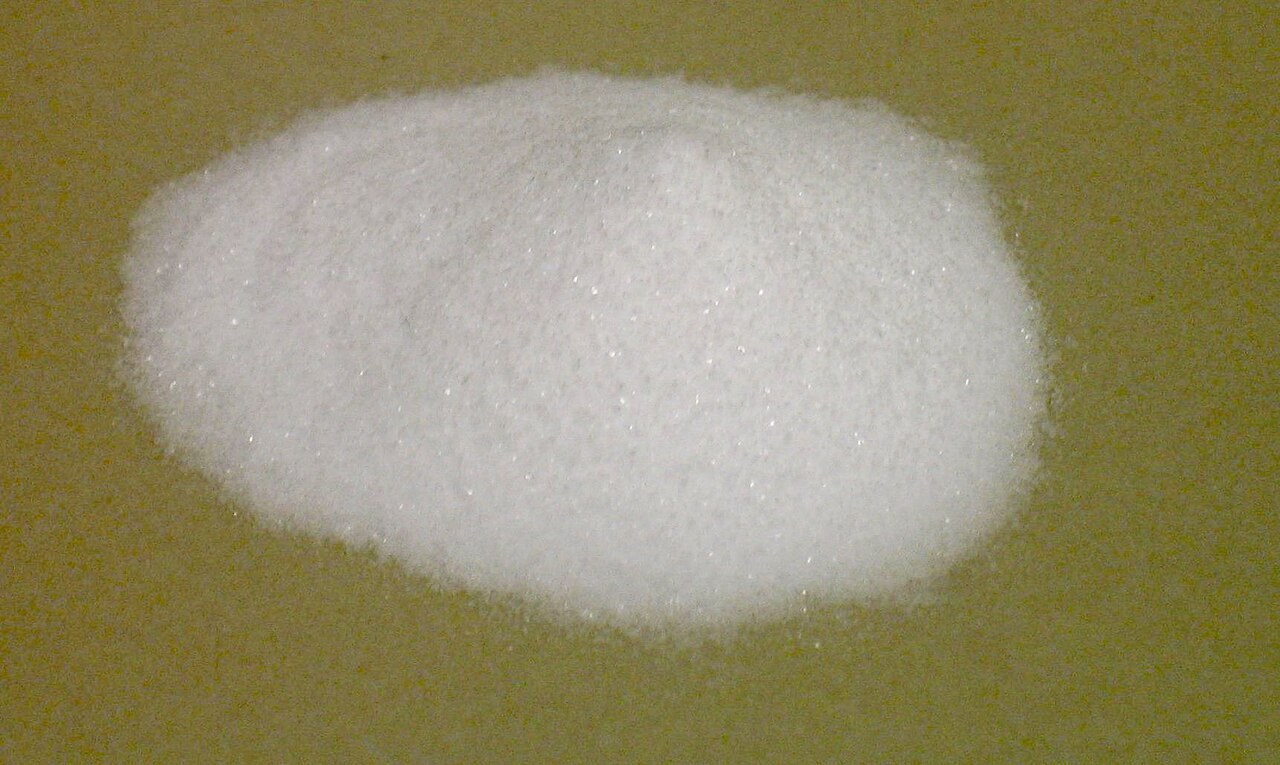
Sodium bicarbonate powder.
Credit: Thavox / Wikimedia Commons

License: Public domain
Resized for the web; no content edits
What it is
Sodium bicarbonate (CAS 144-55-8) is a white salt also known as sodium hydrogen carbonate and bicarbonate of soda. [3,4]
What it does and why it is used
It is the active ingredient of baking soda, sold as a cooking and baking product. [1] Commercially it is made by treating a sodium carbonate solution with carbon dioxide. [3]
Regulatory status and health context
Canada
The sources used for this review do not cover sodium bicarbonate's status in Canada, so we do not summarize it here.
United States
FDA lists sodium bicarbonate as generally recognized as safe for direct use in food, with no limitation other than current good manufacturing practice. [3]
European Union
The EU law website was not fully available when this article was reviewed, so EU legal status was not checked and is not summarized here.
Environmental notes
The sources used for this review do not assess sodium bicarbonate's environmental effects, so we do not summarize them here.
Quick facts
- CAS: 144-55-8. [3,4]
- Where: baking soda used in cooking and baking; added to some processed foods. [1,2]
- Main danger: dehydration and mineral imbalances after very large swallowed doses. [1]
- Most at risk: people using large doses as a remedy or for sport; anyone told to limit sodium. [1,2]
Sources
All URLs were fetched on 2026-11-15. The EU law website was not fully available that day, so EU legislation could not be checked for this review. Source publication dates differ from this draft's review date.