
Cleaning and laundryHousehold materials
Sulfuric acid: the battery acid that needs the most careful handling
CAS 7664-93-9.Also known as sulphuric acid, battery acid, and oil of vitriol.
Editorial draft Last reviewed 15 November 2026 About 722 words
CC INDEX
How it works71/100 High
Concentrated sulfuric acid can cause life-threatening burns, and MedlinePlus says damage can continue for weeks and death can occur up to a month later. Exposure is uncommon for most households and tied to batteries and some cleaners. The US requires child-resistant packaging for household products with 10% or more, so the score sits in the high band.
An editorial summary of this article’s cited evidence. It isn’t medical advice or a personal risk estimate.
Age index
What is the age index?Which age groups are more affected by this chemical’s possible health issues, based on this article’s sources.
- Pregnancy Unborn babies Not well studied
- Infants 0 to 1 Not well studied
- Young children 1 to 5 Higher concern
- Children 6 to 12 Higher concern
- Teens 13 to 19 Moderate
- Adults 20 to 64 Moderate
- Older adults 65 and over Moderate
- Young children (higher concern): Acid cleaners and battery acid can cause severe burns if swallowed or splashed
- Children (higher concern): Acid cleaners and battery acid can cause severe burns if swallowed or splashed
- Concentrated sulfuric acid can cause severe burns at any age; children are rated higher because of accidental swallowing and splashing.

Illustration of a garage workbench. Sulfuric acid is the acid in car batteries.
Credit: Chemical Century; AI-generated illustration
License: CC0 1.0
Illustration, not a photograph of a specific product. Resized and cropped for the web.
Sulfuric acid sits inside car batteries and in some toilet bowl cleaners, out of sight until something leaks or splashes. For most people it rarely comes up in daily life. When it does, it can cause deep burns to skin, eyes and the digestive tract, and the damage may keep developing for weeks. Treating it with real respect, from gloves and goggles to locked storage, can make an enormous difference.
Everyday exposure: where you meet it and how much
Sulfuric acid is found in car battery acid, certain detergents, some fertilizers and some toilet bowl cleaners. [1] It is a strong acid, and poisoning can occur when someone swallows it, breathes it in, or it touches the skin or eyes. [1]
Food uses are tiny by comparison: US rules allow it as a processing aid with limits such as 0.014% in alcoholic beverages and 0.0003% in cheese. [4]
Known and suspected harms
Evidence labels are editorial summaries, not individual risk predictions: established means recognized under the stated conditions; probable means a likely contribution with uncertainty; possible means limited evidence; disputed means assessors disagree. These labels do not describe how common an effect is.
- Established — burns when swallowed: swallowing sulfuric acid can cause burns and severe pain in the mouth and throat, drooling, breathing difficulty from throat swelling, vomiting with blood, fever and a rapid fall in blood pressure. [1]
- Established — skin and eye injury: contact causes severe pain, and extensive damage to the eyes is possible, including vision loss. [1]
- Established — breathing fumes: breathing it in can cause breathing difficulty, chest tightness, choking, coughing up blood, dizziness and bluish skin and lips; serious lung damage can be immediate and long-term. [1]
- Established — slow-developing damage: MedlinePlus explains that damage to the oesophagus and stomach continues for several weeks after swallowing, which can lead to serious infection and organ failure, and death may occur as long as a month later. [1]
Reducing avoidable exposure and harm
Handle batteries and acid cleaners with gloves and eye protection. Keep acid products locked away from children, in their original containers. If sulfuric acid is swallowed or splashed, contact a poison centre or emergency services immediately; MedlinePlus notes that outcome depends on how fast the acid is diluted and neutralized. [1]
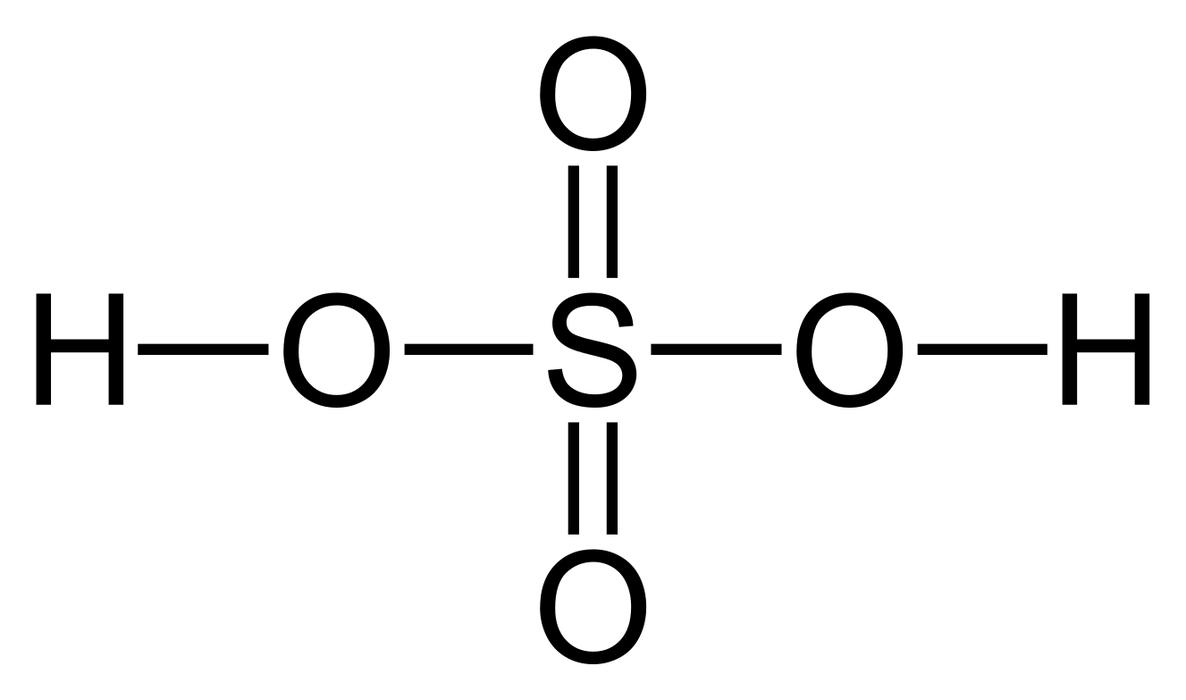
Structural formula of sulfuric acid.
Credit: Jü / Wikimedia Commons

License: Public domain
Rendered from SVG to PNG, whitespace trimmed and placed on white
What it is
Sulfuric acid (CAS 7664-93-9), also spelled sulphuric acid, is a dense, oily, strong mineral acid. [4,5]
What it does and why it is used
It is the acid in car batteries and is used in certain detergents, fertilizers and toilet bowl cleaners. [1] In food processing it is used in very small amounts as a pH control agent and processing aid. [4]
Regulatory status and health context
Canada
Canada's Consumer Chemicals and Containers Regulations ban consumer chemical products that meet the 'very corrosive' criteria, except some glass-etching products, and require child-resistant containers for products classed as corrosive. [3] The sources reviewed do not say which household products fall into each category.
United States
US rules require child-resistant packaging for household substances containing 10% or more sulfuric acid, except wet-cell batteries. [2] FDA lists sulfuric acid as generally recognized as safe for limited food-processing uses, including 0.014% in alcoholic beverages and 0.0003% in cheese. [4]
European Union
The EU law website was not fully available when this article was reviewed, so EU legal status was not checked and is not summarized here.
Environmental notes
The sources used for this review focus on poisoning and do not assess sulfuric acid's environmental effects, so we do not summarize them here.
Quick facts
- CAS: 7664-93-9. [4,5]
- Where: car batteries, certain detergents, some toilet bowl cleaners and fertilizers. [1]
- Main danger: deep burns that can keep worsening for weeks. [1]
- Most at risk: children; anyone handling batteries or acid cleaners without protection. [1,2]
Sources
All URLs were fetched on 2026-11-15. The EU law website was not fully available that day, so EU legislation could not be checked for this review. Source publication dates differ from this draft's review date.