
Food and drinkMakeup and colour
Tartrazine: the bright yellow food dye with a small group of sensitive people
CAS 1934-21-0.Also known as FD&C Yellow No. 5, E102, and Yellow 5.
Editorial draft Last reviewed 15 November 2026 About 750 words
CC INDEX
How it works48/100 Moderate
EFSA found tartrazine negative in long-term cancer studies and intakes below its safe level, but notes intolerance reactions in a small fraction of people and a disputed behaviour study in children. It is widely used in coloured foods, so exposure is common. Canada and the US require it to be named and set limits, so the score sits in the moderate band.
An editorial summary of this article’s cited evidence. It isn’t medical advice or a personal risk estimate.
Age index
What is the age index?Which age groups are more affected by this chemical’s possible health issues, based on this article’s sources.
- Pregnancy Unborn babies Not well studied
- Infants 0 to 1 Not well studied
- Young children 1 to 5 Moderate
- Children 6 to 12 Moderate
- Teens 13 to 19 Lower concern
- Adults 20 to 64 Lower concern
- Older adults 65 and over Lower concern
- EFSA considered a study reporting more hyperactivity in 3-year-olds and 8- to 9-year-olds after a dye mixture including tartrazine, but judged it insufficient to change the safe intake; sensitive individuals of any age may react.

Illustration of colourful party foods. Tartrazine is a synthetic yellow dye used in candies, drinks and desserts.
Credit: Chemical Century; AI-generated illustration
License: CC0 1.0
Illustration, not a photograph of a specific product. Resized and cropped for the web.
Tartrazine is the synthetic dye that gives many candies, soft drinks, desserts and snack foods their sunny yellow colour. Food-safety reviews have found typical intakes to be below the accepted safe level, and it did not cause cancer in long-term animal studies. Some people may react to it, though, and a well-known study on children's behaviour has kept it in the headlines. Because it has to be named on ingredient lists, it is easy to spot and skip if you want to.
Everyday exposure: where you meet it and how much
Tartrazine is a synthetic yellow food colour, known in the US as FD&C Yellow No. 5 and in the EU as E 102. [1,2] In the US it may be used to colour foods generally, including dietary supplements, in amounts consistent with good manufacturing practice, and foods containing it, including butter, cheese and ice cream, must list it by name among the ingredients. [2]
Canada permits it in many foods, with combined limits for synthetic colours in some products. [4]
Known and suspected harms
Evidence labels are editorial summaries, not individual risk predictions: established means recognized under the stated conditions; probable means a likely contribution with uncertainty; possible means limited evidence; disputed means assessors disagree. These labels do not describe how common an effect is.
- Established — intolerance in sensitive people: EFSA concluded that tartrazine appears able to cause intolerance reactions in a small fraction of the exposed population, and that sensitive individuals may react at intakes within the acceptable daily intake. [1]
- Disputed — children's behaviour: a 2007 study by McCann and colleagues concluded that a mixture of colours including tartrazine increased hyperactivity in 3-year-old and 8- to 9-year-old children; EFSA agreed that the findings could not be used to change the safe intake level. [1]
- Established — no cancer in long-term animal studies: tartrazine was negative in long-term carcinogenicity studies, and EFSA did not expect DNA effects seen in one mouse test to lead to cancer. [1]
Reducing avoidable exposure and harm
Check ingredient lists for tartrazine, FD&C Yellow No. 5, Yellow 5 or E 102 if you or your child seems sensitive to it. [1,2] Choosing fewer brightly coloured sweets and drinks lowers intake. If you suspect a reaction, discuss it with a clinician.
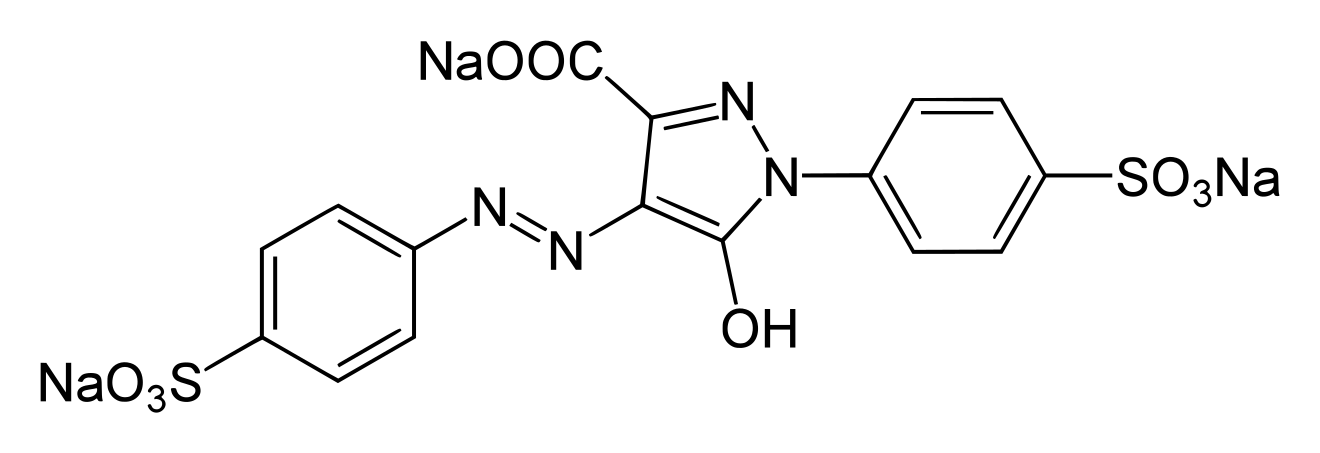
Structural formula of tartrazine.
Credit: Lukáš Mižoch; later Yikrazuul / Wikimedia Commons

License: Public domain
Rendered from SVG to PNG, whitespace trimmed and placed on white
What it is
Tartrazine (CAS 1934-21-0) is a synthetic azo dye, the trisodium salt of a sulfonated pyrazolone compound. [2,5]
What it does and why it is used
It gives a bright yellow colour to foods, including dietary supplements. [2]
Regulatory status and health context
Canada
Health Canada's List of Permitted Food Colours includes tartrazine as a synthetic colour; in foods such as jams and flavoured milks it shares a combined limit of 300 ppm with other synthetic colours. [4]
United States
FDA permits FD&C Yellow No. 5 in foods generally under good manufacturing practice and requires it to be named on ingredient lists. [2] As of FDA's tracking page, the agency is working with industry to eliminate it and five other petroleum-based colours from the food supply by the end of 2027; this is a voluntary effort, not a ban. [3]
European Union
EFSA re-evaluated tartrazine (E 102) in 2009 and kept its acceptable daily intake of 7.5 mg per kg of body weight a day, finding refined intake estimates below that level. [1] EU legislation itself could not be checked for this review.
Environmental notes
The sources used for this review do not assess tartrazine's environmental effects, so we do not summarize them here.
Quick facts
- CAS: 1934-21-0. [2,5]
- Where: yellow candies, soft drinks, desserts and other coloured foods. [2]
- Main concern: intolerance reactions in a small group of sensitive people. [1]
- Most at risk: people sensitive to tartrazine; possibly some children. [1]
Planning meals around fewer additives? See also The Low-Additive Family Meal Plan, a printable 7-day plan with recipes and a grocery list ($4 USD).
Sources
All URLs were fetched on 2026-11-15; Health Canada pages were read with a separate web-reading tool because they did not respond to this review's direct requests, and the EFSA opinion was read with a browser. The EU law website was not fully available that day, so EU legislation itself could not be checked. Source publication dates differ from this draft's review date.