
TBHQ (tert-butylhydroquinone): the preservative in frying oils and fats
CAS 1948-33-0.Also known as tertiary butylhydroquinone, tert-butylhydroquinone, E319, tBHQ, and 2-tert-butylhydroquinone.
Editorial draft Last reviewed 21 November 2026 About 630 words
CC INDEX
How it works36/100 Mild
TBHQ is limited by law to 0.02% of fat. EFSA and JECFA found it not carcinogenic and set an ADI that typical diets do not exceed. Immune effects come from laboratory studies only.
An editorial summary of this article’s cited evidence. It isn’t medical advice or a personal risk estimate.
Age index
What is the age index?Which age groups are more affected by this chemical’s possible health issues, based on this article’s sources.
- Pregnancy Unborn babies Not well studied
- Infants 0 to 1 Moderate
- Young children 1 to 5 Lower concern
- Children 6 to 12 Lower concern
- Teens 13 to 19 Lower concern
- Adults 20 to 64 Lower concern
- Older adults 65 and over Lower concern
- Infants (moderate): Use in infant formula would exceed the safe intake (EFSA)
- EFSA found high-fat-eating adults and children would not exceed the safe intake at permitted uses.

Illustration of cooking oil and snacks. TBHQ slows fats from going rancid.
Credit: Chemical Century; AI-generated illustration
License: CC0 1.0
Illustration, not a photograph of a specific product. Resized and cropped for the web.
TBHQ is a synthetic antioxidant added to cooking oils, frying fats and foods made with them so they do not go rancid. Regulators allow it in small amounts and have set a safe daily intake that most people stay well below. Questions remain because Europe's scientists once rejected it for lack of data, and recent laboratory studies suggest it can dampen immune cell responses. For most people, the main sources are oils, frying fats and the processed foods made with them.
Everyday exposure: where you meet it and how much
In the United States, TBHQ may be used as an antioxidant alone or with BHA and BHT, with total antioxidants not exceeding 0.02% of the food's fat or oil content. [1] In the EU it is authorised (E 319) in specific fats such as frying oils, lard, fish oil and animal fats used in manufacturing. [3] The main sources are therefore fats, oils and foods made with them.
Known and suspected harms
Evidence labels are editorial summaries, not individual risk predictions: established means recognized under the stated conditions; probable means a likely contribution with uncertainty; possible means limited evidence; disputed means assessors disagree.
- Established — safe intake limit and infant formula: EFSA set an acceptable daily intake of 0 to 0.7 mg/kg body weight, based on effects in dogs, the most sensitive species. It found that high-fat eaters would not exceed this, but that use in infant and follow-on formula at the requested level would push infants above it. [2]
- Possible — immune effects (laboratory studies): in mouse immune cells grown in the lab, TBHQ reduced markers of dendritic cell maturation and inflammatory signals in response to bacterial and viral stimuli. The researchers' earlier work found it impeded T-cell activation. These are laboratory findings, not studies in people. [4]
EFSA concluded TBHQ is not carcinogenic and that further genotoxicity studies were unnecessary. Earlier, in 1987, the EU's former Scientific Committee on Food had found it not acceptable because of missing data. [2]
Reducing avoidable exposure
Eating fewer fried and processed snack foods lowers intake of TBHQ along with other additives. Labels list it as "TBHQ" or "tertiary butylhydroquinone" in the US and "E319" in Europe. [1,3]
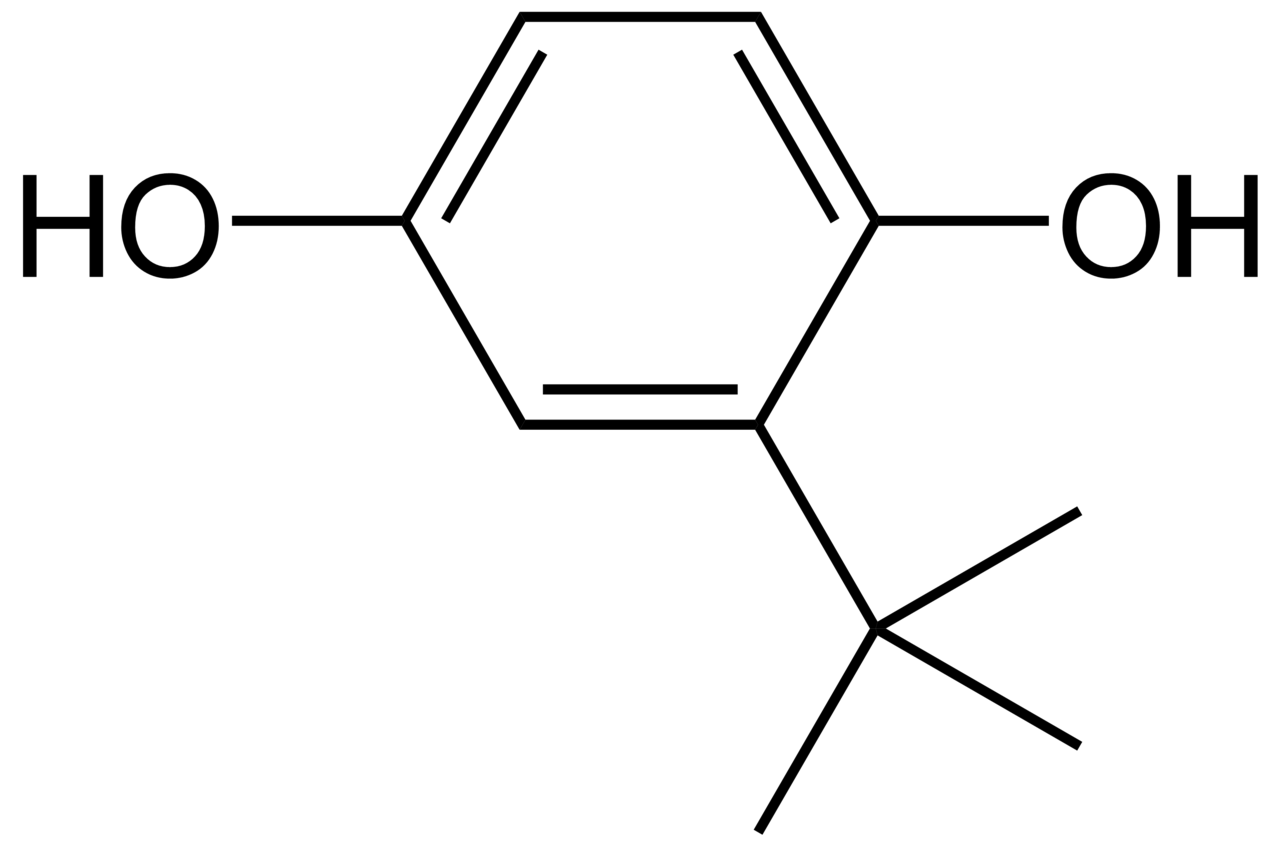
Structural formula of tert-butylhydroquinone (TBHQ).
Credit: Shaddack / Wikimedia Commons

License: Public domain
Wikimedia-provided scaled PNG/JPEG rendering; no content edits
What it is
TBHQ (CAS 1948-33-0) is a hydroquinone with a tert-butyl group. [1,5]
What it does and why it is used
It slows fats and oils from oxidising and going rancid. [1,2]
Regulatory status and health context
Canada
The sources used here do not cover Canadian rules for TBHQ.
United States
TBHQ is an approved food additive; total antioxidants may not exceed 0.02% of fat or oil content. [1]
European Union
The EU authorised TBHQ in 2006 for certain fats and oils after EFSA's 2004 opinion, with combined limits when used with gallates, BHA or BHT. [3]
International
JECFA allocated an ADI of 0 to 0.7 mg/kg body weight in 1997. [5]
Environmental notes
The sources used here do not provide enough environmental data for a rating.
Quick facts
- CAS: 1948-33-0. [5]
- US limit: 0.02% of fat or oil (all antioxidants combined). [1]
- ADI: 0.7 mg/kg body weight. [2,5]
- Cancer: not carcinogenic per EFSA. [2]
- Open question: immune effects in lab studies. [4]
Planning meals around fewer additives? See also The Low-Additive Family Meal Plan, a printable 7-day plan with recipes and a grocery list ($4 USD).
Sources
Sources were accessed on 2026-11-21. Source publication dates differ from this draft's review date. Image licences are listed with each image.
- eCFR: 21 CFR 172.185, TBHQ.
- EFSA AFC Panel. Opinion related to tertiary-butylhydroquinone (TBHQ). EFSA Journal, 2004.
- European Parliament and Council: Directive 2006/52/EC amending Directive 95/2/EC on food additives (EUR-Lex).
- Awali S et al. The Nrf2 activator tBHQ inhibits dendritic cell maturation and activation in response to bacterial and viral stimuli. Toxicol In Vitro, 2026 (PubMed).
- FAO/WHO JECFA: Tertiary butylhydroquinone specifications (PDF).