
Household materialsWater, air and residues
Xylene: the solvent in paints, stains and nail polish, and its effects on the brain
Also known as xylol and dimethylbenzene.
Editorial draft Last reviewed 15 November 2026 About 694 words
CC INDEX
How it works44/100 Moderate
Xylene fumes can cause dizziness and other nervous system effects, and long-term inhalation can cause permanent brain damage. It is in many paints, stains, glues and nail polishes. Canada and the US set drinking-water limits and US packaging rules apply to paint solvents, so the score sits in the moderate band.
An editorial summary of this article’s cited evidence. It isn’t medical advice or a personal risk estimate.
Age index
What is the age index?Which age groups are more affected by this chemical’s possible health issues, based on this article’s sources.
- Pregnancy Unborn babies Lower concern
- Infants 0 to 1 Lower concern
- Young children 1 to 5 Moderate
- Children 6 to 12 Lower concern
- Teens 13 to 19 Moderate
- Adults 20 to 64 Lower concern
- Older adults 65 and over Lower concern
- MedlinePlus notes that among teens and young adults, exposure may come from recreational inhalant misuse.

Illustration of staining a deck. Some wood stains contain xylene.
Credit: Chemical Century; AI-generated illustration
License: CC0 1.0
Illustration, not a photograph of a specific product. Resized and cropped for the web.
Xylene is a solvent found in some paints, paint thinners, wood stains, lacquers, glues and nail polish. Breathing its fumes can cause dizziness and headaches, and inhaling it for long periods, as happens with deliberate sniffing, can cause permanent brain damage. Drinking-water limits in Canada and the US are set to protect against nervous system and neuromuscular effects. MedlinePlus advises moving a person who has breathed in the fumes to fresh air right away.
Everyday exposure: where you meet it and how much
Toluene and xylene are used in fingernail polish, glues and adhesives, lacquers, gasoline octane boosters, paints, paint thinners, printing and leather tanning processes, rubber and plastic cements, and wood stains. [1] Among teens and young adults, exposure may come from recreational inhalant misuse called huffing, sniffing or bagging. [1] Health Canada lists emissions, effluents or spills from the petroleum and chemical industries as sources in drinking water. [2]
Known and suspected harms
Evidence labels are editorial summaries, not individual risk predictions: established means recognized under the stated conditions; probable means a likely contribution with uncertainty; possible means limited evidence; disputed means assessors disagree. These labels do not describe how common an effect is.
- Established — long-term inhalation: inhaling these substances for long periods can cause permanent brain damage, which is seen in people who sniff them on purpose to get high. [1]
- Established — nervous system: symptoms can include dizziness, drowsiness, headache, memory loss, staggering, tremors, seizures and unconsciousness. [1]
- Established — drinking water: Health Canada bases its xylene guideline on adverse neuromuscular effects, and the US EPA lists nervous system damage from long-term exposure above its limit. [2,3]
- Disputed — cancer: Health Canada says there is insufficient information to determine whether xylenes cause cancer in humans. [2]
Reducing avoidable exposure and harm
If someone breathed in the fumes, move them to fresh air right away; flush skin or eyes with lots of water for at least 15 minutes. [1] If it is swallowed, get medical help right away and do not make the person throw up unless poison control or a health care provider says to. [1] US rules require child-resistant packaging for many low-viscosity paint removers, thinners and brush cleaners containing 10 percent or more xylene. [4]
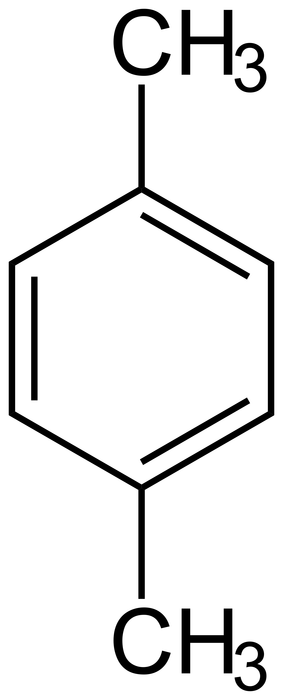
Structural formula of para-xylene, one of the three xylene isomers.
Credit: NEUROtiker / Wikimedia Commons

License: Public domain
Rendered from SVG to PNG, whitespace trimmed and placed on white
What it is
Xylene is a hydrocarbon that occurs as ortho-xylene, meta-xylene and para-xylene. [1]
What it does and why it is used
It dissolves paints, lacquers and adhesives, which is why it is used as a solvent. [1]
Regulatory status and health context
Canada
Health Canada's drinking-water guideline sets a maximum acceptable concentration of 0.09 mg/L for total xylenes, with an aesthetic objective of 0.02 mg/L based on odour. [2]
United States
The US EPA's drinking-water limit for total xylenes is 10 mg/L. [3] Under 16 CFR 1700.14, prepackaged liquid paint solvents with 10 percent or more xylene and low viscosity must be in child-resistant packaging. [4]
European Union
The EU law website was not fully available when this article was reviewed, so EU legal status was not checked and is not summarized here.
Environmental notes
Health Canada lists emissions, effluents or spills from the petroleum and chemical industries as sources of xylenes in drinking water, and the US EPA lists discharge from petroleum and chemical factories. [2,3]
Quick facts
- CAS: no single CAS number verified. [1]
- Where: paints, thinners, wood stains, glues, nail polish. [1]
- Main concern: nervous system effects; brain damage from long-term inhalation. [1]
- Most at risk: teens and young adults who misuse inhalants. [1]
Sources
All URLs were fetched on 2026-11-15; Health Canada pages were read with a separate web-reading tool because they did not respond to this review's direct requests. The EU law website was not fully available that day, so EU legislation could not be checked for this review. Source publication dates differ from this draft's review date.