
Carboxymethylcellulose (cellulose gum): what a human feeding study found
CAS 9004-32-4.Also known as CMC, cellulose gum, sodium carboxymethylcellulose, E466, and carmellose.
Editorial draft Last reviewed 21 November 2026 About 594 words
CC INDEX
How it works42/100 Moderate
CMC is common in processed foods. A small randomized human trial found adverse gut microbiota and metabolite changes, supported by mouse studies, but regulators found no safety concern at reported uses.
An editorial summary of this article’s cited evidence. It isn’t medical advice or a personal risk estimate.
Age index
What is the age index?Which age groups are more affected by this chemical’s possible health issues, based on this article’s sources.
- Pregnancy Unborn babies Not well studied
- Infants 0 to 1 Not well studied
- Young children 1 to 5 Not well studied
- Children 6 to 12 Not well studied
- Teens 13 to 19 Not well studied
- Adults 20 to 64 Moderate
- Older adults 65 and over Not well studied
- Adults (moderate): Small human study: gut bacteria and discomfort changes
- The only human trial studied healthy adults for 11 days.

Illustration of foods that may contain cellulose gum, a common thickener.
Credit: Chemical Century; AI-generated illustration
License: CC0 1.0
Illustration, not a photograph of a specific product. Resized and cropped for the web.
Carboxymethylcellulose, often listed as cellulose gum, thickens and stabilises foods such as ice cream, sauces, baked goods, dressings and some diet products. It is not absorbed and regulators consider it safe, so it passes through the gut. That is exactly where researchers have found effects: in mice it promoted gut inflammation, and in a small human feeding study it caused mild stomach discomfort, reduced the diversity of gut bacteria and lowered beneficial gut compounds. The human evidence is early and small, but it is the clearest test of a common emulsifier in people so far.
Everyday exposure: where you meet it and how much
Carboxymethylcellulose (CMC) is described as a ubiquitous synthetic emulsifier in processed foods. [1] On labels it may appear as "cellulose gum," "carboxymethylcellulose" or "E466."
Known and suspected harms
Evidence labels are editorial summaries, not individual risk predictions: established means recognized under the stated conditions; probable means a likely contribution with uncertainty; possible means limited evidence; disputed means assessors disagree.
- Possible — gut bacteria and metabolites (human trial): in a double-blind controlled-feeding study, healthy adults ate an emulsifier-free diet (9 people) or the same diet with 15 g of CMC a day (7 people) for 11 days. CMC modestly increased abdominal discomfort after meals, reduced gut bacterial diversity, and lowered short-chain fatty acids and free amino acids in stool. Two people on CMC showed bacteria encroaching into the normally sterile inner mucus layer, a feature of gut inflammation. The study was small and used a high daily dose. [1]
- Possible — inflammation in mice: in mice, CMC and polysorbate 80 induced low-grade inflammation and metabolic syndrome and promoted colitis in susceptible animals. [2]
EFSA's 2018 re-evaluation concluded there was no need for a numerical acceptable daily intake for celluloses, including CMC, and no safety concern at the reported uses and levels. [4]
Reducing avoidable exposure
People with gut symptoms or inflammatory bowel disease who want to test a change can read labels for "cellulose gum" or "carboxymethylcellulose" and choose less processed foods. This is a precaution, not proven treatment. [1,2]
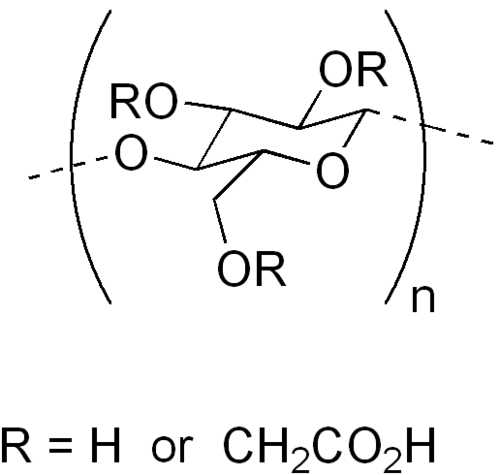
Structural formula of carboxymethylcellulose.
Credit: Edgar181 / Wikimedia Commons

License: Public domain
Wikimedia-provided scaled PNG/JPEG rendering; no content edits
What it is
CMC is cellulose, the main fibre in plant cell walls, chemically modified with carboxymethyl groups. It is usually sold as the sodium salt. [3]
What it does and why it is used
It thickens, stabilises and emulsifies foods. [1,4]
Regulatory status and health context
Canada
The sources used here do not cover Canadian rules for CMC.
United States
FDA lists sodium carboxymethylcellulose as generally recognized as safe when used under good manufacturing practice. [3]
European Union
CMC is authorised as E 466. EFSA found no need for a numerical ADI and no safety concern at reported uses. [4]
Environmental notes
The sources used here do not provide enough environmental data for a rating.
Quick facts
- CAS: 9004-32-4.
- Label names: cellulose gum, carboxymethylcellulose, E466. [1,4]
- Human trial: 15 g/day for 11 days changed gut bacteria (possible harm). [1]
- US status: GRAS. [3]
- EU: no numerical ADI needed. [4]
Planning meals around fewer additives? See also The Low-Additive Family Meal Plan, a printable 7-day plan with recipes and a grocery list ($4 USD).
Sources
Sources were accessed on 2026-11-21. Source publication dates differ from this draft's review date. Image licences are listed with each image.
- Chassaing B et al. Randomized controlled-feeding study of dietary emulsifier carboxymethylcellulose reveals detrimental impacts on the gut microbiota and metabolome. Gastroenterology, 2022 (PubMed).
- Chassaing B et al. Dietary emulsifiers impact the mouse gut microbiota promoting colitis and metabolic syndrome. Nature, 2015 (PubMed).
- eCFR: 21 CFR 182.1745, sodium carboxymethylcellulose.
- EFSA FAF Panel. Re-evaluation of celluloses E 460(i)–E 469 as food additives. EFSA Journal, 2018.