
Water, air and residuesFood and drink
Chlorothalonil: the fungicide Europe banned over groundwater and cancer concerns
CAS 1897-45-6.Also known as tetrachloroisophthalonitrile, TCPN, 2,4,5,6-tetrachloroisophthalonitrile, and chlorothalonil fungicide.
Editorial draft Last reviewed 21 November 2026 About 668 words
CC INDEX
How it works62/100 High
Rodent tumours led EPA to classify chlorothalonil as a likely human carcinogen, though the mechanism is disputed. The EU banned it over groundwater metabolites and a genotoxicity concern it could not exclude, and Canada cancelled some uses.
An editorial summary of this article’s cited evidence. It isn’t medical advice or a personal risk estimate.
Age index
What is the age index?Which age groups are more affected by this chemical’s possible health issues, based on this article’s sources.
- Pregnancy Unborn babies Not well studied
- Infants 0 to 1 Not well studied
- Young children 1 to 5 Not well studied
- Children 6 to 12 Not well studied
- Teens 13 to 19 Not well studied
- Adults 20 to 64 Moderate
- Older adults 65 and over Not well studied
- Adults (moderate): Farm and turf workers: severe eye irritant
- Dietary risks by age group are not established in the sources; the clearest direct risk is eye and skin irritation for people who handle it.

Illustration of fungicide spraying near a well. EU regulators were concerned about chlorothalonil breakdown products reaching groundwater.
Credit: Chemical Century; AI-generated illustration
License: CC0 1.0
Illustration, not a photograph of a specific product. Resized and cropped for the web.
Chlorothalonil is a fungicide sprayed on vegetable, field and orchard crops, including potatoes, and on golf-course turf to stop moulds and leaf diseases. People may meet small residues on food and, where it has been used heavily, breakdown products in groundwater. In rodents, high doses caused kidney and stomach tumours, and the US EPA classifies it as a likely human carcinogen, although the manufacturer argues the mechanism does not apply to people. In 2019 the European Union refused to renew its approval, citing groundwater contamination and unresolved concerns about residues in food.
Everyday exposure: where you meet it and how much
Chlorothalonil is a broad-spectrum fungicide registered for field, vegetable and orchard crops and turf, and as a mildewcide added to paint. [2,4] The general public may be exposed to residues in food and, where it has been used, to its breakdown products (metabolites) in groundwater. [1] People who mix, load or apply it can be exposed through skin and eyes. [2]
Known and suspected harms
Evidence labels are editorial summaries, not individual risk predictions: established means recognized under the stated conditions; probable means a likely contribution with uncertainty; possible means limited evidence; disputed means assessors disagree.
- Disputed — cancer: long-term feeding of chlorothalonil caused kidney tumours and forestomach tumours in rats and mice. EPA classifies it as a "likely human carcinogen." [2,3] An industry-authored review argues it is not genotoxic and that the tumours arise from tissue irritation and cell damage through a mechanism that does not operate in dogs, monkeys or, likely, people. [3]
- Established regulatory concern — groundwater and genotoxicity: the European Food Safety Authority found that several chlorothalonil metabolites are predicted to exceed 0.1 µg/L in groundwater in all relevant scenarios, and it could not exclude a genotoxicity concern for residues consumers will be exposed to. [1]
- Established — eye irritation: EPA's fact sheet reports that chlorothalonil produces severe eye irritation in rabbits (its highest toxicity category), which matters mainly for people who handle it. [2]
Reducing avoidable exposure
Rinse produce under running water. If you have a private well near intensive crop production, you can ask your local health authority about pesticide testing. Anyone applying chlorothalonil must follow label directions, including protective equipment. [4]
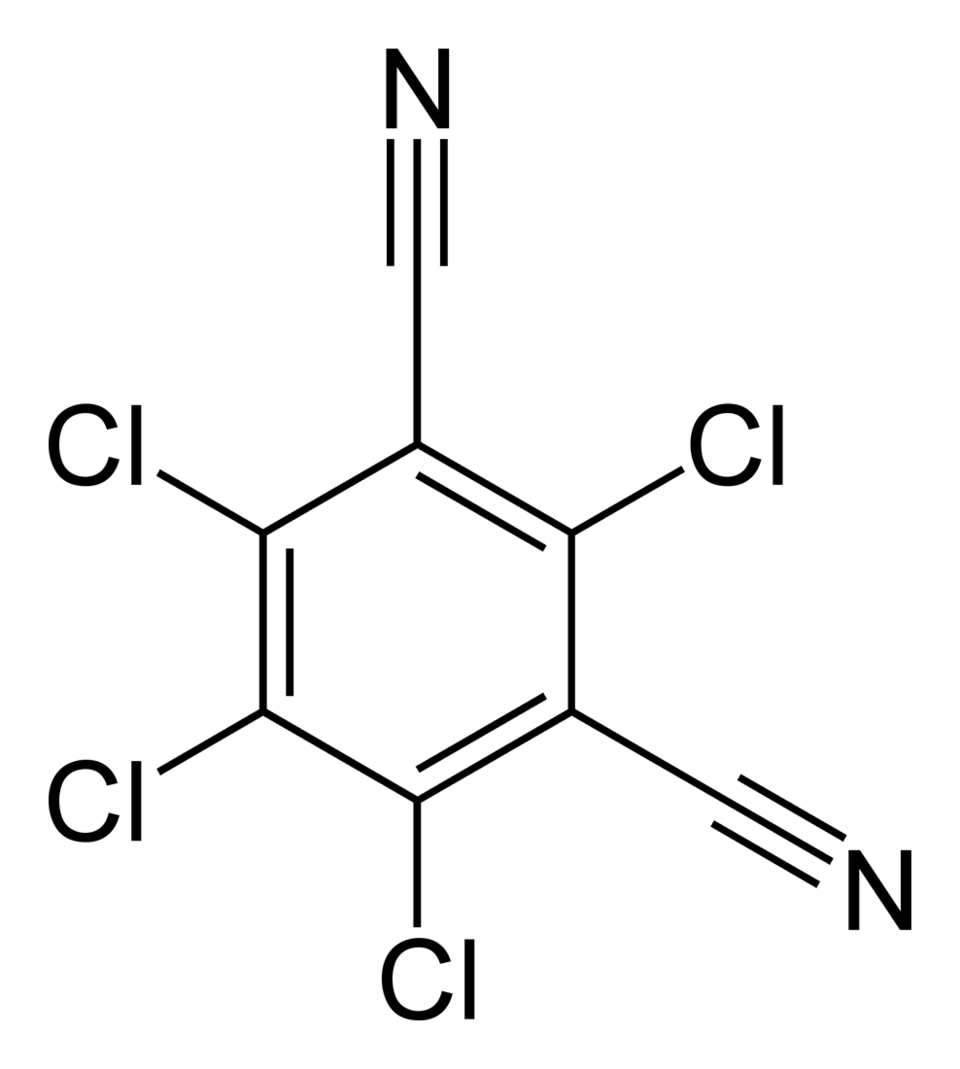
Structural formula of chlorothalonil.
Credit: Unknown / Wikimedia Commons

License: Public domain
Wikimedia-provided scaled PNG/JPEG rendering; no content edits
What it is
Chlorothalonil (CAS 1897-45-6) is a chlorinated aromatic compound: a benzene ring carrying four chlorine atoms and two nitrile groups. [2]
What it does and why it is used
It acts mainly as a fungicide and mildewcide on crops, conifers, ornamentals and turf, and is also used in paint. [2,4]
Regulatory status and health context
Canada
Following its 2018 re-evaluation, Health Canada cancelled some uses, prohibited use on most greenhouse food crops, limited applications on potatoes to three a year, barred the public from golf courses after late-fall snow-mould treatment, and required more protective equipment, buffer zones and closed loading systems. [4]
United States
EPA's 1999 reregistration decision classified chlorothalonil as a likely human carcinogen (formerly Group B2). [2]
European Union
The EU did not renew chlorothalonil's approval in 2019, citing groundwater metabolites, an unresolved genotoxicity concern for consumer residues and high risk to amphibians and fish. [1]
Environmental notes
EU regulators identified a high risk to amphibians and fish for all uses evaluated. [1]
Quick facts
- CAS: 1897-45-6. [2]
- Use: fungicide on crops and turf. [2]
- EPA: likely human carcinogen (rodent tumours; human relevance disputed). [2,3]
- EU: not renewed in 2019. [1]
- Canada: some uses cancelled. [4]
Sources
Sources were accessed on 2026-11-21. Source publication dates differ from this draft's review date. Image licences are listed with each image.
- European Commission: Implementing Regulation (EU) 2019/677 concerning the non-renewal of approval of chlorothalonil (EUR-Lex).
- US EPA: Reregistration eligibility decision (RED) fact sheet, chlorothalonil, 1999 (PDF).
- Wilkinson CF, Killeen JC. A mechanistic interpretation of the oncogenicity of chlorothalonil in rodents and an assessment of human relevance. Regul Toxicol Pharmacol, 1996 (PubMed).
- Health Canada: Changes to chlorothalonil pesticides registration, agricultural and turf uses.