
Chromium picolinate supplements for blood sugar: weak evidence and safety notes
CAS 14639-25-9.Also known as chromium(III) picolinate, CrPic, chromium supplement, and trivalent chromium supplement.
Editorial draft Last reviewed 21 November 2026 About 652 words
CC INDEX
How it works36/100 Mild
Chromium picolinate is a common supplement with weak, inconsistent evidence of benefit. Serious harms are limited to isolated case reports, with interaction risk for people on diabetes medicines.
An editorial summary of this article’s cited evidence. It isn’t medical advice or a personal risk estimate.
Age index
What is the age index?Which age groups are more affected by this chemical’s possible health issues, based on this article’s sources.
- Pregnancy Unborn babies Not well studied
- Infants 0 to 1 Not well studied
- Young children 1 to 5 Not well studied
- Children 6 to 12 Not well studied
- Teens 13 to 19 Not well studied
- Adults 20 to 64 Lower concern
- Older adults 65 and over Moderate
- Older adults (moderate): Kidney or liver disease; diabetes drug interactions
- The older-adult rating is an editorial judgement: people with kidney or liver disease may be more susceptible, and low blood sugar is a risk alongside diabetes medicines.

Illustration of a chromium supplement. Food sources provide chromium too.
Credit: Chemical Century; AI-generated illustration
License: CC0 1.0
Illustration, not a photograph of a specific product. Resized and cropped for the web.
Chromium picolinate is the most common form of chromium sold in supplements aimed at blood sugar control, weight loss and cravings. Some trials suggest small improvements in blood glucose in people with type 2 diabetes, but results are inconsistent, and US regulators allow only a heavily qualified claim calling the evidence highly uncertain. European assessors concluded that chromium is not an essential nutrient. Side effects are uncommon, but there are case reports of kidney and liver problems after large doses, and it can add to the effect of diabetes medicines.
Everyday exposure: where you meet it and how much
Chromium supplements commonly provide 200 to 500 mcg of chromium, and some up to 1,000 mcg. Chromium picolinate is one of several forms; about 1.2% of the chromium in chromium picolinate is absorbed, similar to chromium from food. Labels declare elemental chromium, which is 12.4% of the weight of chromium picolinate. [1]
Known and suspected harms
Evidence labels are editorial summaries, not individual risk predictions: established means recognized under the stated conditions; probable means a likely contribution with uncertainty; possible means limited evidence; disputed means assessors disagree.
- Possible — kidney, liver and other problems after large doses: isolated case reports link chromium supplements to weight loss, anaemia, low platelets, liver dysfunction, kidney failure, muscle breakdown (rhabdomyolysis), dermatitis and low blood sugar. The US Food and Nutrition Board did not set an upper limit but noted that caution may be warranted and that people with kidney or liver disease might be more susceptible. [1,2]
- Probable — interactions: chromium might add to the glucose-lowering effect of insulin, metformin and other diabetes medicines, raising the risk of low blood sugar. A small study found chromium picolinate taken with levothyroxine reduced levothyroxine absorption. [1]
- Established — mild side effects: stomach pain and bloating. Long-term effects have not been well investigated. [2]
What the research shows on blood sugar
Results are mixed. A 2019 overview of 58 trials found chromium as an add-on lowered fasting glucose and HbA1c, while a 24-week trial of 1,000 mcg a day as chromium picolinate found no significant effect on insulin sensitivity, fasting glucose or HbA1c. [1] A 2024 systematic review reported possible benefits in some trials, mainly with longer use. [3] NCCIH describes the evidence for chromium and other supplements in diabetes as weak, with no clear conclusions. [2]
Reducing avoidable exposure
Talk to your clinician before taking chromium, especially if you have kidney or liver disease or take insulin, other diabetes medicines or levothyroxine. [1]
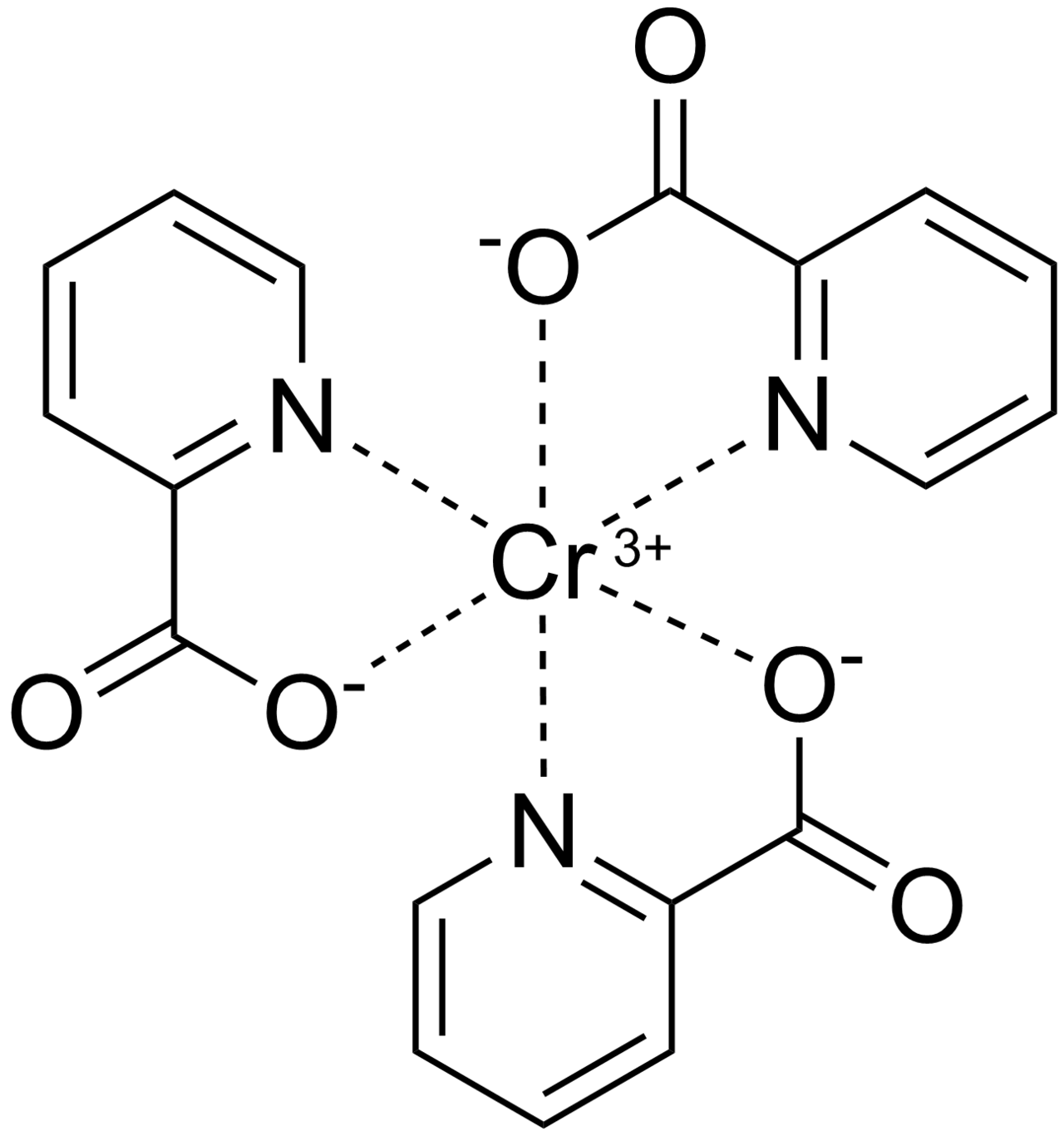
Structural formula of chromium(III) picolinate.
Credit: Edgar181 / Wikimedia Commons

License: Public domain
Wikimedia-provided scaled PNG/JPEG rendering; no content edits
What it is
Chromium picolinate is trivalent chromium bound to picolinic acid. [1]
What it does and why it is used
It is sold in the hope of improving blood sugar control or reducing diabetes risk. [1]
Regulatory status and health context
International
The sources used here do not include an international evaluation.
United States
FDA allows only a qualified health claim for chromium picolinate, stating that one small study suggests it may reduce the risk of insulin resistance and possibly type 2 diabetes, but that the relationship "is highly uncertain." [1]
European Union
In 2014 an EFSA panel concluded there is no convincing evidence that chromium is an essential nutrient, so setting intake recommendations would be inappropriate. [1]
Environmental notes
The sources used here do not provide enough environmental data for a rating.
Quick facts
- CAS: 14639-25-9.
- Typical supplement dose: 200–500 mcg chromium. [1]
- Absorption: about 1.2%. [1]
- FDA claim status: qualified, "highly uncertain". [1]
Sources
Sources were accessed on 2026-11-21. Source publication dates differ from this draft's review date. Image licences are listed with each image.