
Food and drinkNutrients and supplements
Dextrose (glucose): the sugar hiding in ingredient lists, and when it helps
CAS 50-99-7.Also known as glucose, D-glucose, corn sugar, grape sugar, dextrose monohydrate, and glucose tablets.
Editorial draft Last reviewed 21 November 2026 About 660 words
CC INDEX
How it works42/100 Moderate
Dextrose is widespread in processed foods and counts toward added sugar limits; the harm is from total free sugar intake rather than dextrose itself. It is also a useful medical treatment for low blood sugar.
An editorial summary of this article’s cited evidence. It isn’t medical advice or a personal risk estimate.
Age index
What is the age index?Which age groups are more affected by this chemical’s possible health issues, based on this article’s sources.
- Pregnancy Unborn babies Not well studied
- Infants 0 to 1 Not well studied
- Young children 1 to 5 Not well studied
- Children 6 to 12 Lower concern
- Teens 13 to 19 Lower concern
- Adults 20 to 64 Lower concern
- Older adults 65 and over Moderate
- Older adults (moderate): Age 65+ raises low blood sugar risk on diabetes drugs
- Health limits apply to added sugars overall rather than to dextrose alone; NIDDK lists age 65 or older among the factors that make low blood glucose more likely.

Illustration of everyday foods that may list dextrose, beside glucose tablets.
Credit: Chemical Century; AI-generated illustration
License: CC0 1.0
Illustration, not a photograph of a specific product. Resized and cropped for the web.
Dextrose is simply glucose, the sugar your blood carries, made commercially by breaking down corn or other starch. It turns up in ingredient lists for bread, crackers, cured meats, sauces, sports drinks and sweets, often in products that do not taste very sweet, and it counts as an added sugar. Because it needs no digestion it raises blood sugar fast, which is a drawback in everyday eating but exactly why glucose tablets are the standard first aid for low blood sugar. For older adults and anyone managing diabetes, knowing where it hides and when it is useful are both worth understanding.
Everyday exposure: where you meet it and how much
US regulations describe corn sugar, commonly called D-glucose or dextrose, as made by the complete breakdown of corn starch with acids or enzymes, followed by refining and crystallisation. [1] FDA names dextrose as an example of an added sugar on the Nutrition Facts label. [3] It appears in many savoury processed foods as well as sweets.
Known and suspected harms
Evidence labels are editorial summaries, not individual risk predictions: established means recognized under the stated conditions; probable means a likely contribution with uncertainty; possible means limited evidence; disputed means assessors disagree.
- Established — counts toward added sugar limits: WHO recommends reducing free sugars to less than 10% of total energy intake, with a further reduction below 5% for added benefits. [2] US dietary guidance cited by FDA advises limiting added sugars to less than 10% of calories, about 50 g a day on a 2,000-calorie diet. [3]
- Established — fast rise in blood glucose: the glycemic index (GI) ranks carbohydrate foods on a 100-point scale with glucose as the reference; foods at 55 or below are low-GI. Glucose sits at the top of that scale by definition. [5]
A useful medical role
For people with diabetes, NIDDK advises that if blood glucose is below target or under 70 mg/dL, they should eat or drink 15 to 20 g of glucose or carbohydrate right away, such as four glucose tablets, then recheck after 15 minutes and repeat if still low. NIDDK lists being 65 or older, taking insulin or some other diabetes medicines, and kidney disease among the factors that make low blood glucose more likely, and advises carrying fast-acting carbohydrate such as glucose tablets. [4]
Reducing avoidable exposure
Check ingredient lists for "dextrose" and the added sugars line on nutrition labels, especially in savoury snacks and breads. Keep glucose tablets for treating low blood sugar if your clinician advises. [3,4]
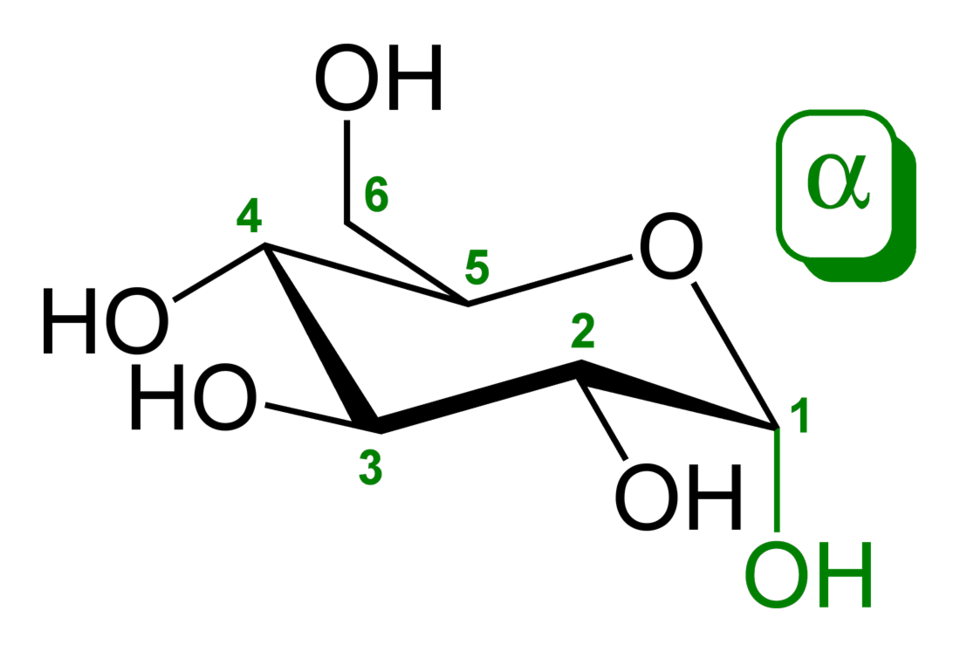
Structural formula of glucose (dextrose).
Credit: Unknown / Wikimedia Commons

License: Public domain
Wikimedia-provided scaled PNG/JPEG rendering; no content edits
What it is
Dextrose is D-glucose (alpha-D-glucopyranose), a simple sugar, sold in anhydrous or monohydrate form. [1]
What it does and why it is used
It is a sugar used to sweeten and add carbohydrate to processed foods. [1,3]
Regulatory status and health context
International
WHO recommends limiting free sugars, including added glucose, to below 10% of energy, ideally below 5%. [2]
United States
Corn sugar (dextrose) is affirmed as GRAS. It is declared as an added sugar on the Nutrition Facts label. [1,3]
European Union
The sources used here do not cover EU rules specific to dextrose.
Environmental notes
The sources used here do not provide enough environmental data for a rating.
Quick facts
- CAS: 50-99-7. [1]
- Also called: glucose, D-glucose, corn sugar. [1]
- Label status: added sugar. [3]
- Low blood sugar first aid: 15–20 g glucose, recheck in 15 minutes. [4]
Sources
Sources were accessed on 2026-11-21. Source publication dates differ from this draft's review date. Image licences are listed with each image.
- eCFR: 21 CFR 184.1857, corn sugar (dextrose).
- WHO: WHO calls on countries to reduce sugars intake among adults and children, 2015.
- FDA: Added sugars on the new Nutrition Facts label.
- NIDDK: Low blood glucose (hypoglycemia).
- Atkinson FS et al. International tables of glycemic index and glycemic load values 2021: a systematic review. Am J Clin Nutr, 2021 (PubMed).