
Sucrose (table sugar): how much is too much for adults and children?
CAS 57-50-1.Also known as table sugar, sugar, cane sugar, beet sugar, saccharose, and white sugar.
Editorial draft Last reviewed 21 November 2026 About 687 words
CC INDEX
How it works64/100 High
Harms of excess added sugar are well established and intake is very common. Sugar itself is not toxic and is only lightly regulated, through labelling and dietary guidance.
An editorial summary of this article’s cited evidence. It isn’t medical advice or a personal risk estimate.
Age index
What is the age index?Which age groups are more affected by this chemical’s possible health issues, based on this article’s sources.
- Pregnancy Unborn babies Not well studied
- Infants 0 to 1 Higher concern
- Young children 1 to 5 Higher concern
- Children 6 to 12 Higher concern
- Teens 13 to 19 Higher concern
- Adults 20 to 64 Moderate
- Older adults 65 and over Moderate
- Infants (higher concern): AHA: avoid added sugars under age 2
- Young children (higher concern): Tooth decay; heart risk factors below typical intakes
- Children (higher concern): Heart risk factors at levels far below current intake
- Teens (higher concern): Sugary drinks main source; obesity and tooth decay
- Adults (moderate): Weight gain, tooth decay above 10% of energy
- Older adults (moderate): Same advice applies; heart risk

Illustration of table sugar and a sugary drink. Sugar-sweetened drinks are a major source of added sugar.
Credit: Chemical Century; AI-generated illustration
License: CC0 1.0
Illustration, not a photograph of a specific product. Resized and cropped for the web.
Sucrose is ordinary table sugar, made from sugar cane or sugar beet and added to drinks, baked goods, cereals, sauces and countless processed foods. It is not toxic, but eating a lot of added sugar is linked to weight gain, tooth decay and heart disease risk factors, and most people eat more than health bodies advise. The World Health Organization recommends keeping free sugars below 10% of daily energy, ideally below 5%. Children under 2 should avoid added sugars altogether, according to the American Heart Association.
Everyday exposure: where you meet it and how much
FDA counts sucrose added during processing, and table sugar itself, as added sugar. For most Americans, the main sources are sugar-sweetened drinks, baked goods, desserts and sweets. [4] A single can of sugar-sweetened soda can contain up to 40 g (about 10 teaspoons) of free sugars, and even a tablespoon of ketchup has about 4 g. [1] In 2001–2004, Americans ate on average 22.2 teaspoons of added sugars a day. [3]
Known and suspected harms
Evidence labels are editorial summaries, not individual risk predictions: established means recognized under the stated conditions; probable means a likely contribution with uncertainty; possible means limited evidence; disputed means assessors disagree.
- Established — weight gain and tooth decay: WHO says there is solid evidence that keeping free sugars below 10% of total energy reduces the risk of overweight, obesity and tooth decay. [1]
- Established — heart disease risk factors in children: the American Heart Association found strong evidence linking added sugars to increased cardiovascular risk in children through extra energy intake, more body fat and unhealthy blood lipids, with associations present at levels far below current consumption. [2]
- Probable — adult cardiovascular and metabolic health: excessive sugar intake has been linked with metabolic abnormalities and adverse health conditions, though trial data are limited and much of the evidence is observational. [3]
How much is advised
- WHO: free sugars below 10% of energy; below 5% (about 25 g or 6 teaspoons a day) for additional benefits. [1]
- US labels: Daily Value for added sugars is 50 g a day on a 2,000-calorie diet; 20% DV or more per serving is high. [4]
- AHA, children: no more than 25 g (about 6 teaspoons) a day, and no added sugars before age 2. [2]
- AHA, adults: no more than about 100 calories a day for most women and 150 for most men from added sugars. [3]
Reducing avoidable exposure
Swap sugary drinks for water or milk, check the Added Sugars line and percent Daily Value on labels, and offer babies and toddlers foods without added sugar. [2,4]
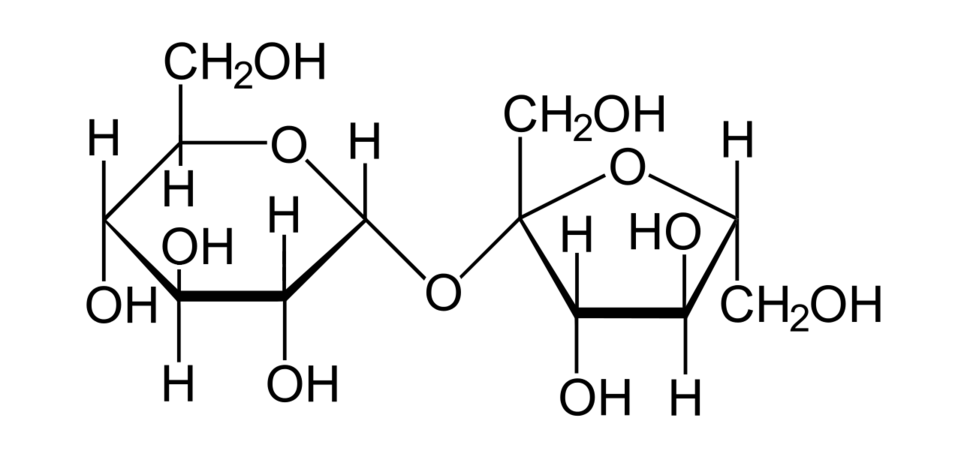
Structural formula of sucrose.
Credit: Bas / Wikimedia Commons

License: CC BY-SA 3.0
Wikimedia-provided scaled PNG/JPEG rendering; no content edits
What it is
Sucrose (CAS 57-50-1) is the sugar sold as table sugar. [4] The structural formula below shows its glucose and fructose units joined together.
What it does and why it is used
It is added to foods and drinks to sweeten them. [4]
Regulatory status and health context
Canada
The sources used here do not cover Canadian rules for sucrose.
United States
Added sugars must be listed in grams and percent Daily Value on Nutrition Facts labels. [4]
International
WHO's 2015 guideline recommends limiting free sugars to below 10% of energy intake. [1]
Environmental notes
The sources used here do not provide enough environmental data for a rating.
Quick facts
- CAS: 57-50-1.
- WHO limit: under 10% of energy, ideally under 5%. [1]
- US Daily Value: 50 g of added sugars. [4]
- Children (AHA): at most 25 g a day; none under age 2. [2]
Sources
Sources were accessed on 2026-11-21. Source publication dates differ from this draft's review date. Image licences are listed with each image.
- World Health Organization: WHO calls on countries to reduce sugars intake among adults and children, 2015.
- Vos MB et al. Added sugars and cardiovascular disease risk in children: a scientific statement from the American Heart Association. Circulation, 2017 (PubMed).
- Johnson RK et al. Dietary sugars intake and cardiovascular health: a scientific statement from the American Heart Association. Circulation, 2009 (PubMed).
- FDA: Added sugars on the Nutrition Facts label.