
Food and drinkNutrients and supplements
Lecithin (E322): the emulsifier in chocolate, and what 'soy lecithin' means for allergies
CAS 8002-43-5.Also known as E322, E 322, soy lecithin, sunflower lecithin, phosphatidylcholine, and lecithins.
Editorial draft Last reviewed 21 November 2026 About 624 words
CC INDEX
How it works28/100 Mild
Lecithin is common in chocolate, spreads and baked goods but assessors found no safety concern. The allergy point is a labelling matter, and the TMAO link is an association involving diet as a whole.
An editorial summary of this article’s cited evidence. It isn’t medical advice or a personal risk estimate.
Age index
What is the age index?Which age groups are more affected by this chemical’s possible health issues, based on this article’s sources.
- Pregnancy Unborn babies Not well studied
- Infants 0 to 1 Lower concern
- Young children 1 to 5 Lower concern
- Children 6 to 12 Lower concern
- Teens 13 to 19 Lower concern
- Adults 20 to 64 Lower concern
- Older adults 65 and over Not well studied
- EFSA found no safety concern from 12 weeks of age at reported uses; people with soy allergy should check the source.

Illustration of chocolate and spread. Lecithin helps fats and other ingredients stay evenly mixed.
Credit: Chemical Century; AI-generated illustration
License: CC0 1.0
Illustration, not a photograph of a specific product. Resized and cropped for the web.
Lecithin is a fatty emulsifier, usually from soy or sunflower, that keeps chocolate smooth, stops margarine and spreads from separating and helps powders mix into liquids. European assessors found no safety concern for the general population and did not need to set a daily limit. The main practical question is allergy: when it comes from soy, many labelling rules treat it as a soy ingredient that must be declared. Research linking dietary phosphatidylcholine to a heart-risk marker called TMAO is about diet overall, not proof that lecithin additives cause heart disease.
Everyday exposure: where you meet it and how much
Commercial lecithin is a natural mixture of phosphatides, isolated as a gum from solvent-extracted soy, safflower or corn oils, according to US regulations. [1] In the EU it is authorised as E 322 in many foods. [2] Labels may say "lecithin", "soy lecithin", "sunflower lecithin" or "E322".
Known and suspected harms
Evidence labels are editorial summaries, not individual risk predictions: established means recognized under the stated conditions; probable means a likely contribution with uncertainty; possible means limited evidence; disputed means assessors disagree.
- Established — soy allergen labelling: EU law lists soybeans and products made from them among the allergens that must be emphasised on labels, with limited exemptions. [3] People with soy allergy should check the lecithin source and follow their allergist's advice.
- Possible — TMAO and heart risk: gut bacteria turn the choline part of dietary phosphatidylcholine (lecithin) into TMAO. In 4,007 patients having coronary angiography, those in the highest TMAO quarter had about 2.5 times the risk of a heart attack, stroke or death over three years compared with the lowest. This is an association study of diet as a whole and does not show that lecithin additives cause heart disease. [4]
EFSA concluded that no numerical acceptable daily intake was needed and that there was no safety concern for people over one year at reported uses, including for the choline released from lecithin. It reached the same conclusion for infants from 12 weeks. [2]
Reducing avoidable exposure
For most people there is no reason to avoid lecithin. People with soy allergy can look for the source on the label. [2,3]
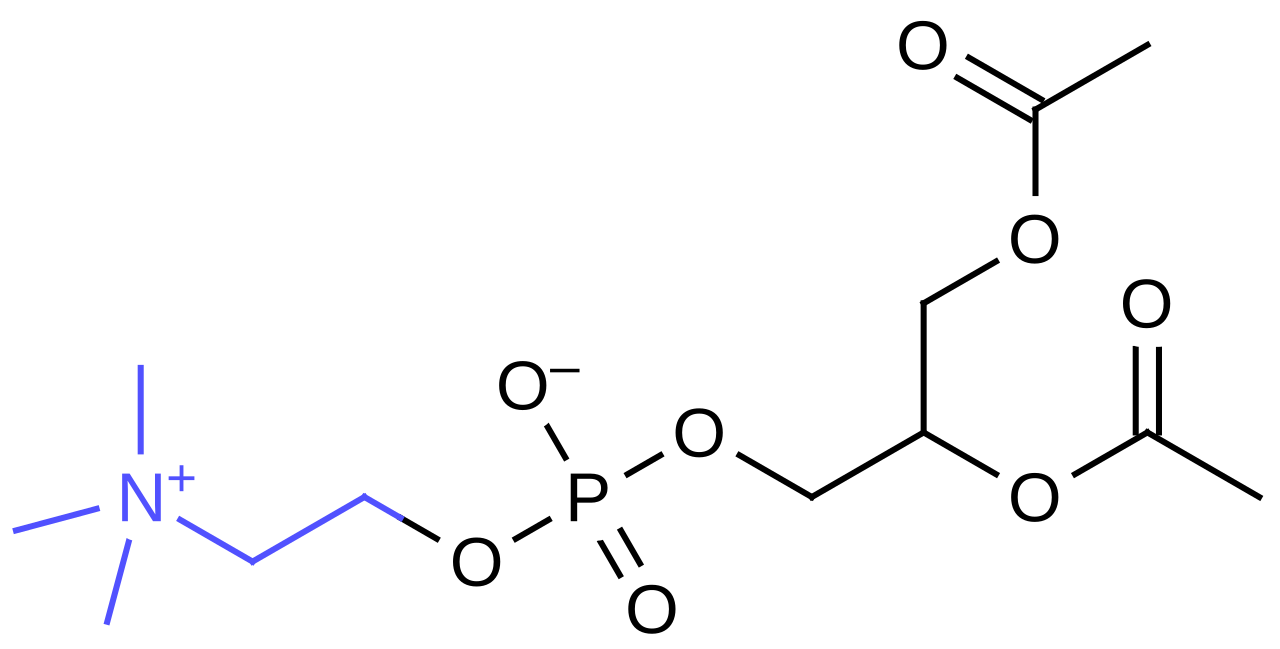
Structural formula of phosphatidylcholine, the main component of lecithin.
Credit: phenida@PHENTANYL / Wikimedia Commons

License: Public domain
Wikimedia-provided scaled PNG/JPEG rendering; no content edits
What it is
Lecithins are mixtures of phospholipids, mainly phosphatidylcholine, phosphatidylethanolamine and phosphatidylinositol. [1,2]
What it does and why it is used
One end of each molecule mixes with fat and the other with water, so lecithin keeps emulsions stable and improves flow in chocolate and powders. [1,2]
Regulatory status and health context
International
The sources used here do not include a separate international evaluation, though EFSA notes JECFA evaluated lecithins in 1973. [2]
United States
Lecithin is affirmed as generally recognized as safe (GRAS) when used under good manufacturing practice. [1]
European Union
E 322 is authorised. EFSA's 2017 re-evaluation found no need for a numerical ADI and no safety concern at reported uses. Soy must be emphasised as an allergen on labels. [2,3]
Environmental notes
The sources used here do not provide enough environmental data for a rating.
Quick facts
- CAS: 8002-43-5.
- E number: E 322. [2]
- Sources: mainly soy, sunflower, safflower or corn oil. [1]
- EU ADI: not specified (no numerical ADI needed). [2]
Sources
Sources were accessed on 2026-11-21. Source publication dates differ from this draft's review date. Image licences are listed with each image.
- eCFR: 21 CFR 184.1400, lecithin.
- EFSA ANS Panel. Re-evaluation of lecithins (E 322) as a food additive. EFSA Journal, 2017 (PubMed).
- European Union: Regulation (EU) No 1169/2011 on food information to consumers (EUR-Lex).
- Tang WH et al. Intestinal microbial metabolism of phosphatidylcholine and cardiovascular risk. N Engl J Med, 2013 (PubMed).