
Water, air and residuesNutrients and supplements
Manganese in well water: why is it a concern for babies?
CAS 7439-96-5.Also known as Mn, manganese in drinking water, and manganese in well water.
Editorial draft Last reviewed 21 November 2026 About 760 words
CC INDEX
How it works66/100 High
Health Canada set its drinking water limit to protect infants' developing brains, and studies link higher tap-water manganese with lower IQ in children. Exposure is concentrated in some wells and water systems rather than everywhere.
An editorial summary of this article’s cited evidence. It isn’t medical advice or a personal risk estimate.
Age index
What is the age index?Which age groups are more affected by this chemical’s possible health issues, based on this article’s sources.
- Pregnancy Unborn babies Not well studied
- Infants 0 to 1 Higher concern
- Young children 1 to 5 Moderate
- Children 6 to 12 Moderate
- Teens 13 to 19 Lower concern
- Adults 20 to 64 Lower concern
- Older adults 65 and over Lower concern
- Infants (higher concern): Formula made with high-manganese water; absorb more, excrete less
- Young children (moderate): Developing brain; drink more water per body weight
- Children (moderate): Lower IQ linked to higher tap-water levels

Illustration of manganese staining at a sink. High manganese can discolour water, but testing is the only way to know.
Credit: Chemical Century; AI-generated illustration
License: CC0 1.0
Illustration, not a photograph of a specific product. Resized and cropped for the web.
Manganese is a mineral your body needs in small amounts, and most people get plenty from food. In some wells and water systems, though, it is high enough to discolour water and stain laundry and fixtures, and at higher levels it can affect the developing brain. Babies fed formula made with tap water are most at risk, because they drink a lot for their size and absorb more manganese than adults. Studies of school-age children have linked higher manganese in tap water with lower IQ scores, so testing well water matters for families with young children.
Everyday exposure: where you meet it and how much
Manganese is an essential nutrient found in air, food, water, soil and rocks. It gets into drinking water when water dissolves manganese-containing minerals, and through mining, industrial discharges and landfill leaching. Levels in Canadian fresh water are usually low but can be higher in groundwater and some lakes and reservoirs. The only way to know is to test; manganese may discolour water, but not always. [1]
In a study of 362 children aged 6 to 13 living in communities on groundwater, the median manganese level in home tap water was 34 µg/L, ranging from 1 to 2,700 µg/L. [3]
Known and suspected harms
Evidence labels are editorial summaries, not individual risk predictions: established means recognized under the stated conditions; probable means a likely contribution with uncertainty; possible means limited evidence; disputed means assessors disagree.
- Probable — brain development in infants: Health Canada says high manganese in drinking water, even for a short time, can be a health risk to infants, and that exposure can cause neurological and behavioural effects and deficits in memory, attention and motor skills. Formula-fed infants are especially at risk because their brains are developing rapidly, they drink more water for their weight, and they absorb more manganese and remove less. [1]
- Probable — lower IQ in children: in that study, a tenfold increase in tap-water manganese was associated with 2.4 fewer IQ points after adjusting for maternal intelligence, family income and other factors, and children in the highest fifth of exposure scored 6.2 points lower than those in the lowest fifth. Hair manganese rose with intake from water but not from food. The study was cross-sectional, so it cannot prove cause. [3]
For adults and older children, Health Canada says short-term exposure slightly above the guideline is unlikely to cause harm. [1]
Reducing avoidable exposure
Test private wells, especially if you have an infant. If your water is above 0.12 mg/L, Health Canada advises using another safe source, such as bottled water, to prepare infant formula until levels are reduced. Reverse osmosis at the tap is the most effective home treatment; Health Canada notes that a unit certified to remove other metals such as arsenic or lead will also remove manganese. Bathing and showering in water above the guideline is considered safe, because manganese is not absorbed through skin or breathed in. [1,2]
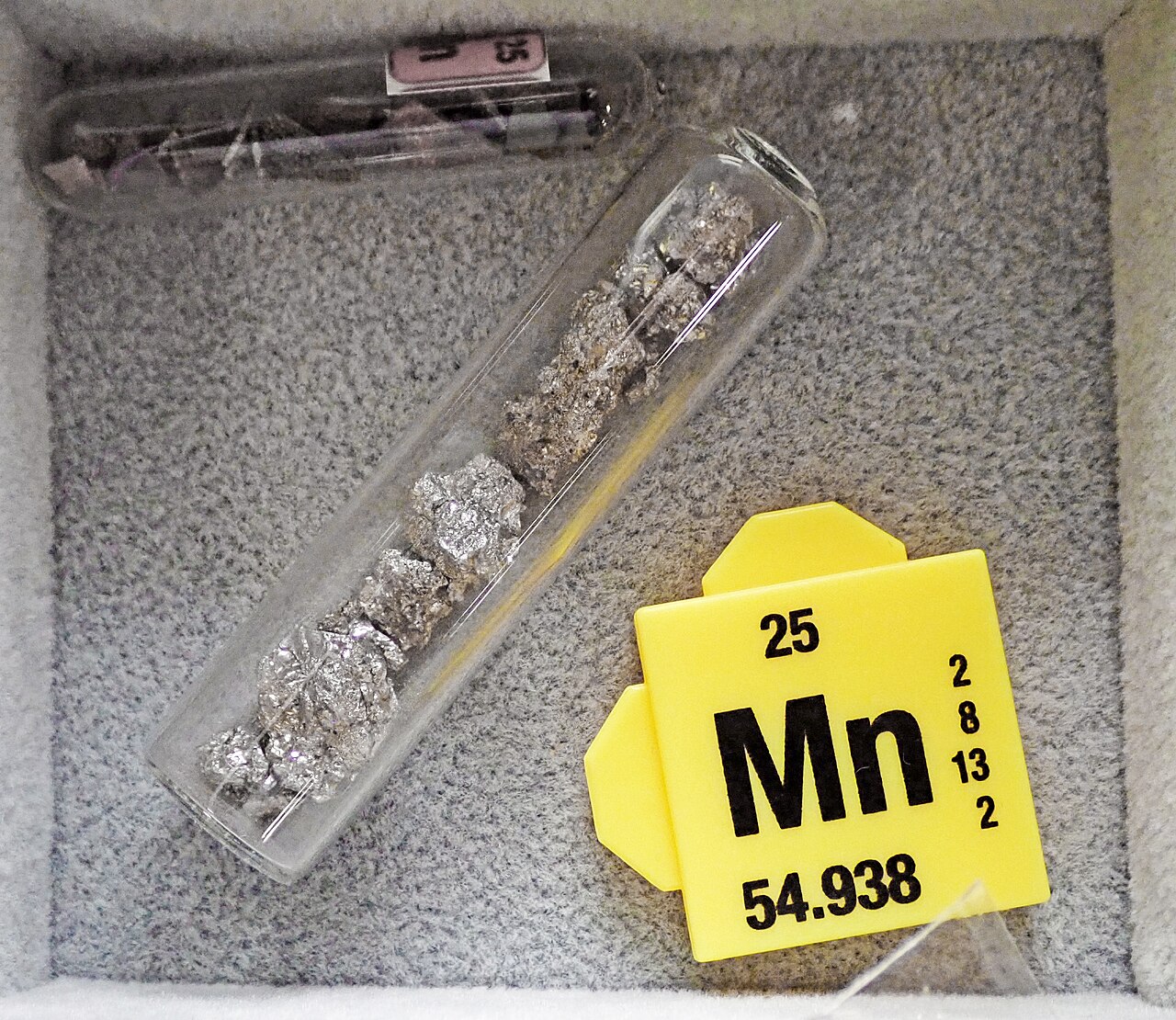
Manganese metal. In water, manganese comes from dissolved minerals.
Credit: James St. John / Wikimedia Commons

License: CC BY 2.0
Wikimedia-provided scaled PNG/JPEG rendering; no content edits
What it is
Manganese (CAS 7439-96-5) is a naturally occurring metallic element and an essential nutrient. [1]
What it does and why it is used
The body needs small amounts of manganese. In water, it comes mostly from natural minerals, though it may also be added during water treatment. Manganese can discolour water and stain laundry and fixtures. [1]
Regulatory status and health context
Canada
Health Canada's maximum acceptable concentration for manganese is 0.12 mg/L, set to protect infants, and its aesthetic objective is 0.02 mg/L to limit discoloured water and staining. [1,4]
United States
The sources used here do not cover a US federal limit.
European Union
The sources used here do not cover EU limits.
Environmental notes
The sources used here focus on drinking water and do not provide an environmental rating.
Quick facts
- CAS: 7439-96-5. [1]
- Source in water: dissolved minerals, industry, landfills. [1]
- Most at risk: formula-fed infants. [1]
- Canada: 0.12 mg/L health limit; 0.02 mg/L aesthetic objective. [1]
- Best home treatment: reverse osmosis at the tap. [1]
Sources
Sources were accessed on 2026-11-21. Source publication dates differ from this draft's review date. Image licences are listed with each image.
- Health Canada: Water Talk, manganese in drinking water.
- Health Canada: Guidelines for Canadian Drinking Water Quality, guideline technical document, manganese.
- Bouchard MF et al. Intellectual impairment in school-age children exposed to manganese from drinking water. Environ Health Perspect, 2011 (PubMed).
- Health Canada: Guidelines for Canadian Drinking Water Quality, summary tables.