
Makeup and colourSkin and personal care
Octocrylene: the sunscreen filter that can break down into benzophenone
CAS 6197-30-4.Also known as octocrilene, 2-ethylhexyl 2-cyano-3,3-diphenylacrylate, and OCR.
Editorial draft Last reviewed 21 November 2026 About 667 words
CC INDEX
How it works48/100 Moderate
Octocrylene is common and absorbed, and benzophenone contamination increases with age. EU scientists found it safe up to 10% in most products, and FDA has asked for more data.
An editorial summary of this article’s cited evidence. It isn’t medical advice or a personal risk estimate.
Age index
What is the age index?Which age groups are more affected by this chemical’s possible health issues, based on this article’s sources.
- Pregnancy Unborn babies Not well studied
- Infants 0 to 1 Not well studied
- Young children 1 to 5 Not well studied
- Children 6 to 12 Lower concern
- Teens 13 to 19 Lower concern
- Adults 20 to 64 Moderate
- Older adults 65 and over Moderate
- Adults (moderate): Absorbed into blood; benzophenone forms as products age
- Older adults (moderate): Absorbed into blood; benzophenone forms as products age
- People sensitised to ketoprofen may react to octocrylene at any age.

Illustration of applying sunscreen. Octocrylene is a common filter in sunscreens.
Credit: Chemical Century; AI-generated illustration
License: CC0 1.0
Illustration, not a photograph of a specific product. Resized and cropped for the web.
Octocrylene is a chemical UV filter used in sunscreens and in face creams, hand creams and lipsticks. It is absorbed into the blood, and studies have found benzophenone, a possible human carcinogen, forming in octocrylene products as they age. It can also cause allergic or light-triggered skin reactions in some people, especially those already sensitised to the anti-inflammatory drug ketoprofen. European scientists still consider it safe up to 10% in most products, and sunscreen use remains important.
Everyday exposure: where you meet it and how much
Octocrylene is a UV filter in sunscreens, face creams, hand creams and lipsticks. [3] In a US trial under maximal-use conditions, octocrylene reached average peak blood levels of 6.6 to 7.8 ng/mL, above the 0.5 ng/mL threshold FDA uses to ask for more safety testing. [6]
Known and suspected harms
Evidence labels are editorial summaries, not individual risk predictions: established means recognized under the stated conditions; probable means a likely contribution with uncertainty; possible means limited evidence; disputed means assessors disagree.
- Established — benzophenone forms in products: octocrylene can be made using benzophenone, a possible human carcinogen. One laboratory study found benzophenone in the octocrylene raw material and in all 28 octocrylene-containing products tested, mostly above 10 ppm, while most octocrylene-free products had none; levels rose with time and temperature. [2] A separate study found benzophenone averaging 39 mg/kg in 16 recently bought octocrylene sunscreens, rising to an average of 75 mg/kg after accelerated ageing, and none in a product without octocrylene. [1]
- Possible — photoallergy: patients photosensitised to the drug ketoprofen can develop severe photoallergic skin reactions to octocrylene. [2]
- Disputed — hormone-like effects: EU scientists said some animal studies suggest possible endocrine effects but the evidence is not conclusive, and found octocrylene safe up to 10% in most products. [3]
FDA has proposed that octocrylene needs additional data before it can be called generally recognized as safe and effective, and says this does not mean it is unsafe. [5]
Reducing avoidable exposure
Keep using sun protection. Replace old sunscreen, store it away from heat, and consider mineral sunscreens with zinc oxide or titanium dioxide if you want to avoid octocrylene. [1,2,5]
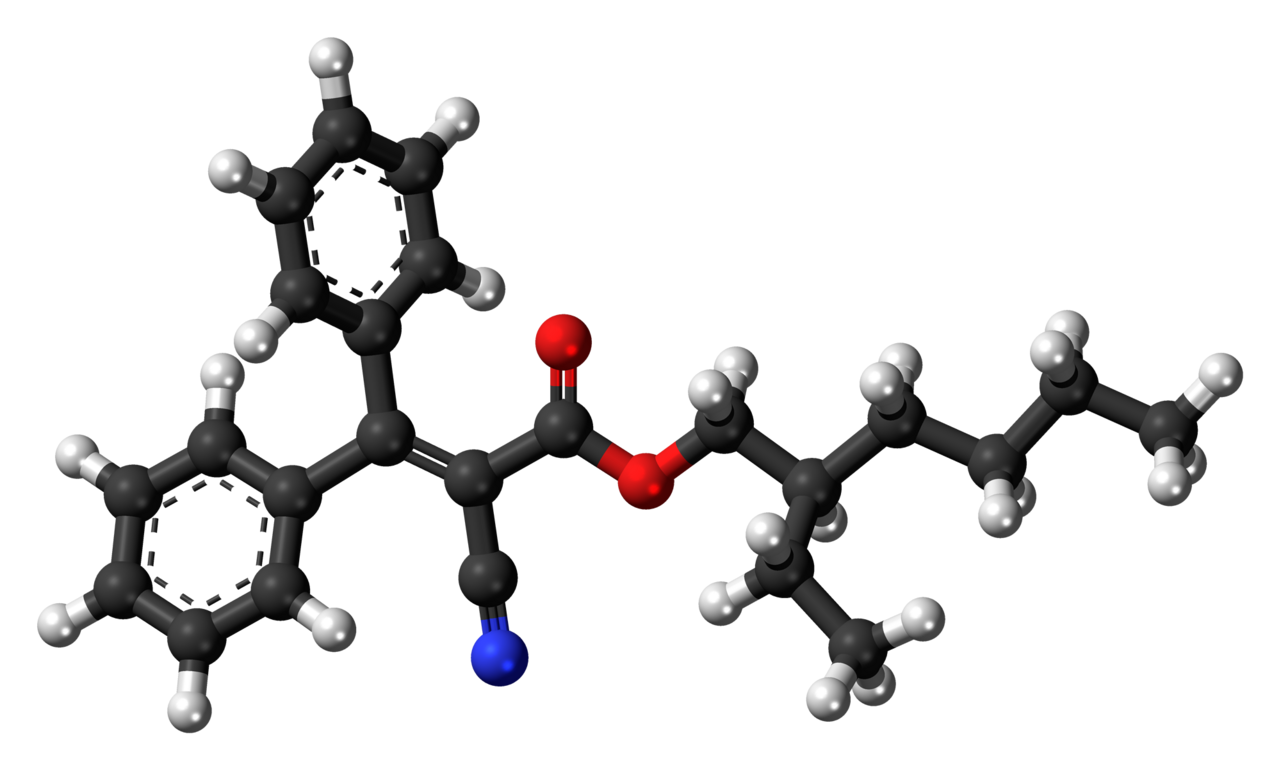
Ball-and-stick model of octocrylene.
Credit: Jynto / Wikimedia Commons

License: CC0
Wikimedia-provided scaled PNG/JPEG rendering; no content edits
What it is
Octocrylene (CAS 6197-30-4) is an organic UV filter with two phenyl rings, a cyano group and an ethylhexyl ester. [2]
What it does and why it is used
It absorbs ultraviolet light in sunscreens and cosmetics. [2,3]
Regulatory status and health context
Canada
The sources used here do not cover Canadian rules for octocrylene.
United States
Octocrylene is permitted in sunscreens, but FDA's proposed order says more data are needed. [5]
European Union
After a 2019 call for data on possible endocrine-disrupting properties, the EU limited octocrylene to 10% in most cosmetic products and 9% in propellant sprays, with benzophenone kept at trace levels; the limits applied to new products from 28 January 2023. [3,4]
Environmental notes
The sources used here do not provide enough environmental data for a rating.
Quick facts
- CAS: 6197-30-4.
- EU limit: 10%; 9% in propellant sprays. [3,4]
- Benzophenone: detected in all octocrylene products in one study. [2]
- Blood levels: 6.6–7.8 ng/mL average peak in a maximal-use trial. [6]
Sources
Sources were accessed on 2026-11-21. Source publication dates differ from this draft's review date. Image licences are listed with each image.
- Downs CA et al. Benzophenone accumulates over time from the degradation of octocrylene in commercial sunscreen products. Chem Res Toxicol, 2021 (PubMed).
- Foubert K et al. The presence of benzophenone in sunscreens and cosmetics containing the organic UV filter octocrylene: a laboratory study. Contact Dermatitis, 2021 (PubMed).
- European Commission SCCS: Opinion on octocrylene, 2021.
- European Commission: Regulation (EU) 2022/1176 amending the Cosmetics Regulation for certain UV filters (EUR-Lex).
- FDA: Questions and answers: FDA posts deemed final order and proposed order for over-the-counter sunscreen.
- Matta MK et al. Effect of sunscreen application on plasma concentration of sunscreen active ingredients: a randomized clinical trial. JAMA, 2020 (PubMed).