
Water, air and residuesPlastics & packaging
Perchlorate: the thyroid-blocking chemical in some food packaging and drinking water
CAS 14797-73-0.Also known as perchlorate ion, ammonium perchlorate, potassium perchlorate, sodium perchlorate, and ClO4.
Editorial draft Last reviewed 21 November 2026 About 838 words
CC INDEX
How it works58/100 Moderate
High doses clearly interfere with thyroid iodine uptake, and FDA names pregnant women, fetuses and newborns as most at risk. Effects of low dietary levels are uncertain. EPA proposed a national drinking-water limit in 2026, and FDA limits its use in food packaging.
An editorial summary of this article’s cited evidence. It isn’t medical advice or a personal risk estimate.
Age index
What is the age index?Which age groups are more affected by this chemical’s possible health issues, based on this article’s sources.
- Pregnancy Unborn babies Higher concern
- Infants 0 to 1 Higher concern
- Young children 1 to 5 Moderate
- Children 6 to 12 Lower concern
- Teens 13 to 19 Lower concern
- Adults 20 to 64 Lower concern
- Older adults 65 and over Not well studied
- Pregnancy (higher concern): Thyroid hormone needed for fetal brain development
- Infants (higher concern): Thyroid hormone critical for growth and brain development
- Young children (moderate): Eat more per kg of body weight (general principle)
- Risk is also higher for people with low iodine intake or existing thyroid disease.

Illustration of foods and water that can carry trace perchlorate. Levels vary widely by region and season.
Credit: Chemical Century; AI-generated illustration
License: CC0 1.0
Illustration, not a photograph of a specific product. Resized and cropped for the web.
Perchlorate is better known as a rocket fuel and firework ingredient, but small amounts reach dinner tables through some drinking water, foods and dry-food packaging. At high doses it blocks the thyroid from taking up iodine, the mineral the body needs to make thyroid hormone. That matters most during pregnancy and early infancy, when thyroid hormone guides a baby's brain development, and for people who are already low in iodine. Whether the much smaller amounts in a typical diet cause harm is still debated, and the US is now writing its first drinking-water limit.
Everyday exposure: where you meet it and how much
FDA explains that perchlorate is used in rocket propellant, explosives, fireworks and road flares, and because it is in the environment it has been found in some drinking water and foods. FDA's Total Diet Study, which tests about 280 types of food a year including 40 baby foods, has measured perchlorate in a range of foods, from collard greens and deli meats to milk chocolate. [1]
Some packaging is a second source. FDA allows small amounts of perchlorate, not more than 1.2% by weight of the finished polymer, as part of antistatic agents in certain containers and processing equipment that touch only certain dry foods. [1]
Known and suspected harms
Evidence labels are editorial summaries, not individual risk predictions: established means recognized under the stated conditions; probable means a likely contribution with uncertainty; possible means limited evidence; disputed means assessors disagree.
- Established — blocks iodine uptake at high doses: FDA states that high doses of perchlorate can interfere with iodide uptake into the thyroid and potentially reduce thyroid hormone production. Perchlorate has even been used as a drug to treat an overactive thyroid. [1]
- Possible — thyroid effects at everyday levels in sensitive groups: a 2020 review concluded that cross-sectional studies show perchlorate exposure affects thyroid hormone production, particularly in people with thyroid disease or low iodine, while the effects of chronic low-dose exposure remain unclear. An analysis of US survey data found that, in women with low iodine, higher perchlorate was linked with lower thyroxine, and the link was stronger in smokers. [3,4]
- Possible — child development after high exposure in pregnancy: the same review reported worse neurocognitive and behavioural outcomes in infants after exaggerated exposure in pregnancy. FDA names pregnant women, fetuses and newborns as having the greatest potential for harm, because thyroid hormone is critical for brain development. [1,3]
Reducing avoidable exposure
FDA says most Americans get enough iodine and do not need iodine supplements to protect against perchlorate, but it is particularly important for pregnant and nursing women to get enough iodine; many prenatal supplements contain it, and FDA advises talking with a health care practitioner before supplementing. If you use a private well near a site that handled rocket fuel, explosives or fireworks, consider having the water tested. [1,2]
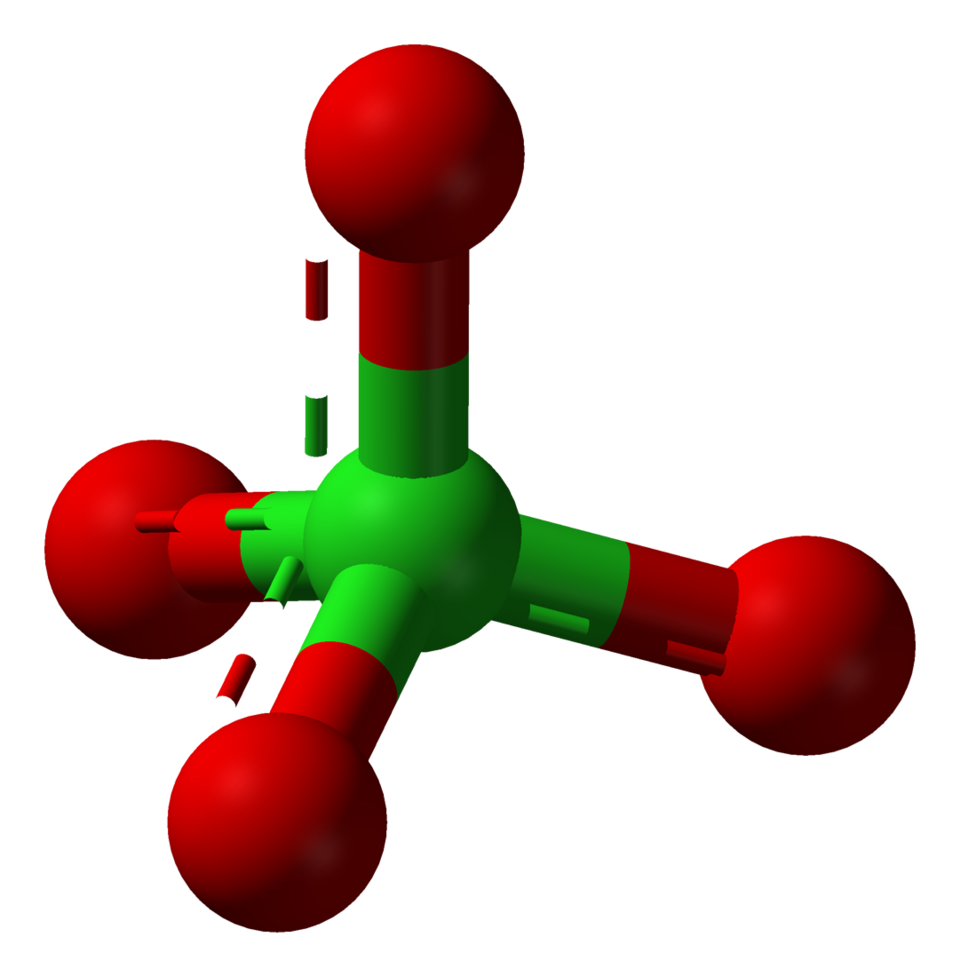
Ball-and-stick model of the perchlorate ion.
Credit: Benjah-bmm27 / Wikimedia Commons

License: Public domain
Wikimedia-provided scaled PNG/JPEG rendering; no content edits
What it is
Perchlorate (ClO4⁻, CAS 14797-73-0 for the ion) is a negatively charged ion made of one chlorine and four oxygen atoms. It forms salts such as ammonium, potassium and sodium perchlorate. It also forms naturally in some arid environments. [1]
What it does and why it is used
Perchlorate salts are powerful oxidizers, used in rocket fuel, fireworks, flares and explosives, and in small amounts as an antistatic agent in some dry-food packaging. [1]
Regulatory status and health context
Canada
Health Canada's drinking water summary table, consulted for this article, did not list a numerical guideline for perchlorate. [5]
United States
After a 2023 court decision, EPA signed a proposed national drinking-water regulation on January 2, 2026, with a health-based goal of 0.02 mg/L (20 µg/L) and co-proposed enforceable limits of 20, 40 or 80 µg/L. EPA must sign a final rule by May 21, 2027. Since May 4, 2017, FDA has limited perchlorate in food contact uses to antistatic agents for certain dry foods. [1,2]
European Union
The sources used here do not cover EU rules for perchlorate.
Environmental notes
Perchlorate is in the environment from both industrial and natural sources, which is how it reaches some drinking water and foods. [1]
Quick facts
- CAS (ion): 14797-73-0.
- Sources: some drinking water and foods, and certain dry-food packaging. [1]
- Main hazard: blocks thyroid iodine uptake at high doses (established). [1]
- Most at risk: pregnancy, fetuses, newborns, people low in iodine. [1,3]
- US status: drinking-water rule proposed in 2026; final rule due by May 2027. [2]
Sources
Sources were accessed on 2026-11-21. Source publication dates differ from this draft's review date. Image licences are listed with each image.
- FDA: Perchlorate questions and answers.
- US EPA: Perchlorate in drinking water.
- Lisco G et al. Interference on iodine uptake and human thyroid function by perchlorate-contaminated water and food. Nutrients, 2020 (PubMed).
- Steinmaus C et al. Impact of smoking and thiocyanate on perchlorate and thyroid hormone associations in NHANES 2001–2002. Environ Health Perspect, 2007 (PubMed).
- Health Canada: Guidelines for Canadian Drinking Water Quality, summary table.