
Food and drinkNutrients and supplements
Potassium chloride salt substitutes: lower stroke risk, and who should avoid them
CAS 7447-40-7.Also known as E508, E 508, KCl, salt substitute, lite salt, low-sodium salt, and potassium-enriched salt.
Editorial draft Last reviewed 21 November 2026 About 752 words
CC INDEX
How it works50/100 Moderate
Potassium chloride is beneficial for most adults replacing salt, but can be dangerous for people with kidney impairment or potassium-raising medicines. Severity reflects that narrow but serious risk.
An editorial summary of this article’s cited evidence. It isn’t medical advice or a personal risk estimate.
Age index
What is the age index?Which age groups are more affected by this chemical’s possible health issues, based on this article’s sources.
- Pregnancy Unborn babies Not well studied
- Infants 0 to 1 Not well studied
- Young children 1 to 5 Not well studied
- Children 6 to 12 Not well studied
- Teens 13 to 19 Not well studied
- Adults 20 to 64 Lower concern
- Older adults 65 and over Higher concern
- Older adults (higher concern): Kidney disease or potassium-raising medicines: hyperkalaemia
- WHO's suggestion excludes pregnant women, children and people with kidney impairment or conditions that limit potassium excretion; the older-adult rating reflects those risks, not the overall effect, which was beneficial in the trial.

Illustration of salt shakers and soup. Potassium chloride replaces part of the sodium in salt substitutes.
Credit: Chemical Century; AI-generated illustration
License: CC0 1.0
Illustration, not a photograph of a specific product. Resized and cropped for the web.
Potassium chloride is the main ingredient in low-sodium salt substitutes and is also added to processed foods to cut sodium. In a large trial of older adults with high blood pressure or a past stroke, swapping regular salt for a salt substitute lowered rates of stroke, heart events and death. The World Health Organization now suggests potassium-containing salt substitutes for adults who use table salt. The important exception is people with kidney problems or medicines that raise potassium, for whom extra potassium can cause dangerous heart rhythm problems.
Everyday exposure: where you meet it and how much
Potassium chloride replaces part of the sodium chloride in salt substitutes; a common blend is 75% sodium chloride and 25% potassium chloride. [3,8] It is also a permitted food ingredient in the US (GRAS) and an authorised additive in the EU (E 508). [6,7]
Known and suspected harms
Evidence labels are editorial summaries, not individual risk predictions: established means recognized under the stated conditions; probable means a likely contribution with uncertainty; possible means limited evidence; disputed means assessors disagree.
- Established — benefit for older adults at high risk: in a cluster-randomised trial in 600 rural Chinese villages, 20,995 people with a history of stroke or aged 60 or over with high blood pressure (mean age 65) used either a 75/25 salt substitute or regular salt for an average of 4.7 years. Stroke (rate ratio 0.86), major cardiovascular events (0.87) and death (0.88) were all lower with the substitute, and serious adverse events attributed to high potassium were not significantly more common. A Cochrane review notes that all 26 salt-substitute trials it found excluded people in whom extra potassium is known to be potentially harmful. [3,4]
- Probable — dangerous high potassium in at-risk people: reviews note concern about hyperkalaemia, particularly with chronic kidney disease or medicines that impair potassium excretion. [4] One case report described an older woman with diabetes and high blood pressure, on an ACE inhibitor and a beta blocker, with high salt-substitute intake and normal kidney function, who developed life-threatening hyperkalaemia after a minor procedure. [5]
Reducing avoidable exposure
WHO's strong recommendation is to keep sodium below 2 g a day; using less salt overall comes first. [1,2] If you have kidney disease, take a potassium supplement or a potassium-sparing diuretic, or take other medicines that affect potassium (the case report involved an ACE inhibitor), ask your clinician before using a salt substitute. [2,5,8]
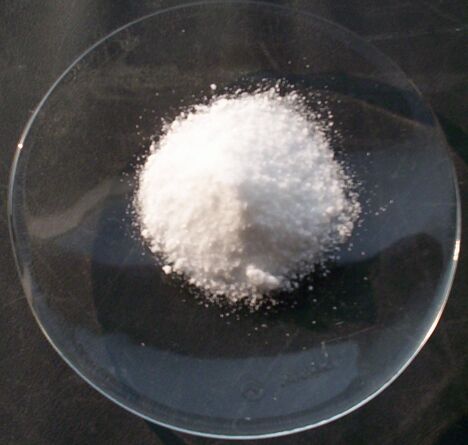
Crystals of potassium chloride.
Credit: Unknown / Wikimedia Commons

License: Public domain
Resized for the web; no content edits
What it is
Potassium chloride (KCl) is a salt of potassium, an essential mineral, and chloride. [6]
What it does and why it is used
It provides saltiness with less sodium, and is used as a flavour enhancer and nutrient. [6,8]
Regulatory status and health context
International
WHO suggests that adults who use table salt replace it with lower-sodium salt substitutes containing potassium (a conditional recommendation, based on low-certainty evidence). This is intended for adults in general populations, not pregnant women or children, and excludes people with kidney impairment or conditions that limit potassium excretion. [1,2]
United States
Potassium chloride is affirmed as GRAS for uses such as flavour enhancer and nutrient supplement under good manufacturing practice. [6]
European Union
Potassium chloride is authorised as E 508. [7]
Environmental notes
The sources used here do not provide enough environmental data for a rating.
Quick facts
- CAS: 7447-40-7.
- E number: E 508. [7]
- Common salt substitute blend: 75% sodium chloride, 25% potassium chloride. [3]
- Key trial result: about 14% fewer strokes. [3]
- Not for: people with kidney impairment or potassium-raising medicines without medical advice. [1,5]
Sources
Sources were accessed on 2026-11-21. Source publication dates differ from this draft's review date. Image licences are listed with each image.
- WHO: Use of lower-sodium salt substitutes: WHO guideline, 2025.
- WHO: Launch of the guideline on use of lower-sodium salt substitutes, overview presentation, 2025 (PDF).
- Neal B et al. Effect of salt substitution on cardiovascular events and death. N Engl J Med, 2021 (PubMed).
- Brand A et al. Replacing salt with low-sodium salt substitutes (LSSS) for cardiovascular health in adults, children and pregnant women. Cochrane Database Syst Rev, 2022 (PubMed).
- Ayach T et al. Life-threatening hyperkalemia in a patient with normal renal function. Clin Kidney J, 2014 (PubMed).
- eCFR: 21 CFR 184.1622, potassium chloride.
- European Union: Regulation (EC) No 1333/2008 on food additives, consolidated text with the Union list (EUR-Lex).
- Xu X et al. Potassium-enriched salt substitutes: a review of recommendations in clinical management guidelines. Hypertension, 2024 (PubMed).