
Annatto (E160b): the natural orange colour in cheese and snacks, and rare allergies
CAS 1393-63-1.Also known as E160b, E 160b, annatto extract, bixin, norbixin, and achiote.
Editorial draft Last reviewed 21 November 2026 About 634 words
CC INDEX
How it works34/100 Mild
Annatto is a common plant-based colour. Assessors set ADIs that intakes generally stay within; documented allergic reactions are rare but can be serious.
An editorial summary of this article’s cited evidence. It isn’t medical advice or a personal risk estimate.
Age index
What is the age index?Which age groups are more affected by this chemical’s possible health issues, based on this article’s sources.
- Pregnancy Unborn babies Not well studied
- Infants 0 to 1 Not well studied
- Young children 1 to 5 Moderate
- Children 6 to 12 Lower concern
- Teens 13 to 19 Lower concern
- Adults 20 to 64 Lower concern
- Older adults 65 and over Not well studied
- Young children (moderate): Norbixin intake reached the ADI in some toddlers
- Allergic reactions are rare and can occur at any age.

Illustration of cheese and snacks coloured with annatto; the seeds shown are artistic, not botanically exact.
Credit: Chemical Century; AI-generated illustration
License: CC0 1.0
Illustration, not a photograph of a specific product. Resized and cropped for the web.
Annatto is an orange-yellow colour extracted from the seeds of the achiote tree, used in cheeses, snack foods, drinks and cereals. Because it comes from a plant, it is often used to replace synthetic dyes. European assessors set safe daily limits for its two colouring compounds, bixin and norbixin, and found intakes generally within them. Rarely, people react to annatto with hives or, in documented cases, severe allergic reactions, probably because of traces of seed protein.
Everyday exposure: where you meet it and how much
Annatto extract is prepared from the seeds of Bixa orellana using food-grade solvents such as alkaline water, oils or alcohol. [1] It is used in cheeses, snack foods, beverages and cereals. [4] In the EU it is E 160b. [6]
Known and suspected harms
Evidence labels are editorial summaries, not individual risk predictions: established means recognized under the stated conditions; probable means a likely contribution with uncertainty; possible means limited evidence; disputed means assessors disagree.
- Possible — rare allergic reactions: a patient developed hives, swelling and severe low blood pressure within 20 minutes of eating a cereal containing annatto. Skin and antibody tests pointed to annatto, probably due to residual seed proteins; the authors called it "a potential rare cause of anaphylaxis." [4] A later report described an IgE-mediated allergy to annatto in cheese. [5]
- Established — intake close to the norbixin limit for some groups: EFSA set acceptable daily intakes (ADIs) of 6 mg/kg body weight for bixin and 0.3 mg/kg for norbixin. Bixin exposure was below its ADI in all groups; for norbixin, some high-consumer (95th percentile) estimates reached or exceeded the ADI under some scenarios, including proposed new uses. [2,3]
Reducing avoidable exposure
People who have had a reaction they think was caused by annatto should see an allergist and check labels for "annatto", "E160b", "bixin" or "norbixin". [4,5]
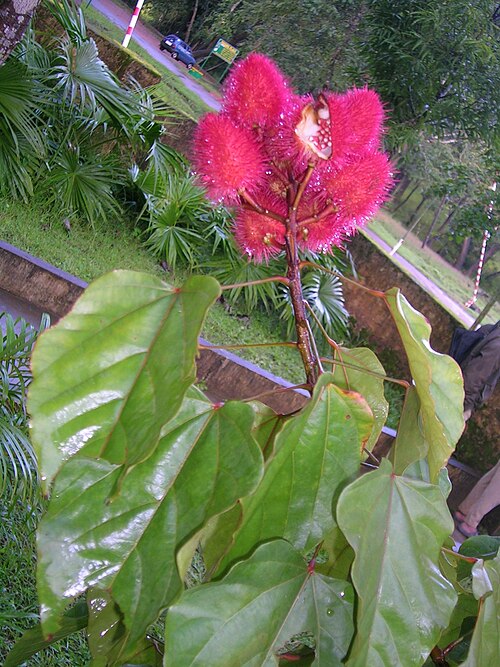
Fruit of the achiote tree (Bixa orellana), the source of annatto.
Credit: L. Shyamal / Wikimedia Commons

License: CC BY 2.5
Resized for the web; no content edits
What it is
Annatto is a carotenoid colour. Its main colouring compounds are bixin, which dissolves in fat, and norbixin, which dissolves in water. [2,3]
What it does and why it is used
It gives a yellow to orange colour to cheese, snacks and other foods. [1,4]
Regulatory status and health context
International
The sources used here do not include a separate international evaluation.
United States
Annatto extract is a listed colour additive exempt from batch certification. The eCFR notes an amendment to this section published on 10 November 2026; its content is not covered by the sources used here. [1]
European Union
E 160b is authorised. EFSA set ADIs of 6 mg/kg bixin and 0.3 mg/kg norbixin in 2016 and updated exposure estimates in 2019. [2,3]
Environmental notes
The sources used here do not provide enough environmental data for a rating.
Quick facts
- CAS: 1393-63-1.
- E number: E 160b. [6]
- Source: seeds of the achiote tree, Bixa orellana. [1]
- EU ADIs: bixin 6 mg/kg; norbixin 0.3 mg/kg body weight per day. [2]
Sources
Sources were accessed on 2026-11-21. Source publication dates differ from this draft's review date. Image licences are listed with each image.
- eCFR: 21 CFR 73.30, annatto extract.
- EFSA ANS Panel. Scientific opinion on the safety of annatto extracts (E 160b) as a food additive. EFSA Journal, 2016.
- EFSA FAF Panel. Safety of annatto E and the exposure to the annatto colouring principles bixin and norbixin (E 160b) when used as a food additive. EFSA Journal, 2019 (PubMed).
- Nish WA et al. Anaphylaxis to annatto dye: a case report. Ann Allergy, 1991 (PubMed).
- Ebo DG et al. Allergy for cheese: evidence for an IgE-mediated reaction from the natural dye annatto. Allergy, 2009 (PubMed).
- European Union: Regulation (EC) No 1333/2008 on food additives, consolidated text with the Union list (EUR-Lex).