
Sunset Yellow (E110, Yellow 6): the orange dye with an EU warning label
CAS 2783-94-0.Also known as E110, E 110, FD&C Yellow No. 6, Yellow 6, Sunset Yellow FCF, and orange yellow S.
Editorial draft Last reviewed 21 November 2026 About 656 words
CC INDEX
How it works48/100 Moderate
Sunset Yellow is common in coloured foods. The behavioural evidence comes from dye mixtures, but it triggered a mandatory EU warning label and a US phase-out request, which raise the regulatory score.
An editorial summary of this article’s cited evidence. It isn’t medical advice or a personal risk estimate.
Age index
What is the age index?Which age groups are more affected by this chemical’s possible health issues, based on this article’s sources.
- Pregnancy Unborn babies Not well studied
- Infants 0 to 1 Not well studied
- Young children 1 to 5 Moderate
- Children 6 to 12 Moderate
- Teens 13 to 19 Not well studied
- Adults 20 to 64 Lower concern
- Older adults 65 and over Not well studied
- Young children (moderate): Dye mixture raised hyperactivity scores in 3-year-olds
- Children (moderate): Dye mixtures raised hyperactivity scores at 8 to 9
- The behaviour trial tested mixtures of several dyes plus a preservative, so the effect of Sunset Yellow alone is not known.

Illustration of orange-coloured foods. Sunset Yellow is a common synthetic orange dye.
Credit: Chemical Century; AI-generated illustration
License: CC0 1.0
Illustration, not a photograph of a specific product. Resized and cropped for the web.
Sunset Yellow is the synthetic dye behind many orange sweets, soft drinks, snack coatings and desserts. Regulators in Europe and the US allow it within set limits, and European exposure estimates sit well below the safe daily intake. The concern that matters to families comes from a UK trial in which drinks containing mixtures of dyes, including Sunset Yellow, slightly increased hyperactive behaviour in some children. Because of that study, EU foods containing it must carry a warning about children's activity and attention, and the US is asking manufacturers to phase it out.
Everyday exposure: where you meet it and how much
In the US, FD&C Yellow No. 6 may colour foods and dietary supplements in amounts consistent with good manufacturing practice, with batch certification. [1] In the EU it is E 110. EFSA found that consumer exposure is well below its acceptable daily intake (ADI) for all age groups. [2]
Known and suspected harms
Evidence labels are editorial summaries, not individual risk predictions: established means recognized under the stated conditions; probable means a likely contribution with uncertainty; possible means limited evidence; disputed means assessors disagree.
- Possible — hyperactive behaviour in children: in a randomised, double-blind trial of 153 three-year-olds and 144 eight-to-nine-year-olds, drinks containing a dye mixture plus sodium benzoate increased a global hyperactivity score compared with placebo; one mix in the younger group and both mixes in the older group, when analysis was restricted to children who drank most of the drinks. The effect sizes were small, and Sunset Yellow was one of several additives tested together. [3]
- Possible — hives in a minority of sensitive people: among 39 adults with chronic urticaria who suspected food dyes, only 2 (5.1%) reacted to a placebo-controlled challenge with an azo dye mixture that included Sunset Yellow, far fewer than patients reported. [6]
EFSA raised its temporary ADI of 1 mg/kg body weight (2009) to 4 mg/kg in 2014 after new data. [2]
Reducing avoidable exposure
Families who want to limit synthetic dyes can check labels for "Sunset Yellow", "E110" or "Yellow 6". EU labels on foods containing it carry the children's activity warning. [1,4]
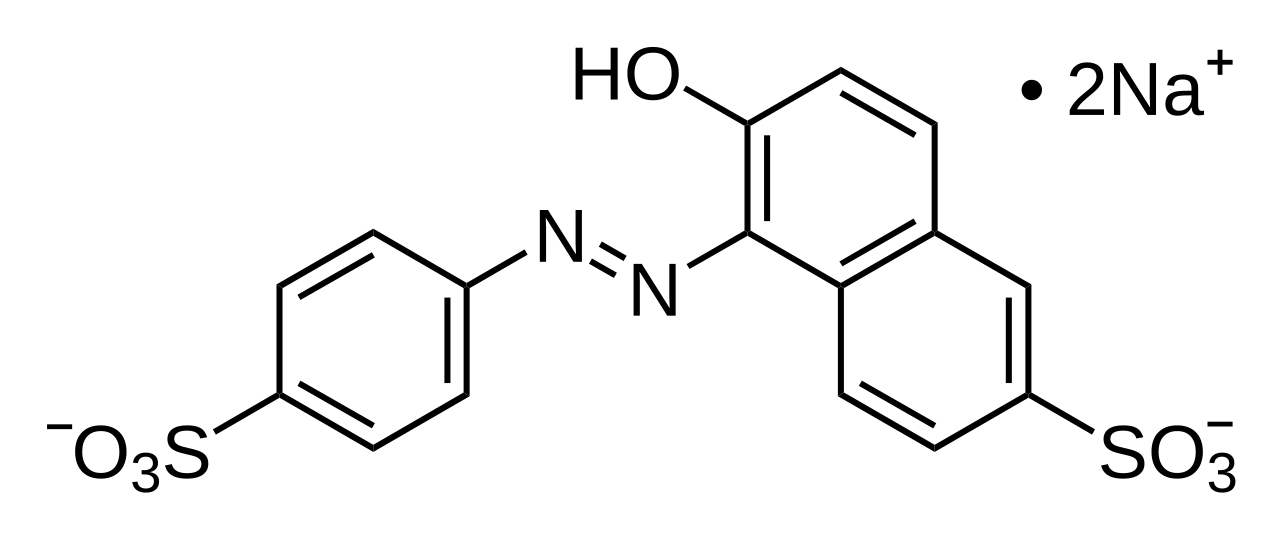
Structural formula of Sunset Yellow FCF.
Credit: Calvero. / Wikimedia Commons

License: Public domain
Wikimedia-provided scaled PNG/JPEG rendering; no content edits
What it is
Sunset Yellow FCF is a synthetic, water-soluble azo dye. [1]
What it does and why it is used
It gives foods and drinks a stable orange-yellow colour. [1]
Regulatory status and health context
International
The sources used here do not include a separate international (WHO/JECFA) evaluation.
United States
Yellow 6 remains a listed, batch-certified colour additive. [1] FDA's tracker says it is working with manufacturers to eliminate six certified food dyes, including Yellow 6, by the end of 2027; this is a voluntary transition, not a completed ban. [5]
European Union
Foods containing E 110 must state that it "may have an adverse effect on activity and attention in children", with narrow exceptions. [4] EFSA's ADI is 4 mg/kg body weight per day. [2]
Environmental notes
The sources used here do not provide enough environmental data for a rating.
Quick facts
- CAS: 2783-94-0.
- Names: E110, FD&C Yellow No. 6. [1,2]
- EU ADI: 4 mg/kg body weight per day. [2]
- EU label warning: yes. [4]
- US: voluntary phase-out target end of 2027. [5]
Planning meals around fewer additives? See also The Low-Additive Family Meal Plan, a printable 7-day plan with recipes and a grocery list ($4 USD).
Sources
Sources were accessed on 2026-11-21. Source publication dates differ from this draft's review date. Image licences are listed with each image.
- eCFR: 21 CFR 74.706, FD&C Yellow No. 6.
- EFSA: Sunset Yellow: EFSA sets ADI, 2014.
- McCann D et al. Food additives and hyperactive behaviour in 3-year-old and 8/9-year-old children in the community: a randomised, double-blinded, placebo-controlled trial. Lancet, 2007 (PubMed).
- European Union: Regulation (EC) No 1333/2008 on food additives, Annex V colour warning (EUR-Lex).
- FDA: Tracking food industry pledges to remove petroleum-based food dyes.
- Sadowska B et al. Hypersensitivity of azo dyes in urticaria patients based on a single-blind, placebo-controlled oral challenge. Postepy Dermatol Alergol, 2022 (PubMed).