
Calcium propionate (E282): the bread preservative and the blood sugar question
CAS 4075-81-4.Also known as E282, E 282, calcium propanoate, propionate, and preservative 282.
Editorial draft Last reviewed 21 November 2026 About 636 words
CC INDEX
How it works38/100 Mild
Calcium propionate is eaten often in packaged bread. Regulators see no safety concern at permitted levels; human signals on blood sugar hormones and children's behaviour are short-term and small.
An editorial summary of this article’s cited evidence. It isn’t medical advice or a personal risk estimate.
Age index
What is the age index?Which age groups are more affected by this chemical’s possible health issues, based on this article’s sources.
- Pregnancy Unborn babies Not well studied
- Infants 0 to 1 Not well studied
- Young children 1 to 5 Not well studied
- Children 6 to 12 Moderate
- Teens 13 to 19 Not well studied
- Adults 20 to 64 Moderate
- Older adults 65 and over Not well studied
- Children (moderate): Small trial: behaviour worsened in some sensitive children
- Adults (moderate): Meal study: short-term insulin resistance
- Both human signals come from short or small studies; long-term effects are not known.

Illustration of packaged bread, buns and tortillas, which often contain propionate preservatives.
Credit: Chemical Century; AI-generated illustration
License: CC0 1.0
Illustration, not a photograph of a specific product. Resized and cropped for the web.
Calcium propionate is the mould inhibitor that lets packaged bread, buns, tortillas and some cheeses last for days on the shelf. US and European assessors consider it safe at permitted levels. Two strands of research keep it in the news: a study in which a propionate-containing meal raised hormones that oppose insulin in healthy adults, and a small trial in which some children's behaviour seemed to worsen on preserved bread. Neither has shown long-term harm, but both are reasons some families prefer fresh or freezer-kept bread.
Everyday exposure: where you meet it and how much
In the US, calcium propionate is affirmed as safe (GRAS) for use as an antimicrobial agent in foods including baked goods and cheeses, at levels set by good manufacturing practice. [1] In the EU it is E 282. [5] Propionate is also made naturally by gut bacteria when they ferment fibre. [3]
Known and suspected harms
Evidence labels are editorial summaries, not individual risk predictions: established means recognized under the stated conditions; probable means a likely contribution with uncertainty; possible means limited evidence; disputed means assessors disagree.
- Possible — blood sugar hormones: in mice, propionate raised glucagon and the hormone FABP4 and caused high blood sugar; long-term feeding at a preservative-level dose caused gradual weight gain. In a randomised, double-blind, placebo-controlled study in healthy adults, a mixed meal containing propionate raised glucagon, FABP4 and noradrenaline after eating, leading to insulin resistance with higher insulin. The human study measured short-term responses only. [3]
- Possible — behaviour in sensitive children: 27 children whose behaviour had improved on an additive-free diet were given bread with or without calcium propionate in a double-blind crossover trial. Average scores did not differ significantly, but more children worsened on the preservative (52%) than improved (19%), with irritability, restlessness, inattention and sleep disturbance reported. The sample was small and pre-selected. [4]
EFSA found no concern for genotoxicity or cancer and concluded that propionates at authorised levels are not a safety concern. [2]
Reducing avoidable exposure
Bread without preservatives can be frozen in portions to slow mould. Check labels for "calcium propionate" or "E282". These are optional, precautionary steps. [1,3,4]
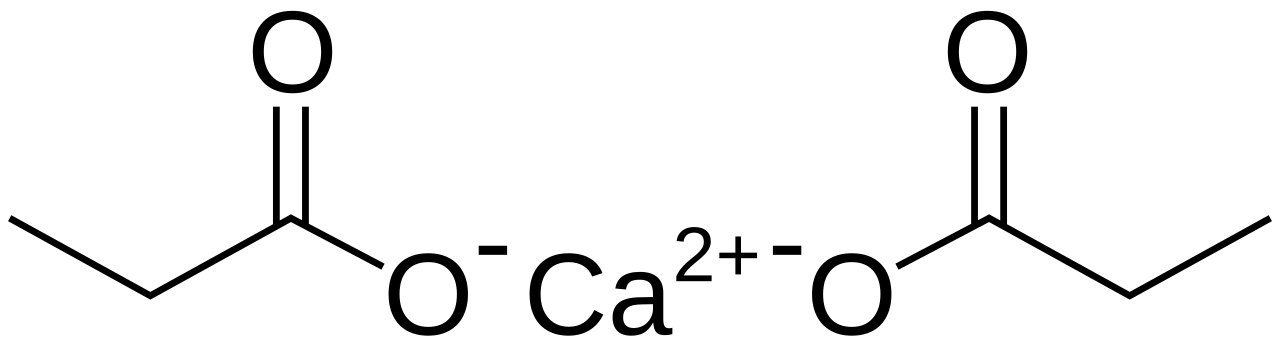
Structural formula of calcium propanoate.
Credit: Д.Ильин: vectorization / Wikimedia Commons

License: Public domain
Wikimedia-provided scaled PNG/JPEG rendering; no content edits
What it is
Calcium propionate is the calcium salt of propionic acid, made by neutralising propionic acid with calcium hydroxide. [1]
What it does and why it is used
It slows the growth of moulds and some bacteria, extending shelf life. [1,3]
Regulatory status and health context
International
The sources used here do not include a separate international (WHO/JECFA) evaluation.
United States
GRAS as an antimicrobial agent in specified foods under good manufacturing practice. [1]
European Union
Authorised as E 282. EFSA's 2014 re-evaluation of propionates found no safety concern at authorised uses. [2,5]
Environmental notes
The sources used here do not provide enough environmental data for a rating.
Quick facts
- CAS: 4075-81-4. [1]
- E number: E 282. [5]
- Use: mould inhibitor in bread and baked goods. [1]
- Open question: whether repeated intake affects long-term blood sugar control. [3]
Planning meals around fewer additives? See also The Low-Additive Family Meal Plan, a printable 7-day plan with recipes and a grocery list ($4 USD).
Sources
Sources were accessed on 2026-11-21. Source publication dates differ from this draft's review date. Image licences are listed with each image.
- eCFR: 21 CFR 184.1221, calcium propionate.
- EFSA ANS Panel. Scientific opinion on the re-evaluation of propionic acid (E 280), sodium propionate (E 281), calcium propionate (E 282) and potassium propionate (E 283) as food additives. EFSA Journal, 2014.
- Tirosh A et al. The short-chain fatty acid propionate increases glucagon and FABP4 production, impairing insulin action in mice and humans. Sci Transl Med, 2019 (PubMed).
- Dengate S, Ruben A. Controlled trial of cumulative behavioural effects of a common bread preservative. J Paediatr Child Health, 2002 (PubMed).
- European Union: Regulation (EC) No 1333/2008 on food additives, consolidated text with the Union list (EUR-Lex).