
Maltitol: the sugar alcohol in sugar-free chocolate and candy
CAS 585-88-6.Also known as E965, maltitol syrup, hydrogenated maltose, sugar alcohol, and polyol.
Editorial draft Last reviewed 21 November 2026 About 534 words
CC INDEX
How it works36/100 Mild
The sources show dose-related gut symptoms but no serious harm. Maltitol is common in sugar-free sweets. The EU requires a laxative warning on high-polyol foods.
An editorial summary of this article’s cited evidence. It isn’t medical advice or a personal risk estimate.
Age index
What is the age index?Which age groups are more affected by this chemical’s possible health issues, based on this article’s sources.
- Pregnancy Unborn babies Not well studied
- Infants 0 to 1 Not well studied
- Young children 1 to 5 Not well studied
- Children 6 to 12 Not well studied
- Teens 13 to 19 Lower concern
- Adults 20 to 64 Lower concern
- Older adults 65 and over Not well studied
- The tolerance study was in young adults aged 18 to 24.

Illustration of sugar-free chocolate, candy and gum, where maltitol is common.
Credit: Chemical Century; AI-generated illustration
License: CC0 1.0
Illustration, not a photograph of a specific product. Resized and cropped for the web.
Maltitol is a sugar alcohol used as a bulk sweetener in sugar-free chocolate and other sweets because it behaves much like sugar. It has fewer calories and a smaller effect on blood sugar than sugar, though it is not zero. Like other sugar alcohols, it is only partly absorbed, so eating a lot can cause gas, rumbling and stomach cramps. In Europe, foods with more than 10% added polyols must warn that excessive consumption may cause laxative effects.
Everyday exposure: where you meet it and how much
Maltitol is a polyol (sugar alcohol) used as a bulk sweetener in products such as chocolate. [1] In the EU, foods containing more than 10% added polyols must carry the statement "excessive consumption may produce laxative effects." [3]
Known and suspected harms
Evidence labels are editorial summaries, not individual risk predictions: established means recognized under the stated conditions; probable means a likely contribution with uncertainty; possible means limited evidence; disputed means assessors disagree.
- Established — gas and cramps, dose-related: in a double-blind crossover study of 59 young adults, 40 g of maltitol in 100 g of milk chocolate caused mild flatulence, rumbling and colic, less than the same amount of isomalt. At 30 g, all symptoms fell except mild flatulence. Maltitol did not have a significant laxative effect at either dose in this study. [1]
- Established — blood sugar and insulin are lowered, not eliminated: all maltitol products tested had a reduced glycaemic index compared with glucose. The insulin response was low for maltitol solutions but remained high for maltitol chocolate. [2] People managing diabetes should not assume "sugar-free" means no effect on blood sugar.
Reducing avoidable exposure
Eat small portions of sugar-free sweets at first, and check labels for maltitol or "maltitol syrup." In the EU, look for the laxative statement. [1,3]
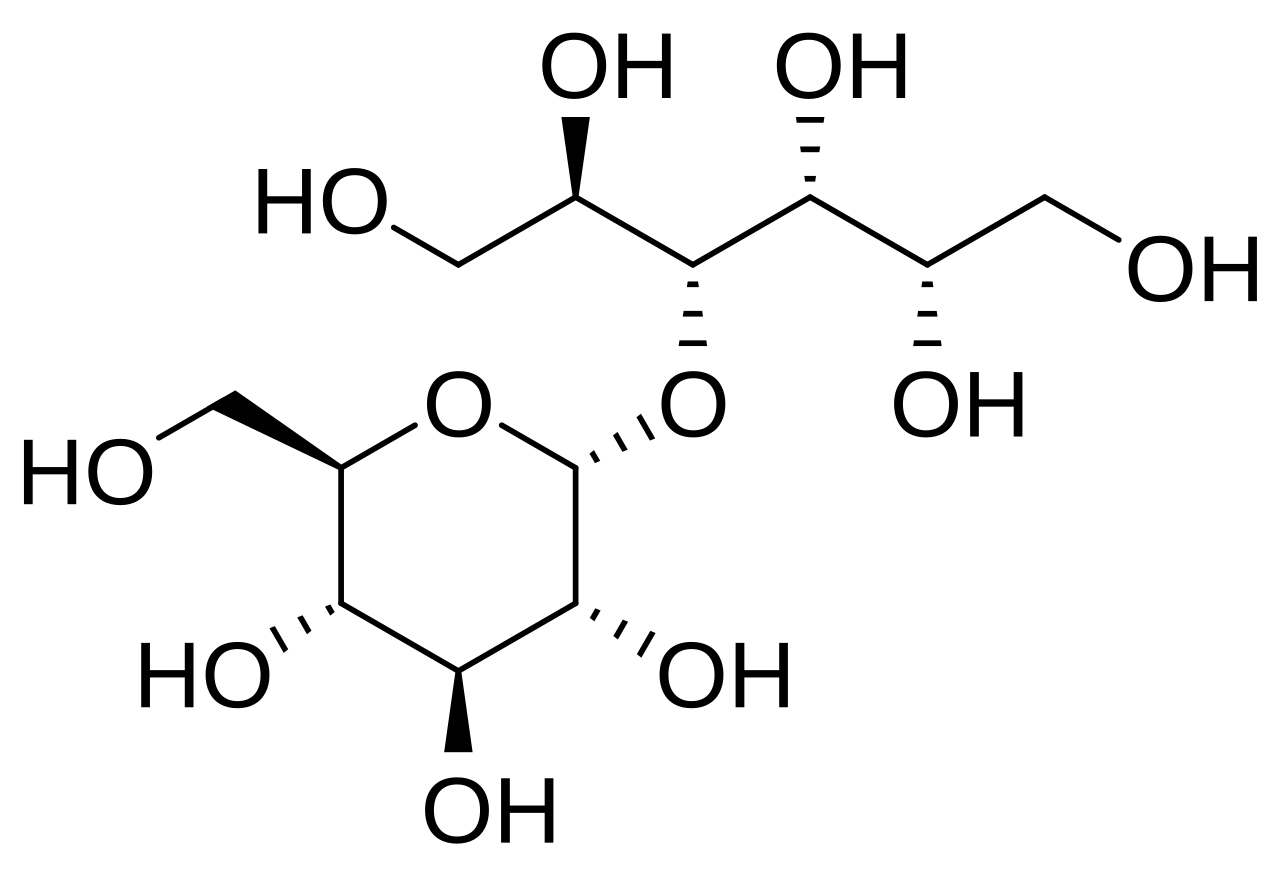
Structural formula of maltitol.
Credit: Karol Głąb / Wikimedia Commons

License: CC BY-SA 3.0
Wikimedia-provided scaled PNG/JPEG rendering; no content edits
What it is
Maltitol (CAS 585-88-6) is a polyol, or sugar alcohol. [1]
What it does and why it is used
It provides sugar-like sweetness and texture with a lower blood sugar effect. [1,2]
Regulatory status and health context
Canada
The sources used here do not cover Canadian rules for maltitol.
United States
The sources used here do not cover US rules for maltitol.
European Union
Foods with more than 10% added polyols must state that excessive consumption may produce laxative effects. [3]
Environmental notes
The sources used here do not provide enough environmental data for a rating.
Quick facts
- CAS: 585-88-6.
- Gut symptoms: mild at 30–40 g in chocolate. [1]
- Insulin: remained high with maltitol chocolate. [2]
- EU label rule: laxative warning above 10% polyols. [3]
Sources
Sources were accessed on 2026-11-21. Source publication dates differ from this draft's review date. Image licences are listed with each image.
- Koutsou GA et al. Dose-related gastrointestinal response to the ingestion of either isomalt, lactitol or maltitol in milk chocolate. Eur J Clin Nutr, 1996 (PubMed).
- Pelletier X et al. Glycaemic and insulinaemic responses in healthy volunteers upon ingestion of maltitol and hydrogenated glucose syrups. Diabete Metab, 1994 (PubMed).
- European Parliament and Council: Regulation (EU) No 1169/2011 on the provision of food information to consumers, Annex III (EUR-Lex).