
Paraquat: the weedkiller banned in Europe and linked to Parkinson's disease
CAS 1910-42-5.Also known as paraquat dichloride, 1,1'-dimethyl-4,4'-bipyridinium dichloride, PQ, and methyl viologen.
Editorial draft Last reviewed 21 November 2026 About 783 words
CC INDEX
How it works72/100 High
Paraquat is acutely lethal and strictly restricted in the US. The Parkinson's evidence is mixed. General public exposure is low because there are no home uses.
An editorial summary of this article’s cited evidence. It isn’t medical advice or a personal risk estimate.
Age index
What is the age index?Which age groups are more affected by this chemical’s possible health issues, based on this article’s sources.
- Pregnancy Unborn babies Not well studied
- Infants 0 to 1 Lower concern
- Young children 1 to 5 Lower concern
- Children 6 to 12 Lower concern
- Teens 13 to 19 Lower concern
- Adults 20 to 64 Higher concern
- Older adults 65 and over Moderate
- Infants (lower concern): No home uses; keep away from children
- Young children (lower concern): Accidental ingestion can be fatal
- Adults (higher concern): Applicators: Parkinson's link; ingestion fatal
- Older adults (moderate): Parkinson's link in long-term users
- There are no home uses in the US; risk centres on agricultural work and accidental or deliberate ingestion.

Illustration of a sprayed field near homes. Paraquat is used only in agricultural and other non-residential settings.
Credit: Chemical Century; AI-generated illustration
License: CC0 1.0
Illustration, not a photograph of a specific product. Resized and cropped for the web.
Paraquat is one of the most widely used weedkillers in US agriculture, sprayed on fields and to dry crops such as cotton before harvest. It is extremely poisonous if swallowed: EPA says one small sip can be fatal and there is no antidote. Studies of farmers have linked paraquat use to Parkinson's disease, though results conflict and EPA has not found a clear link from labelled uses. It is banned in the EU, and in the US only trained, certified applicators may use it, so the people most at risk are farmworkers and neighbours of treated fields.
Everyday exposure: where you meet it and how much
Paraquat is one of the most widely used herbicides in the United States, for weed control and to dry crops such as cotton before harvest. There are no homeowner uses and no products registered for residential areas. [1] EPA has identified possible risks to workers who mix, load and apply it or enter treated fields, and from spray drift to bystanders at the field edge; it found no dietary risks of concern from labelled uses. [1]
Known and suspected harms
Evidence labels are editorial summaries, not individual risk predictions: established means recognized under the stated conditions; probable means a likely contribution with uncertainty; possible means limited evidence; disputed means assessors disagree.
- Established — fatal poisoning: EPA says paraquat is highly toxic, one small sip can be fatal and there is no antidote. Pouring it into drink containers has led to accidental deaths, about one to two a year in the US. It is also corrosive to skin and eyes. [1]
- Disputed — Parkinson's disease: in a US study nested in the Agricultural Health Study, people who had used paraquat had 2.5 times the odds of Parkinson's disease. [2] Among farmers, the link appeared in those who did not consistently wear protective gloves but not in glove users. [3] A 2025 meta-analysis found higher odds in case-control studies but not in cohort studies and concluded that paraquat does not obviously increase Parkinson's incidence. [4] EPA says studies conflict, an updated 2020 analysis of the Agricultural Health Study did not replicate the 2011 finding, and it has not found a clear link from labelled uses. [1]
Reducing avoidable exposure
Never transfer paraquat into food or drink containers. Workers should use required protective equipment, especially gloves. If anyone swallows or touches paraquat, get medical help immediately. [1,3]
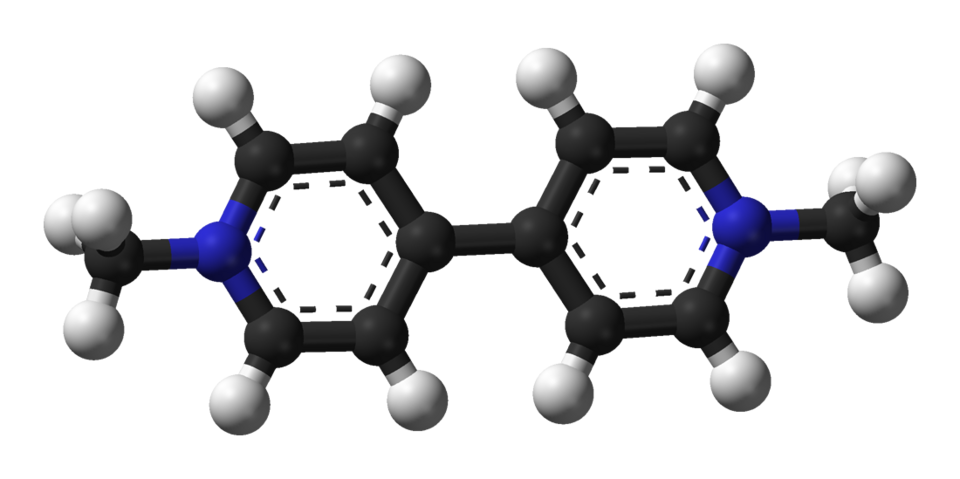
Ball-and-stick model of paraquat.
Credit: Benjah-bmm27 / Wikimedia Commons

License: Public domain
Wikimedia-provided scaled PNG/JPEG rendering; no content edits
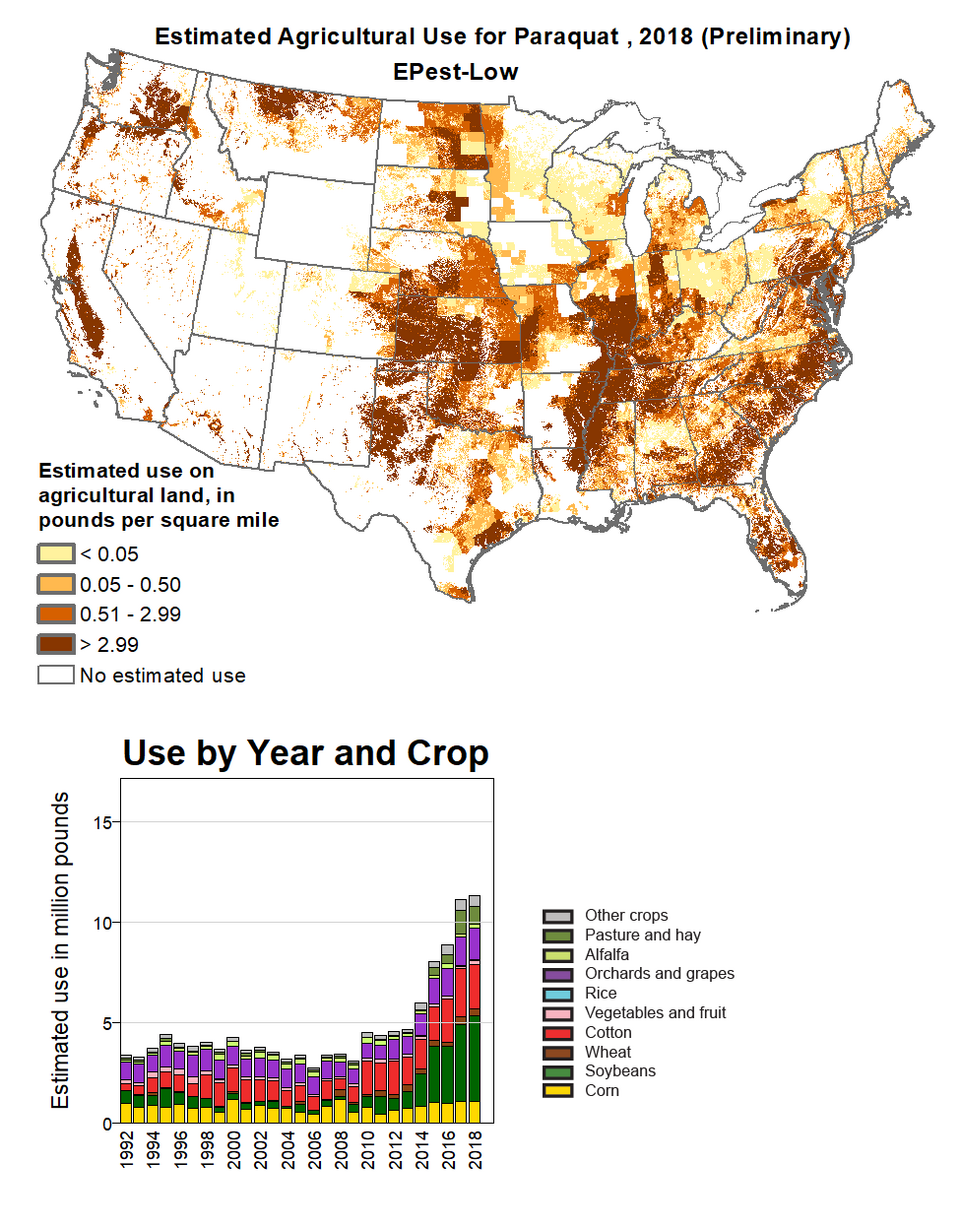
Estimated agricultural use of paraquat in the United States (USGS).
Credit: US Geological Survey / Wikimedia Commons

License: Public domain
Wikimedia-provided scaled PNG/JPEG rendering; no content edits
What it is
Paraquat is a herbicide that destroys the green tissue of plants by drying the leaves. [5]
What it does and why it is used
It is a fast-acting, non-selective weedkiller and crop desiccant. [1,5]
Regulatory status and health context
Canada
Health Canada lists its former drinking-water guideline for paraquat as withdrawn (2022). [6] The sources used here do not cover Canada's pesticide registration status.
United States
All paraquat products are Restricted Use Pesticides that only trained certified applicators may use, not even people working under their supervision. EPA's 2021 interim decision added protections such as limits on aerial application, and in November 2025 it said there is greater uncertainty about paraquat's potential to evaporate and drift than previously thought and will require more data from manufacturers. [1]
European Union
In 2007 the EU's Court of First Instance annulled the directive authorising paraquat, finding that it did not satisfy the requirement to protect human and animal health. At that time it was already banned in 13 countries, including Sweden, Denmark, Austria and Finland. [5]
Environmental notes
EPA's ecological assessment identified possible risks to mammals, birds, land invertebrates, plants and algae, and required spray drift labelling. [1]
Quick facts
- CAS (dichloride): 1910-42-5.
- Acute toxicity: one small sip can be fatal; no antidote. [1]
- US: certified applicators only. [1]
- EU: approval annulled in 2007. [5]
- Parkinson's: disputed. [1,2,4]
Sources
Sources were accessed on 2026-11-21. Source publication dates differ from this draft's review date. Image licences are listed with each image.
- US EPA: Paraquat dichloride.
- Tanner CM et al. Rotenone, paraquat, and Parkinson's disease. Environ Health Perspect, 2011 (PubMed).
- Furlong M et al. Protective glove use and hygiene habits modify the associations of specific pesticides with Parkinson's disease. Environ Int, 2015 (PubMed).
- Ba RQ et al. Interrelationship between PQ exposure and Parkinson disease: a systematic review and meta-analysis. Medicine (Baltimore), 2025 (PubMed).
- Court of First Instance of the European Communities: Press release 45/07, judgment in Case T-229/04 Sweden v Commission, 2007 (PDF).
- Health Canada: Guidelines for Canadian drinking water quality: summary tables, December 2025.