
Brilliant Blue (E133, Blue 1): the blue dye in sweets, drinks and icing
CAS 3844-45-9.Also known as E133, E 133, FD&C Blue No. 1, Blue 1, Brilliant Blue FCF, and Acid Blue 9.
Editorial draft Last reviewed 21 November 2026 About 691 words
CC INDEX
How it works46/100 Moderate
Brilliant Blue is common in coloured sweets and drinks. Its worst documented harms are confined to critically ill patients given it in tube feeds. EFSA's ADI is not exceeded at refined estimates, and the US is seeking a voluntary phase-out.
An editorial summary of this article’s cited evidence. It isn’t medical advice or a personal risk estimate.
Age index
What is the age index?Which age groups are more affected by this chemical’s possible health issues, based on this article’s sources.
- Pregnancy Unborn babies Not well studied
- Infants 0 to 1 Not well studied
- Young children 1 to 5 Moderate
- Children 6 to 12 Moderate
- Teens 13 to 19 Not well studied
- Adults 20 to 64 Lower concern
- Older adults 65 and over Not well studied
- Young children (moderate): High-consuming children could exceed the ADI
- Children (moderate): High-consuming children could exceed the ADI
- The serious reports involved critically ill hospital patients given the dye in tube feeds, not people eating coloured foods.

Illustration of blue-coloured foods. Brilliant Blue is the most common synthetic blue food dye.
Credit: Chemical Century; AI-generated illustration
License: CC0 1.0
Illustration, not a photograph of a specific product. Resized and cropped for the web.
Brilliant Blue is the synthetic dye that turns sports drinks, icing, sweets and some cereals blue, and it is also mixed with yellow dyes to make greens. Regulators allow it, and refined European estimates put typical intake below the safe daily limit, although some high-consuming children could exceed it on worst-case assumptions. Unlike some yellow and red dyes, it does not carry the EU children's behaviour warning. The most serious harms on record came from a hospital practice, adding the dye to tube feeds of very ill patients, which led US regulators to alert health professionals.
Everyday exposure: where you meet it and how much
In the US, FD&C Blue No. 1 may colour foods and dietary supplements in amounts consistent with good manufacturing practice, with batch certification. [1] In the EU it is E 133. EFSA found that refined intake estimates were below its acceptable daily intake (ADI) of 6 mg/kg body weight per day; using maximum permitted levels, high-consuming (95th percentile) children were above it. [2]
Known and suspected harms
Evidence labels are editorial summaries, not individual risk predictions: established means recognized under the stated conditions; probable means a likely contribution with uncertainty; possible means limited evidence; disputed means assessors disagree.
- Probable — harm in critically ill patients given dye-tinted tube feeds: in 2003 FDA alerted health professionals to reports of blue discoloration of the skin, urine, faeces or serum, with serious complications including refractory low blood pressure, metabolic acidosis and death, in patients given Blue No. 1 in enteral (tube) feeds to detect aspiration. Seriously ill patients with increased gut permeability, such as those with sepsis, appeared most at risk. FDA said a causal link had not been definitively established. [5]
- Established — possible intake above the ADI for some children: this applies only under worst-case (maximum permitted level) assumptions; refined estimates were lower. [2]
EFSA lowered the ADI from 10 to 6 mg/kg in 2010 based on a long-term rat study. [2] Brilliant Blue is not on the EU list of colours requiring the children's activity warning. [3]
Reducing avoidable exposure
Check labels for "Brilliant Blue", "E133" or "Blue 1", especially in brightly coloured sweets and drinks for children. [1,2]
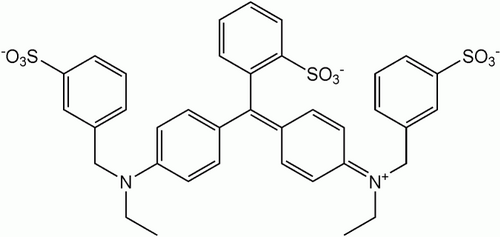
Structural formula of Brilliant Blue FCF.
Credit: Shaddack (assumed author per Commons) / Wikimedia Commons

License: Public domain
Wikimedia-provided scaled PNG/JPEG rendering; no content edits
What it is
Brilliant Blue FCF is a synthetic, water-soluble triarylmethane dye. [1,2]
What it does and why it is used
It gives a stable blue colour and, mixed with yellow dyes, makes greens. [1]
Regulatory status and health context
International
EFSA notes that JECFA (1970) and the EU Scientific Committee for Food (1975) set an ADI of 12.5 mg/kg, later revised to 10 mg/kg by that committee in 1984; EFSA's 2010 ADI is lower. [2]
United States
Blue 1 remains a listed, batch-certified colour additive. [1] FDA's tracker says it is working with industry to eliminate it and five other certified dyes from foods by the end of 2027, a voluntary transition rather than a completed ban. [4]
European Union
E 133 is authorised, with an ADI of 6 mg/kg body weight per day. It is not among the colours that require the Annex V children's warning. [2,3]
Environmental notes
The sources used here do not provide enough environmental data for a rating.
Quick facts
- CAS: 3844-45-9.
- Names: E133, FD&C Blue No. 1. [1,2]
- EU ADI: 6 mg/kg body weight per day. [2]
- EU children's warning: not required. [3]
- US: voluntary phase-out target end of 2027. [4]
Planning meals around fewer additives? See also The Low-Additive Family Meal Plan, a printable 7-day plan with recipes and a grocery list ($4 USD).
Sources
Sources were accessed on 2026-11-21. Source publication dates differ from this draft's review date. Image licences are listed with each image.
- eCFR: 21 CFR 74.101, FD&C Blue No. 1.
- EFSA ANS Panel. Scientific opinion on the re-evaluation of Brilliant Blue FCF (E 133) as a food additive. EFSA Journal, 2010 (PubMed).
- European Union: Regulation (EC) No 1333/2008 on food additives, Annex V colour warning (EUR-Lex).
- FDA: Tracking food industry pledges to remove petroleum-based food dyes.
- FDA Public Health Advisory: reports of blue discoloration and death in patients receiving enteral feedings tinted with the dye FD&C Blue No. 1, 2003 (copy hosted by a third party, PDF).